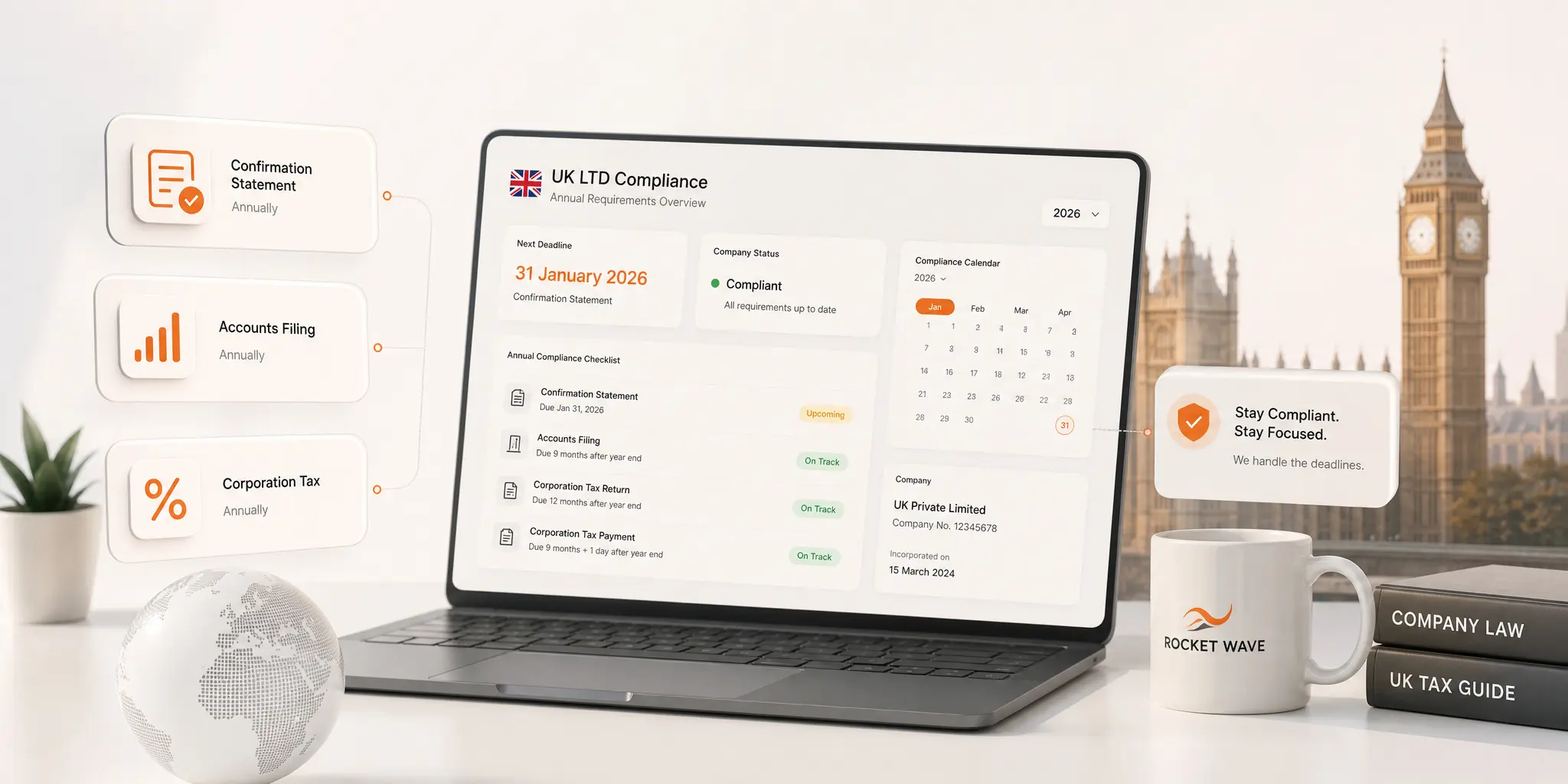
Forming your UK LTD was the easy part. Twenty-four hours, a handful of documents, and you had a Certificate of Incorporation in your inbox. What comes next is quieter and easier to overlook, a set of annual obligations to Companies House and HMRC that begin the moment your company exists and never stop for as long as it does.
None of these obligations are complicated on their own. The risk isn’t complexity, it’s forgetting. A missed confirmation statement or a late set of accounts doesn’t trigger a friendly reminder from Companies House first. It triggers a penalty, and if ignored long enough, it can result in your company being struck off the register entirely.
This guide lays out exactly what a non-resident UK LTD director must file every year, what each filing actually involves, what happens if you miss one, and how to build a simple system so you never have to think about it under pressure. Written from the experience of helping 150+ founders keep their UK LTDs in good standing from Bangladesh, India, UAE, and other markets around the world.
Quick answer
What must a non-resident UK LTD director file every year? A Confirmation Statement with Companies House annually, Annual Accounts within 9 months of the accounting period end, a CT600 Corporation Tax Return within 12 months of the accounting period end, and an updated PSC register whenever ownership or control changes. VAT Returns are also required quarterly if the company is VAT registered. Missing these can result in penalties starting around GBP150 and, if ignored, the company being struck off the register.
In this guide
The 4 annual obligations every UK LTD has
Every UK LTD, regardless of where its director lives, has four recurring obligations. None of them depend on your residency status. They apply the moment your company is incorporated and continue for as long as it exists.
| Obligation | Filed with | Frequency | Typical cost |
| Confirmation Statement | Companies House | Annually | Small filing fee, often free to low-cost via a formation agent |
| Annual Accounts | Companies House | Annually, 9 months after accounting period end | Included in accountant fees |
| CT600 Corporation Tax Return | HMRC | Annually, 12 months after accounting period end | Included in accountant fees |
| PSC register update | Companies House, via Confirmation Statement | As changes occur, within 14 days | No separate fee |
What this means for you: None of these four obligations require you to be in the UK. Every one of them can be filed online or handled entirely by a UK accountant on your behalf. The obligation isn’t the hard part, remembering it is.
Obligation 1: Confirmation Statement
The Confirmation Statement is an annual snapshot confirming your company’s core details are still accurate on the public register. It’s not a financial filing, it’s a factual one.
What the Confirmation Statement confirms
- Your registered office address
- Your director and shareholder details
- Your SIC code or codes
- Your share structure and PSC register
When it’s due
Your first Confirmation Statement is due 12 months after incorporation, and then annually from that date. You have a 14-day window after the due date to file it. If nothing about your company has changed, filing takes a few minutes online.
File it directly through the Companies House Confirmation Statement service, or have your formation agent or accountant file it on your behalf.
What this means for you: This is the single easiest filing to forget precisely because it’s so simple. There’s no complex data to gather, which paradoxically makes it easy to assume you’ll remember later. Set the reminder the day your company is incorporated, not the week before it’s due.
Obligation 2: Annual Accounts
Annual Accounts are your company’s financial statements, filed with Companies House and made publicly available. This is where an accountant becomes essential, not optional.
What Annual Accounts include
- A balance sheet showing assets, liabilities, and shareholder equity
- A profit and loss statement, for companies above the small company thresholds
- Notes to the accounts explaining the figures
- For small companies, an abridged or micro-entity version with reduced disclosure requirements
When Annual Accounts are due
Your first set of accounts is due 21 months after incorporation. Every year after that, accounts are due 9 months after your accounting period end. If your year ends 31 March, accounts are due by 31 December.
⚠ Late filing penalties escalate quickly. Filing even one day late triggers a penalty starting around GBP150, rising to GBP1,500 for accounts filed more than 6 months late. These penalties double if you file late in two consecutive years.
What this means for you: Your accountant prepares these based on your bookkeeping throughout the year. The best defence against a late filing isn’t remembering the deadline, it’s giving your accountant clean, organised records well before the deadline arrives.
Want lifetime compliance alerts built in from day one?
Every Rocket Wave UK LTD formation package includes lifetime compliance alerts for your Confirmation Statement, accounts, and tax deadlines, so nothing depends on you remembering.
550+ global founders. Starting from $299, no hidden fees, backed by a 7-day money-back guarantee.
Obligation 3: CT600 Corporation Tax Return
The CT600 is your company’s Corporation Tax Return, filed with HMRC, reporting your taxable profit and calculating what Corporation Tax is owed.
What the CT600 covers
It reports your company’s income, allowable expenses, and resulting taxable profit for the accounting period, along with the Corporation Tax calculation at the applicable rate. For the full breakdown of rates and how Corporation Tax works for non-resident-owned companies, read our UK LTD tax guide for non-residents.
When the CT600 is due
The CT600 must be filed within 12 months of your accounting period end. However, any Corporation Tax owed must be paid earlier, within 9 months and 1 day of the accounting period end. These are two different deadlines for two connected things, and mixing them up is a common source of confusion.
| Item | Deadline | Note |
| Corporation Tax payment | 9 months and 1 day after period end | Pay first, even before the return is filed |
| CT600 return filing | 12 months after period end | Filed after payment, confirms the calculation |
| Late payment interest | Accrues from the payment due date | Applies even if the return itself is filed on time |
What this means for you: Pay your estimated Corporation Tax by the 9-month deadline even if your CT600 isn’t finalised yet. HMRC charges interest on late payment starting from the payment deadline, not the filing deadline.
Obligation 4: Keeping your PSC register current
Your PSC register lists everyone with significant control over your company, generally anyone holding more than 25 percent of shares or voting rights. Unlike the other three obligations, this one isn’t on a fixed annual schedule, it’s triggered by events.
When you must update your PSC register
- A new person becomes a PSC, for example a new co-founder taking equity
- An existing PSC’s details change, such as a new residential address
- A PSC’s level of control changes, such as an ownership percentage shift
- A PSC stops being a PSC, for example if they sell their shares
You have 14 days to update your internal PSC register once a change occurs, and this update is then reported to Companies House through your next Confirmation Statement, or immediately if the change is significant.
⚠ Don’t wait for your Confirmation Statement to update PSC changes. Internally record any PSC change within 14 days of it happening, even if you’re reporting it to Companies House later. Keeping accurate internal records protects you if there’s ever a dispute or an audit.
What happens if you miss a filing
Missing one filing rarely causes immediate disaster, but the consequences compound the longer it’s ignored.
| Stage | What happens | Consequence |
| Filing missed | Companies House or HMRC flags the account | Penalty notice issued, starting around GBP150 for late accounts |
| Penalty ignored | Company remains in default | Escalating penalties, up to GBP1,500 for accounts over 6 months late |
| Persistent non-compliance | Companies House issues a formal warning | Company is at risk of being struck off the register |
| Strike off | Company is removed from the register | The company legally ceases to exist. Its assets can become property of the Crown |
| Bank account impact | Banks may flag or freeze accounts | Wise, Revolut, and Tide monitor company status and can restrict access |
What this means for you: Strike off is not immediate. Companies House sends multiple warnings before taking this step, which is exactly why the earlier stages are the moment to act. Don’t wait for a final notice to address a missed filing.
How to reinstate a struck-off company
If your company has already been struck off, reinstatement is possible but adds cost, time, and complexity you can avoid entirely by staying current on filings.
Administrative restoration
If the company was struck off for failing to file, and it’s been less than 6 years, you can apply for administrative restoration. This requires filing all outstanding documents, paying all outstanding fees and penalties, and submitting a restoration application to Companies House.
Court order restoration
If more than 6 years have passed, or the situation is more complex, restoration requires a court order, involving a solicitor and significantly higher cost and time.
⚠ Reinstatement is not guaranteed and is never cheap. Beyond the direct fees, a struck-off period disrupts your banking, Stripe account, and any contracts tied to the company. It’s dramatically cheaper in time and money to simply not miss filings in the first place.
Building a simple compliance system as a non-resident
You don’t need complex software to stay compliant. You need three things in place from day one.
The 3-part compliance system
- A calendar reminder system. Set every deadline the day your company is incorporated, not after your first filing is already close. Google Calendar with recurring annual reminders works fine
- A UK accountant who understands non-resident-owned companies. They handle accounts, CT600, and can often file your Confirmation Statement as part of their service
- A single folder for company documents. Certificate of Incorporation, Memorandum and Articles, all filed Confirmation Statements, and all Annual Accounts, stored somewhere accessible from anywhere
Once these three things exist, staying compliant becomes routine rather than something you have to think hard about each year.
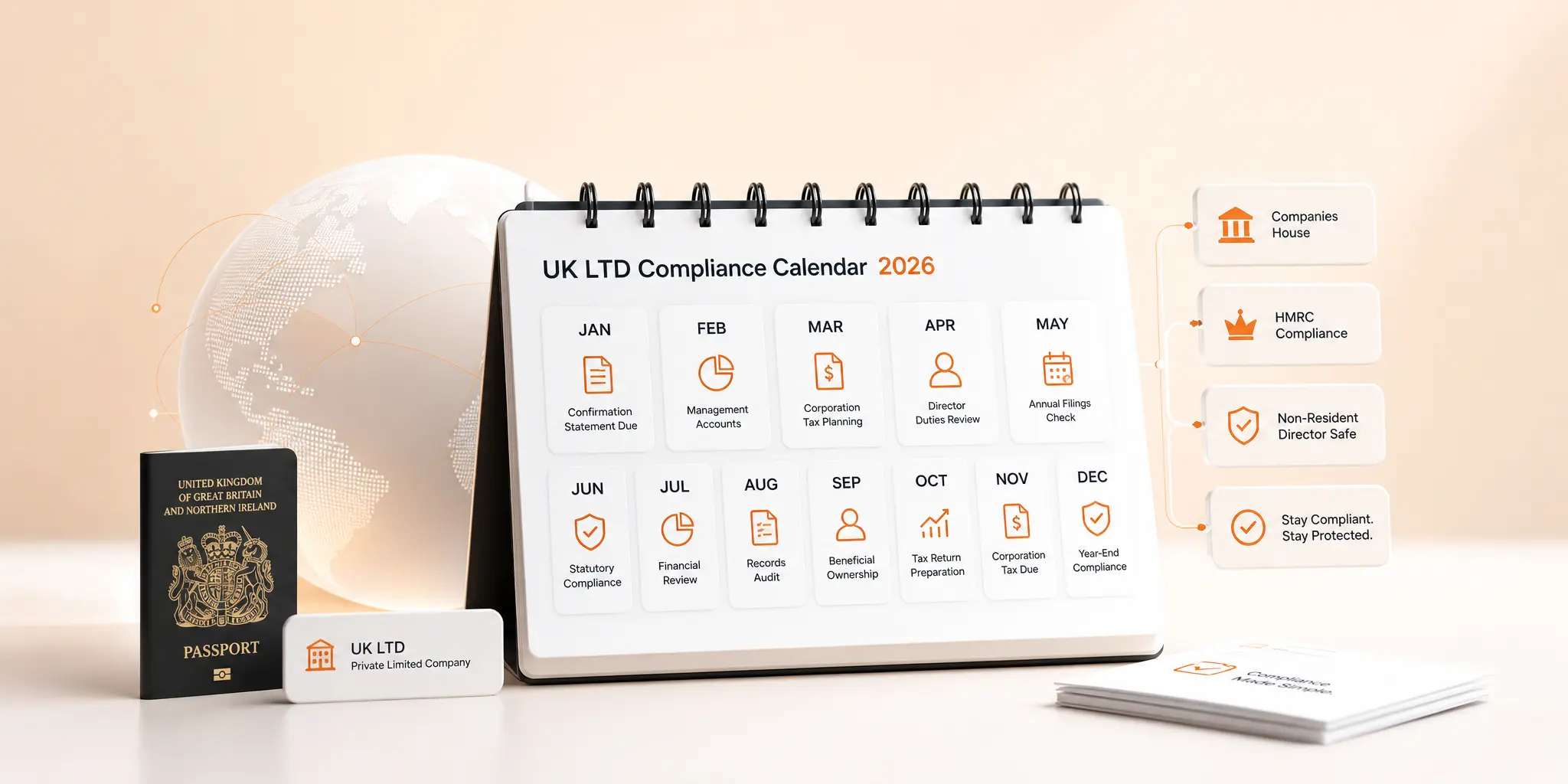
UK LTD annual compliance checklist
Use this every year, starting from the day your UK LTD is incorporated.
- Set a calendar reminder for your Confirmation Statement due date, 12 months from incorporation
- Engage a UK accountant who specialises in non-resident-owned companies
- Set a reminder for Annual Accounts, due 9 months after your accounting period end
- Set a separate reminder for Corporation Tax payment, due 9 months and 1 day after period end
- Set a reminder for CT600 filing, due 12 months after period end
- Update your PSC register within 14 days of any ownership or control change
- Keep a single, organised folder of all company documents and past filings
- Provide your accountant with clean records well ahead of each deadline, not at the last minute
- Check your company status periodically on the Companies House public register
Frequently asked questions
What is the penalty for filing UK LTD accounts late?
Penalties start around GBP150 for accounts filed up to 1 month late, and rise in stages up to GBP1,500 for accounts filed more than 6 months late. These penalties double if your company files late in two consecutive years, so a single missed deadline can become significantly more expensive if it happens again.
Can my UK LTD be struck off if I live outside the UK?
Yes. Strike off applies based on filing compliance, not director residency. A non-resident-owned UK LTD is struck off for the same reasons a UK-resident-owned one would be, primarily failing to file a Confirmation Statement or Annual Accounts after repeated warnings from Companies House.
Do I need a UK accountant, or can I file everything myself?
The Confirmation Statement can reasonably be filed yourself if nothing has changed about your company. Annual Accounts and the CT600 involve more technical preparation and are best handled by a qualified UK accountant, particularly given the added complexity of non-resident director tax positions. Most non-resident founders use an accountant for everything beyond the Confirmation Statement.
What happens to my UK bank account if my company is struck off?
Banking platforms including Wise, Revolut, and Tide monitor Companies House status and can restrict or freeze access if your company is struck off. This is one of the more disruptive consequences of missed filings, since it directly affects your ability to receive payments. Our UK business bank account guide covers how these platforms work in more detail.
How do I know when my Confirmation Statement is due?
Your first Confirmation Statement is due exactly 12 months after your incorporation date, and annually from that date going forward. Companies House also sends email reminders if you’ve registered for their notification service, though relying solely on this is riskier than setting your own calendar reminder from day one.
Is a dormant UK LTD still required to file annually?
Yes. Even a dormant company, one with no significant financial transactions, must still file a Confirmation Statement and Annual Accounts, though dormant accounts are significantly simpler to prepare. Corporation Tax filing requirements may differ for genuinely dormant companies, so confirm your specific position with your accountant.
Does Rocket Wave handle UK LTD annual compliance?
Rocket Wave is a business operating system and not a law firm or accountancy, so we do not file your accounts or tax returns directly. Every UK LTD formation package includes lifetime compliance alerts so you never miss a deadline, and we connect founders with UK accountants who specialise in non-resident-owned companies for the actual filings.
Form your UK LTD with compliance handled from day one.
Rocket Wave handles your UK LTD formation and provides lifetime compliance alerts for your Confirmation Statement, accounts, and tax deadlines, plus connections to accountants who understand non-resident director tax.
550+ global founders. Starting from $299, no hidden fees, backed by a 7-day money-back guarantee.
Legal Disclaimer: Rocket Wave is a business operating system and not a law firm, which means we do not provide official legal or tax advice. This guide is for general informational and educational purposes only. Companies House penalties, filing deadlines, and reinstatement procedures change periodically. Always verify current details at gov.uk and companieshouse.gov.uk. Always consult a qualified UK accountant or solicitor for advice specific to your circumstances.