Ask any formation agent in Dubai which company type you should choose, and most will give you an answer before they’ve asked what your business actually does. The truth is that the free zone vs mainland decision changed fundamentally in 2021, and most online guides haven’t caught up.
For most of the past decade, the choice was simple. Free zone if you wanted 100% foreign ownership. Mainland if you wanted to trade directly with UAE customers. That’s no longer the right framing. Since the UAE Commercial Companies Law amendments came into effect in 2021, 100% foreign ownership is now standard for most business activities on the mainland too. The old rationale for choosing a free zone on ownership grounds alone has largely disappeared.
What actually determines the right choice in 2026 is a different set of factors: who you invoice, how much you pay in corporate tax, what physical presence your business needs, and whether you plan to serve UAE-based customers directly. This guide breaks down each one honestly, including the part that almost nobody explains clearly, what the 2026 UAE corporate tax changes actually mean for free zone founders.
Quick answer
Free zone or mainland Dubai in 2026? For most global founders running digital, consulting, or export-oriented businesses, a free zone company is the right starting point: lower cost, faster setup, and tax advantages on qualifying income. A mainland company is the right choice when you need to sell directly to UAE-based customers, bid for government contracts, or require a physical retail or operational presence anywhere in Dubai. 100% foreign ownership is now available in both structures for most activities.
In this guide
What changed in 2021 and why the old rules don’t apply
Until 2021, the free zone vs mainland debate was mostly settled by ownership. A mainland LLC required a UAE national to hold 51% of the company’s equity as a local sponsor. Free zones avoided this requirement entirely, offering 100% foreign ownership from the start. That’s why the majority of guides, and the majority of international founders, defaulted to free zone formation without much analysis.
The UAE Commercial Companies Law amendments that came into force in 2021 changed that. Full foreign ownership is now the standard for most commercial and industrial activities on the mainland. A small number of strategically sensitive sectors, parts of defence, certain banking activities, and specific telecoms categories, still have local ownership requirements, but these are the narrow exception rather than the rule.
What this means for you: If you’re choosing a free zone in 2026 because you think it’s the only way to own 100% of your business, that assumption needs re-examining. Both structures allow full foreign ownership for most activities. The decision now turns on tax, market access, cost, and operational footprint.
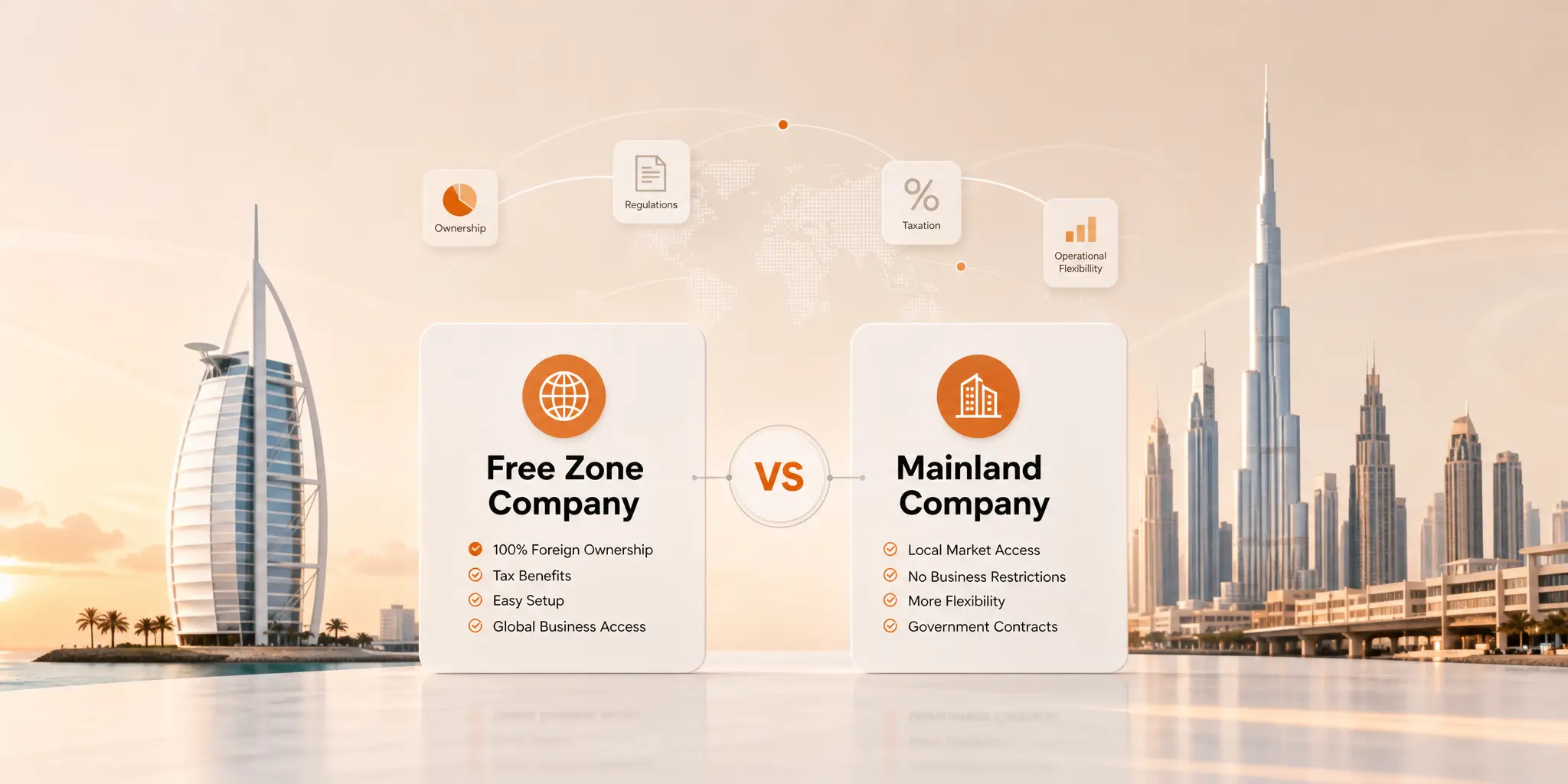
Free zone vs mainland, the full 2026 comparison
Here’s the complete side-by-side before we go deep on each factor.
| Factor | Free Zone | Mainland |
| 100% foreign ownership | Yes, always available | Yes, for most activities since 2021 |
| Corporate tax | 0% on qualifying income if QFZP criteria are met, otherwise 9% | 9% on profits above AED 375,000 |
| Sell directly to UAE mainland customers | No, requires distributor or mainland branch | Yes, unrestricted |
| Government contracts | Generally not eligible | Yes, can bid directly |
| Physical office requirement | Not required, virtual desk covers most packages | Yes, Ejari-registered office is mandatory |
| Setup cost | Lower, from roughly AED 12,000 for a Dubai free zone | Higher, typically AED 25,000 to 70,000 year one |
| Setup speed | 7 to 10 days, some zones same-day | Longer, multiple approvals from DET, labour department |
| Visa quota | Fixed per package tier | Scales with office square footage |
| Best for | International clients, exports, digital services, consulting | UAE domestic market, retail, F&B, government contracts |
The ownership question: 100% foreign ownership in both
Both structures now offer 100% foreign ownership for most commercial activities. This is not marketing language, it’s confirmed by Federal Decree-Law No. 26 of 2020 and consolidated in the 2021 UAE Commercial Companies Law amendments.
The practical difference that remains: free zones have always permitted full foreign ownership as a default from day one. Mainland companies now permit it for most activities, but a small number of restricted sectors, primarily in banking, defence, and strategic industries, still require UAE national participation. If your business is in one of these categories, confirm your specific activity with a formation advisor before proceeding.
What this means for you: Foreign ownership is no longer the tiebreaker. If you’ve been told to choose a free zone because it’s the only way to own your business fully, that was true before 2021. Get updated advice.
The tax question: QFZP and the 9% corporate tax
This is the factor that now most clearly separates free zone and mainland companies, and it’s the one most guides either oversimplify or get wrong.
Mainland corporate tax
Mainland companies pay UAE corporate tax at 9% on profits above AED 375,000. Profits below this threshold are taxed at 0%. This is the standard UAE corporate tax rate that came into force in June 2023 under Federal Decree-Law No. 47 of 2022.
Free zone corporate tax, the QFZP rule
Free zone companies can qualify for a 0% rate on qualifying income under the Qualifying Free Zone Person rules. However, QFZP status isn’t automatic, and it comes with specific conditions founders often underestimate.
- Your business must have adequate substance in the UAE, real economic activity, not just a registered address
- You must meet specific conditions on your income sources, primarily that qualifying income comes from transactions with other free zone entities or from exports, not from mainland UAE customers
- You must undergo a mandatory audit to confirm QFZP status
- Any income from mainland UAE transactions is generally subject to the standard 9% rate even for a free zone company, removing the tax advantage for that portion
⚠ QFZP status is not a blanket 0% tax guarantee. The UAE Federal Tax Authority actively reviews QFZP claims. Many founders assume their free zone company automatically qualifies for 0% tax. It doesn’t, and getting this wrong creates both a tax liability and compliance risk. Always confirm your QFZP eligibility with a qualified UAE tax advisor before relying on the 0% rate in your business planning.
What this means for you: For a global founder whose income is primarily from international clients, not UAE mainland customers, QFZP status is genuinely achievable and the tax advantage is real. For a founder who plans to generate significant revenue from UAE-based customers, the mainland’s 9% rate on that income and the free zone’s equivalent treatment of mainland-sourced income make the tax difference much smaller than it appears.
Want to form a UAE Free Zone company without navigating IFZA alone?
Rocket Wave is an authorized IFZA partner. We handle licensing, virtual address, visa eligibility, Emirates ID support, and banking assistance, so you don’t have to interpret UAE regulations from scratch.
Starting from $3,849, no hidden fees, backed by a 7-day money-back guarantee.
The market access question: who can you invoice?
This remains the single most practically important difference between the two structures in 2026.
What a mainland company can do
- Sell directly to any UAE-based customer, consumer, or business with no intermediary
- Open a retail store, restaurant, clinic, school, or other physical operation anywhere in Dubai or across all seven emirates
- Bid for UAE government contracts and public-sector tenders
- Sign contracts with mainland UAE companies directly
What a free zone company can and cannot do
- Sell freely to international clients, anywhere outside the UAE, with no restriction
- Trade within the same free zone with other free zone companies
- Sell to UAE mainland customers, but only through an approved mainland distributor, a mainland branch, or a mainland trading arrangement
- Bid for government contracts, generally not eligible
⚠ The mainland trading restriction for free zone companies has a 2025-2026 update worth knowing. Some free zone authorities have introduced onshore-access arrangements that expand how free zone companies can reach mainland customers. However, the scope varies by zone and activity, and using these arrangements may affect your QFZP qualifying-income status. Always confirm the current rules for your specific zone and activity before assuming this route is straightforward.
What this means for you: If your business model involves selling to UAE-based businesses or consumers, a mainland company is structurally cleaner and avoids the distributor arrangement entirely. If your revenue comes primarily from clients outside the UAE, a free zone is operationally simpler and potentially more tax-efficient.
The cost question: what free zone vs mainland actually costs
Year-one cost is where the gap between the two structures is most visible, particularly for a solo founder or small team.
| Cost item | Free Zone (IFZA example) | Dubai Mainland |
| License fee | Included in package, from $3,849 via Rocket Wave | Typically AED 15,000 to 25,000 for the license itself |
| Physical office | Not required, virtual address included | Mandatory Ejari-registered office, typically AED 25,000 per year minimum for the smallest practical space |
| Year-one all-in estimate (1 visa) | Roughly AED 22,000 to 32,000 including visa costs | Roughly AED 50,000 to 70,000 or more including mandatory office |
| Annual renewal | Generally close to original cost, varies by zone and activity | License renewal plus ongoing office lease |
The cost gap is material. For a solo founder or a small remote team with no need for a physical Dubai presence, the free zone’s avoidance of the mandatory office requirement alone justifies the structure from a pure cost perspective.
What this means for you: The mandatory Ejari-registered office on the mainland isn’t just an administrative requirement. It’s a recurring cost that compounds every year. For businesses that don’t need a physical presence in Dubai to operate, the free zone’s virtual desk option removes this cost entirely.
The office question: virtual desks vs mandatory Ejari
This is the operational constraint that surprises many founders researching a mainland company for the first time.
Mainland: Ejari is mandatory
A mainland company in Dubai must have a physical office registered through Ejari, the Dubai government’s official tenancy registration system. There is no virtual address workaround on the mainland. The office lease must be registered with Ejari and maintained for the lifetime of the company. The minimum practical office size carries costs of roughly AED 25,000 per year even at the entry end, and this cost is on top of, not included in, the license fee.
Free zone: virtual desk covers most founders
Most free zone packages include a virtual desk or flexi-desk at the zone’s registered address, which serves as your company’s official address without requiring a dedicated physical space. This is what makes free zone formation dramatically cheaper for founders who don’t need a physical Dubai office to operate.
Physical office space in a free zone becomes necessary when your visa allocation exceeds what the virtual desk allows, or when your specific activity requires a physical presence. For most non-resident solo founders or small remote teams, the virtual desk covers the full requirement.
The visa question: how headcount affects your choice
Both structures allow you to obtain UAE residence visas for your team, but the mechanics are different.
Free zone visa allocation
Free zone visa quotas are fixed by the package tier you select. Rocket Wave’s IFZA packages range from zero visas through to four or more, as detailed in our UAE Free Zone company formation guide. If you need more visas than your current tier allows, you upgrade your package, not your office.
Mainland visa allocation
Mainland visa allocation scales with the physical size of your office space, measured in square footage. Larger offices allow more visa allocations. This creates genuine scalability for businesses with large UAE-based teams but adds proportional cost at every stage of growth.
What this means for you: If you’re building a team of more than 6 to 8 people who all need UAE visas and will all be working physically in Dubai, the mainland’s office-based visa scaling may become more practical at that headcount. For a founding team of one to four with the flexibility to work remotely, free zone visa packages are simpler and cheaper.
How to decide: a practical framework
Most founders who ask this question fall clearly into one of these two profiles.
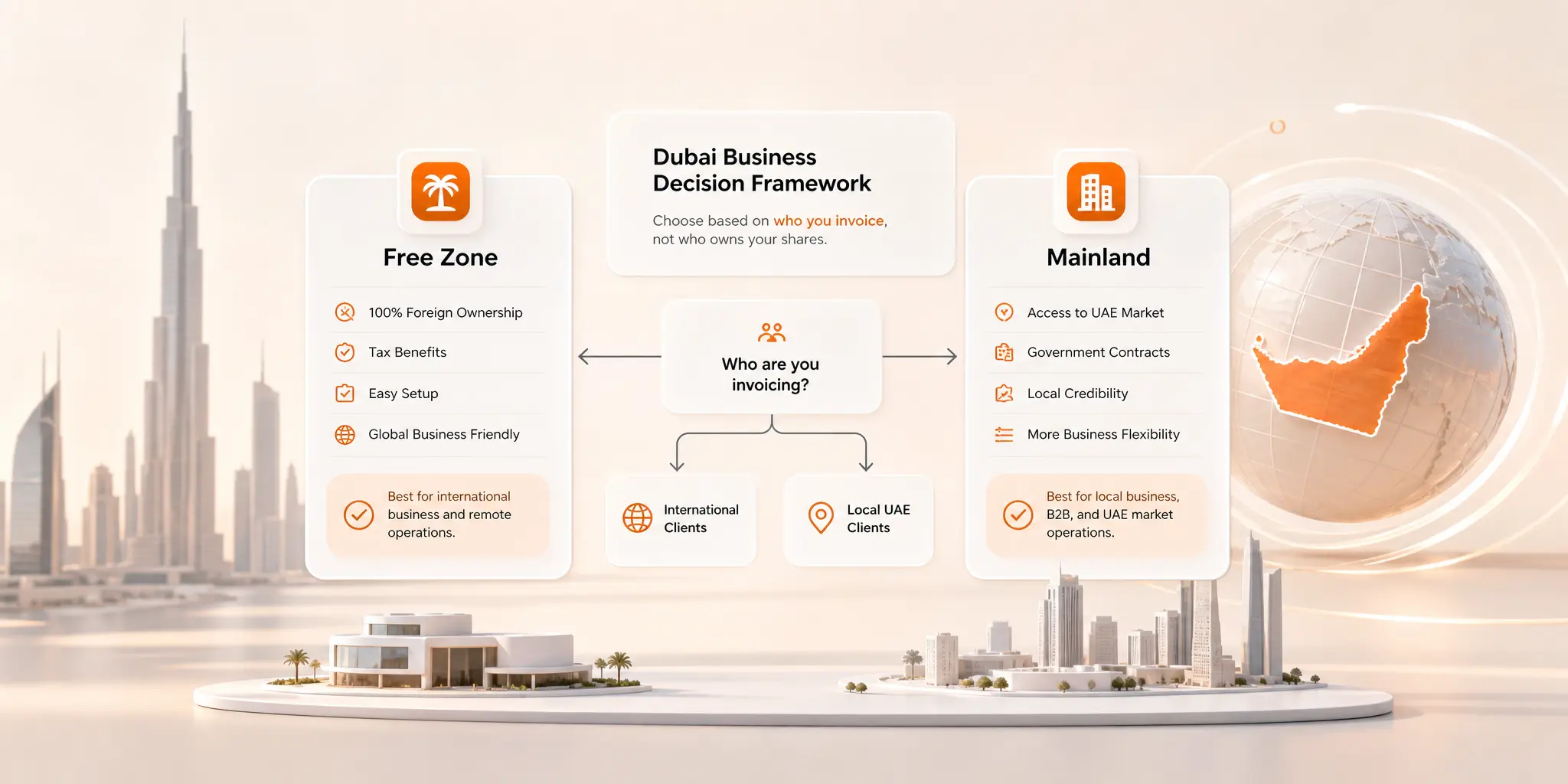
Choose a Free Zone company if:
- Your customers are primarily outside the UAE, whether international clients, global e-commerce, or export-oriented services
- You want the lowest possible setup and ongoing cost
- You don’t need a physical office in Dubai to operate
- Your income structure makes QFZP status achievable, primarily qualifying income from non-mainland sources
- You want a faster, simpler formation process
- You’re a non-resident founder forming through Rocket Wave’s IFZA route, which covers licensing, banking guidance, and visa support
Choose a Mainland company if:
- Your primary revenue comes from UAE-based customers, consumer or B2B
- You need a physical retail or operational presence anywhere in Dubai
- You plan to bid for UAE government contracts
- You need the flexibility to open offices across all seven emirates
- Your team headcount is large enough that office-based visa scaling makes sense
- Your specific business activity requires a DET-issued mainland license
What this means for you: When in doubt, here’s a practical shortcut: ask yourself who your first ten clients will be. If the answer is businesses or consumers based in the UAE, think mainland. If the answer is international clients anywhere in the world, think free zone. Revenue source is almost always the clearest single indicator.
Frequently asked questions
Can a free zone company sell to mainland UAE customers?
Not directly as a standard free zone entity. To sell to UAE mainland customers, a free zone company traditionally needs to go through a mainland distributor, open a mainland branch, or use an approved onshore-access route where available. Some free zones introduced expanded mainland-access arrangements in 2025 and 2026, but the scope and conditions vary. Income from mainland transactions may also affect your QFZP qualifying-income status.
Does a mainland company still require a local UAE partner in 2026?
No, for most activities. Since the 2021 UAE Commercial Companies Law amendments, 100% foreign ownership is the standard for most commercial and industrial mainland activities. A small number of strategically sensitive sectors still require UAE national participation. Confirm your specific activity falls within the 100% category with a formation advisor before proceeding.
Is the 0% corporate tax rate automatic for free zone companies?
No. A Qualifying Free Zone Person rate of 0% on qualifying income requires specific conditions: adequate substance in the UAE, qualifying income primarily from non-mainland sources, and a mandatory annual audit. The Federal Tax Authority actively reviews QFZP claims. Income from UAE mainland transactions is generally subject to the standard 9% rate even for free zone companies. Always confirm your QFZP eligibility with a qualified UAE tax advisor.
Which is cheaper to set up, free zone or mainland?
Free zone is significantly cheaper at the entry level. A Dubai free zone company through Rocket Wave starts from $3,849 including a virtual address. A Dubai mainland company requires a mandatory Ejari-registered physical office on top of the license fee, pushing year-one costs to roughly AED 50,000 to 70,000 or more. For a founder who doesn’t need a physical Dubai office, this cost gap is material.
Can I upgrade from a free zone to a mainland company later?
You can’t convert one structure into the other directly. However, you can form a mainland company at any point and run both structures in parallel, as many larger UAE businesses do when they grow their domestic market focus. You would then wind down the free zone entity if needed, or continue operating both for different purposes.
Which structure is better for a non-resident founder who doesn’t plan to move to Dubai?
A free zone company is almost always the better starting point. It’s cheaper, faster to set up, doesn’t require a physical Dubai office, and the visa path, if you ever want residency, is available through your package tier. For a non-resident running an international business, the free zone’s tax advantages on qualifying income and its virtual desk option make it the more practical structure. See our UAE Free Zone company formation guide for the full process.
Does Rocket Wave form mainland companies?
Rocket Wave’s UAE formation service is built on the IFZA free zone route, as an authorized IFZA partner. Mainland company formation involves different regulatory processes, including DET licensing and Ejari registration, which fall outside Rocket Wave’s current service scope. Contact the Rocket Wave team directly if you have specific questions about your business activity and which structure it requires.
Form your UAE Free Zone company with an authorized IFZA partner.
Rocket Wave handles licensing, virtual address, visa eligibility, Emirates ID support, and banking assistance for non-resident founders forming through IFZA.
Starting from $3,849, no hidden fees, backed by a 7-day money-back guarantee.
Legal Disclaimer: Rocket Wave is a business operating system and not a law firm, which means we do not provide official legal or tax advice. This guide is for general informational and educational purposes only. UAE company law, corporate tax rules, QFZP eligibility conditions, and mainland ownership permissions are subject to change. Always verify current details with the UAE Federal Tax Authority, the Department of Economy and Tourism, or a qualified UAE legal and tax advisor before making decisions. Rocket Wave’s UAE formation service is specifically for the IFZA free zone route and does not cover mainland company formation.