Your US LLC is approved. Your EIN is confirmed. And now every piece of advice online tells you to “just open a Mercury account” — without telling you what documents you actually need, what triggers a rejection, or what to do when the application gets stuck in review for two weeks.
Opening a US business bank account as a non-resident is possible — fully remote, no US travel required, and the best platforms cost nothing per month. But the process has specific requirements, a strict document sequence, and common failure points that nobody explains clearly.
This guide covers everything: which platforms actually work for non-residents in 2026, the exact documents you need in the right order, the complete application process for Mercury and Relay, what to do if you get rejected, and how Wise Business fits alongside your main account. Written from the experience of helping 500+ global founders from Bangladesh, UAE, India, Australia, Nigeria, and beyond open their US business banking.
Quick answer
Can a non-US resident open a US business bank account? Yes — Mercury and Relay both support fully remote account opening for non-resident LLC owners at no monthly cost. You need five documents: Certificate of Formation, EIN confirmation letter, Operating Agreement/ BOIR Filing, Proof of Address (Utility/ Bank Statement), and a valid passport. Apply only after your EIN is confirmed.
In this guide
Why your US LLC needs a dedicated US business bank account
A US LLC without a US bank account is like a registered company without a front door. It exists, but it cannot do much.
Your US business bank account is the financial hub that connects your LLC to every tool a global founder needs: Stripe payouts, PayPal transfers, Amazon Seller Central disbursements, USD invoicing, and the paper trail that keeps your LLC’s liability protection intact.
Here is why it matters in practice:
- Stripe and PayPal pay out to a US bank account — not to international accounts or personal accounts
- Amazon Seller Central requires a US bank account for USD disbursements
- US clients and platforms trust USD invoices backed by a US bank account more than international wire transfers
- Mixing personal and business funds in a single account undermines the liability protection your LLC provides — courts call this “piercing the corporate veil”
- Annual tax filings — including Form 5472 for foreign-owned LLCs — are cleaner and more accurate when your LLC has a dedicated US business account with a clear transaction record that caters all business transactions.
What this means for you: Opening your US bank account is the step that turns your LLC from a legal document into a working business. Do it immediately after your EIN is confirmed — not weeks later.
Why traditional US banks don’t work for non-residents
Chase, Bank of America, Wells Fargo, and most traditional US banks require an in-person visit at a US branch to open a business account. For a founder based in Dhaka, Lagos, or Dubai, this is not a practical option.
Even those that technically allow remote applications often require a US residential address, a US phone number for verification, or a US-based reference — none of which most non-residents have.
The non-resident banking landscape changed significantly when fintech-first platforms entered the market. Mercury, Relay, and Wise Business were each built for exactly this scenario — remote founders who need a US banking infrastructure without a US physical presence.
What this means for you: Do not waste time applying to traditional banks as a non-resident. Start with Mercury or Relay — they are purpose-built for remote LLC owners, have no monthly fees, and process non-resident applications routinely.
The 5 documents you need before applying — in order
Every US business bank account application for a non-resident LLC requires the same four documents. Apply without any one of them and your application will be rejected or stuck in manual review.
Document 1 — Certificate of Formation (or Certificate of Organization)
This is the official document issued by your formation state (Wyoming, Delaware, or New Mexico) confirming your LLC legally exists. You received this when your LLC was approved. It must match your LLC name exactly as you enter it in the bank application.
Document 2 — EIN Confirmation Letter (CP-575 or EIN Verification Letter)
The IRS confirmation of your Employer Identification Number (EIN); your Tax ID which you’ll need to prove that you’re legally allowed to do transactions for your business. Even if you applied by phone, you received your EIN verbally — but you will also receive a CP-575 letter by mail. If you need it faster, you can request an EIN Verification Letter (147C) by calling the IRS. Most banks in the past accepted the EIN number itself plus a screenshot of your SS-4 Return if the CP-575 had not arrived, but that is not the case anymore.
Document 3 — Operating Agreement/ BOIR
The financial tools will ask for one of these documents to verify or record the shareholder structure. As most state issued certificates of formation don’t contain the owner’s name. These documents play a part in connecting the beneficiary owner of the business to the business. Operating Agreement is your LLC’s internal governance document — the one that records ownership percentages, member roles, and management structure. And Beneficiary Owner Information Report (BOIR) is filed to FinCEN that also declares the ownership of the company.
Document 4 — Valid Passport
Your government-issued passport is your primary identity document. Ensure it is current and not expiring within 6 months of your application. Some platforms also accept a national ID card, but a passport is the safest and most universally accepted option.
Document 5 — Proof of Address
You may need to submit a work address and a home address which has to be physical addresses. If you do not have an office and work from home, you can use your home address as a work address too. For the address/es you’ll need to provide proof of address such as a utility bill, bank statement, insurance document, US-accepted Driver’s License, etc. Bank Statement is the wisest choice, if it is in English.
Important — apply in this order: You have your Passport → LLC approved → EIN confirmed → Operating Agreement finalized → BOIR Filing Done → Bank application submitted. Reversing any step causes delays or automatic rejection.
Mercury vs Relay vs Wise Business: which is right for you?
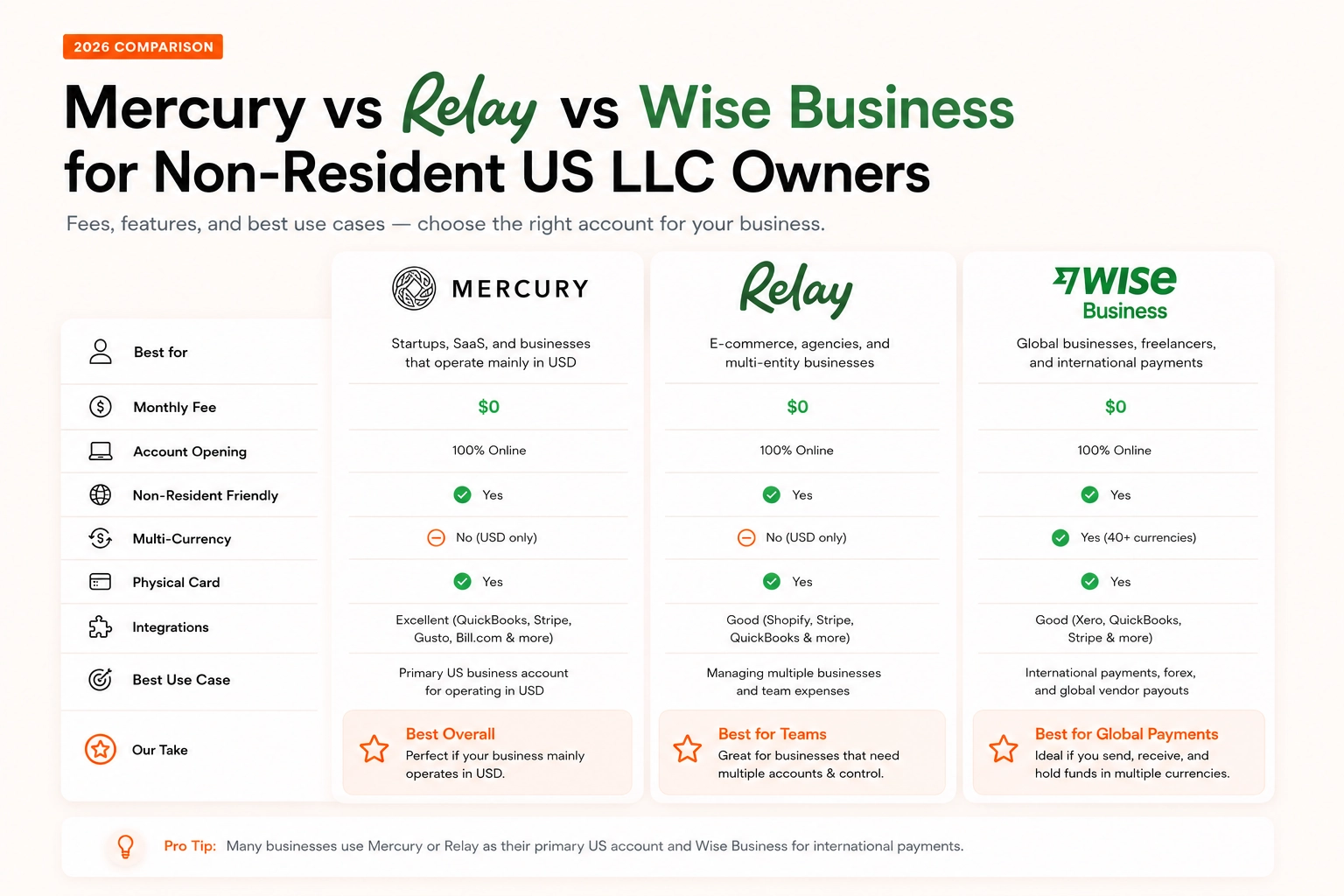
Each of these platforms serves non-resident LLC owners well — but they serve different needs. All of these fintechs have a ‘Prohibited Country’ list, please check if your country is on the list before application. Here is an honest side-by-side:
| Feature | Mercury | Relay | Wise Business |
|---|---|---|---|
| Account type | Full US business checking & savings | Full US business checking with sub-accounts | US account number only (not a full bank) |
| Monthly fee | $0 | $0 (paid plan available) | $0 to open, fees on transfers |
| Non-resident support | Yes — fully supported | Yes — fully supported | Yes — widely used globally |
| Debit card | Yes — virtual + physical | Yes — virtual + physical | Yes — Wise debit card |
| Stripe integration | Direct — highly recommended by Stripe | Direct — fully compatible | Compatible but Stripe prefers Mercury/Relay |
| Sub-accounts / envelopes | No | Yes — up to 20 sub-accounts | Yes — multiple currency accounts |
| International transfers | Wire transfers available | Wire transfers available | Excellent — core feature |
| Best for | Primary US business account for most founders | Founders wanting budget separation and multiple accounts | International transfers and multi-currency invoicing |
| FDIC insured | Yes (via partner banks) | Yes (via Thread Bank) | Not a bank — not FDIC insured |
Our recommendation for most non-resident founders
Start with Mercury as your primary US business account. It has the cleanest onboarding experience for non-residents, the strongest Stripe integration, and zero monthly fees. Add Wise Business as a companion account for receiving international payments in multiple currencies and sending low-cost international wire transfers.
Relay is the right choice if you want to separate budget categories — for example, keeping tax reserves, operating expenses, and owner distributions in separate sub-accounts. It is slightly more complex to set up but highly effective for disciplined financial management.
What this means for you: You do not have to choose just one. Many non-resident founders run Mercury as their primary US account and Wise Business for international client invoicing — using each platform for what it does best. Before applying for a bank account, always see the ‘Prohibited Country’ list first.
Step-by-step: How to open a Mercury account as a non-resident
Mercury is the most popular US business banking choice among non-resident LLC owners. Here is the exact process:
Before you apply
- Confirm your LLC is fully formed — Certificate of Formation in hand.
- Confirm your EIN is confirmed — Number & Doc (CP575 and/or 147C) received.
- Have your Operating Agreement ready as a PDF and Have completed BOIR.
- Have your passport scan ready — Clear, Full-page photo, All four corners visible.
- Have an online bank statement — Ready to be uploaded.
- Use a laptop for the application — The document upload process is smoother than mobile.
The Mercury application process
Step 1 — Go to mercury.com and click ‘Open Account’. Select ‘LLC’ as your business type. Enter your LLC’s legal name exactly as it appears on your Certificate of Formation — any mismatch triggers a review.
Step 2 — Enter your business details. Business name, state of formation, EIN, business address (your non-US address is acceptable), and business type/industry. Be specific about your industry — vague entries like ‘consulting’ slow down review.
Step 3 — Enter your personal details. Your full legal name, date of birth, country of residence, and home address. Mercury asks for your ownership percentage — enter your exact stake (100% if you are the sole owner).
Step 4 — Upload your documents. Certificate of Formation, EIN confirmation, and Operating Agreement — all as clear PDFs, as asked by Mercury. Mercury will also ask you to verify your identity using your passport via their identity verification partner.
Step 5 — Complete identity verification. Mercury uses an automated verification system. You will be asked to take a live photo of your passport and a selfie. Ensure good lighting, a plain background, and that the passport photo page is fully visible and unobstructed.
Want your US LLC, EIN, and bank account handled together?
Rocket Wave sets up your complete US business infrastructure — LLC formation, EIN application, Operating Agreement, BOIR Filing, and bank account guidance — in one package.
We have helped 500+ founders from Bangladesh, UAE, India, Pakistan, Nigeria, and 25+ other countries open their US LLC and banking without a single trip to the US.
Step 6 — Wait for approval. Most non-resident accounts are approved within 1–3 business days. Some applications go into manual review — Mercury will email you if they need additional information. Check your spam folder if you do not hear back within 5 business days.
Step 7 — Activate your account. Once approved, log in, set up your virtual debit card, and note your US routing number and account number. These are what you will give to Stripe, PayPal, and clients.
What this means for you: The single most common cause of Mercury rejection for non-residents is a mismatch between the LLC name on the Certificate of Formation and the name entered in the application. Copy and paste — do not type from memory.
Step-by-step: How to open a Relay account as a non-resident
Relay’s application process is similar to Mercury’s but with a few differences worth knowing before you start.
Step 1 — Go to relayfi.com and click ‘Open an Account’. Select ‘LLC’ as your entity type. Enter your legal LLC name exactly — same rule as Mercury.
Step 2 — Enter your business information. State of formation, EIN, industry, and business address. Relay accepts international addresses. Describe your business activity clearly — ‘digital marketing agency’ or ‘software development’ is better than ‘services’.
Step 3 — Enter owner details. Your name, date of birth, country of citizenship, residential address, and ownership stake. If you have co-founders with 25% or more ownership, you must add them as beneficial owners at this stage.
Step 4 — Identity verification. Relay uses a third-party verification partner — you will upload your passport and complete a live selfie check. Same requirements as Mercury: good lighting, plain background, full passport photo page visible.
Step 5 — Upload documents. After submission of the basic details for KYB and KYC, Relay will send an email to upload documents. You need to submit as requested; Certificate of Formation, EIN confirmation, BOIR, and Operating Agreement. Relay should also request a bank statement or utility bill as address verification.
Step 6 — Approval and account setup. Relay typically approves within 2–5 business days. Once approved, set up your sub-accounts immediately — this is Relay’s strongest feature. Create one account for operating expenses, one for tax reserves, and one for owner distributions.
What this means for you: Relay’s sub-account feature is genuinely useful from day one — even if you are a solo founder with low revenue. Keeping a tax reserve account separate from your operating account is a discipline that pays off every April.
What to do if your bank application is rejected
Rejection is more common than it should be — and almost always fixable. Here are the most frequent rejection reasons and exactly what to do about each one:
LLC name mismatch
The name you entered in the application does not exactly match the name on your Certificate of Formation. Check for missing punctuation, spacing differences, or LLC versus L.L.C. inconsistencies. Reapply with the exact legal name from your state document.
EIN not yet in IRS system
If you received your EIN by phone very recently — within the last 24–48 hours — it may not yet appear in the IRS’s verification database. Banks check your EIN against the IRS database in real time. Wait 48–72 hours after receiving your EIN verbally before applying. If you are unsure about your EIN status, revisit our EIN without SSN guide for guidance on requesting written confirmation.
Incomplete or unclear document scans
Blurry scans, missing corners, or documents with watermarks across key text are a common rejection trigger. Re-scan all documents at high resolution (minimum 300 DPI), ensure all four corners of each page are visible, and save as PDF rather than JPEG where possible.
High-risk business category
Certain business types are flagged for additional review — crypto, adult content, firearms, gambling, and certain financial services. If your business falls into a grey area, describe your activity as specifically and plainly as possible. ‘E-commerce store selling physical goods’ is clearer than ‘online retail’.
If Mercury rejects — apply to Relay, and vice versa
Mercury and Relay have different risk appetites and review processes. A rejection from one does not mean a rejection from the other. Many non-residents who were initially rejected by Mercury were approved by Relay within days — and the reverse is equally true. If both reject, Wise Business is a solid alternative for receiving US bank transfers, even though it is not a full US business bank account.
What this means for you: Do not give up after one rejection. Read the rejection email carefully — banks are usually specific about what was missing. Fix that one issue, wait 48–72 hours, and reapply.
What to do immediately after your account is approved
Approval is not the finish line — it is the starting line. Here is the exact sequence to follow once your account is live:
- Note your US routing number and account number — you will use these constantly
- Set up Stripe — apply as your LLC entity using your EIN and your new US bank account details. Our Stripe approval guide for non-US residents covers the full process including common approval pitfalls.
- Link your PayPal Business account — use your EIN and US bank account to upgrade from personal PayPal to a business account with higher transfer limits
- Update your Amazon Seller Central account — replace any temporary payment details with your new US bank account for USD disbursements
- Update your invoicing — add your US account details (routing + account number) to your invoice template for USD bank transfers from clients
- Set compliance reminders — your LLC now has US financial activity, which makes your annual Form 5472 filing more important than ever. Set an April 15 reminder.
- Keep your bank records — download monthly statements starting from month one. Clean records make tax filing straightforward and are essential if your LLC is ever audited
US bank account checklist for non-resident LLC owners
Work through this in order. Every step depends on the one before it.
- LLC approved — Certificate of Formation received from your state
- EIN confirmed — received verbally by phone or by fax (wait 48–72 hours before applying to bank)
- Operating Agreement drafted and saved as a PDF
- Passport scan ready — high resolution, all corners visible
- Apply to Mercury first — enter LLC name exactly as it appears on Certificate of Formation
- Complete identity verification — clear lighting, plain background, full passport page visible
- If rejected — check rejection email, fix the specific issue, wait 48–72 hours, reapply
- If Mercury rejects — apply to Relay immediately. In case that also gets rejected, surf other options available in the market.
- Once approved — note routing number and account number
- Set up Stripe using EIN + new US bank account details
- Add Wise Business for international transfers and multi-currency invoicing if needed
- Set April 15 reminder for Form 5472 annual filing
Pro-Tip 1: Have a well-structured website that represents your organization and/or business, offering all your products and services. This can help your approval.
Pro-Tip 2: Add social media links in your application and also in your website’s contact page and footer. This gives your business more credibility and helps getting approved.
Frequently asked questions
Do I need a physical US address to open a US business bank account?
Can I apply for a bank account before my EIN arrives?
Is Wise Business a real US bank account?
How long does it take to open a Mercury account?
Which countries are supported by Mercury and Relay?
Can I use my personal bank account instead of a US business account?
What if I need to send money from my US account back to my home country?
Ready to open your US LLC and bank account?
Rocket Wave handles your complete US business setup — LLC formation, EIN application, Operating Agreement, bank account guidance, and first-year compliance support.
500+ non-resident founders across 30+ countries. No hidden fees. No US travel required. No surprises.
Legal Disclaimer: This guide is for informational purposes only and does not constitute legal, financial, or tax advice. Banking platform features, supported countries, fees, and terms are subject to change — always verify current details directly on Mercury, Relay, and Wise Business websites before applying. FDIC insurance coverage and account terms vary by platform. Always consult a qualified financial or tax professional for advice specific to your circumstances.