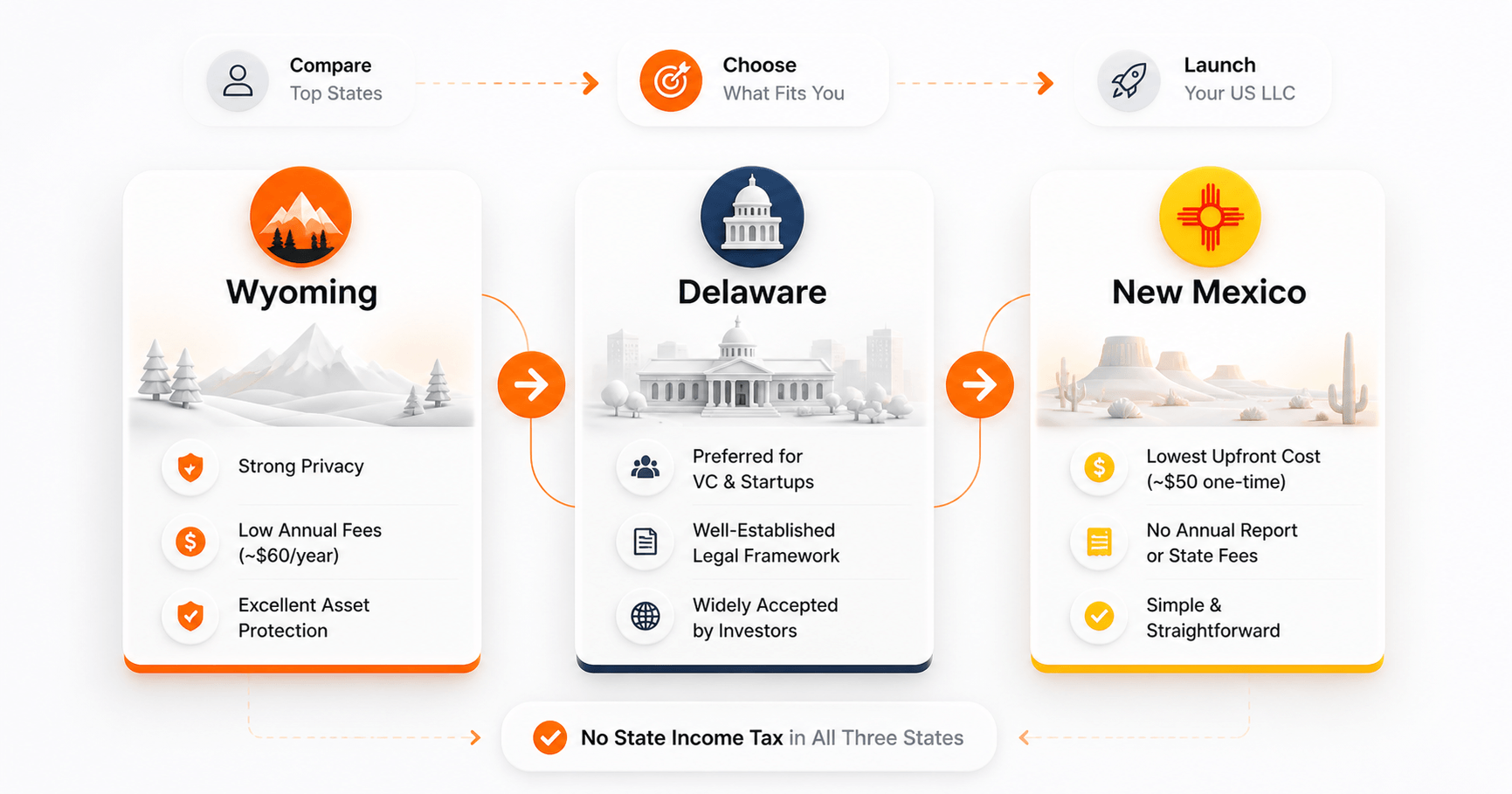
Over 90% of non-resident founders who ask us about the best state for a non-resident LLC have already decided between Wyoming and Delaware before they even call. Most of them are wrong — not because those states are bad choices, but because they are solving the wrong problem.
The state you choose does not determine whether Stripe will approve your account. It does not decide whether Mercury will open your bank account. It does not change your federal tax obligations. What it does affect is your annual cost, your privacy, and the legal framework governing your LLC. Those are the things that actually matter for a non-resident running an online business.
Based on helping 500+ non-resident founders form their US LLCs, this guide gives you an honest breakdown of Wyoming, Delaware, and New Mexico — and a decision framework built specifically for global founders. If you have not yet formed your LLC and want the full step-by-step process first, start with our complete guide to forming a US LLC as a non-resident. If you are at the state selection stage, keep reading.
Quick answer
Which is the best state for a non-resident LLC? Wyoming is the right choice for most non-resident founders in 2026 — low annual fees (~$60/year), strong privacy, no state income tax, and full compatibility with Mercury, Stripe, and PayPal. Delaware is better if you are raising venture capital. New Mexico is the lowest-cost option with zero annual fees.
In this guide
Does the state you choose actually matter for non-residents?
This is the question most guides skip — so let us answer it directly before anything else.
For US residents, state selection is a complex decision involving where they live, where they operate, and state tax implications. For non-residents with no US physical presence, no US employees, and no US office, the decision is much simpler — and the things most people worry about are not actually affected by state choice at all.
Here is what your state choice does NOT affect as a non-resident:
- Whether Stripe, PayPal, or US payment processors will approve your account
- Whether Mercury or Relay will open a bank account for your LLC
- Your federal tax obligations (Form 5472, BOI filing, EIN requirements — identical in all states)
- Your liability protection as an LLC owner
Here is what your state choice DOES affect:
- Annual state fees and ongoing maintenance costs
- Privacy — whether your name appears in public records
- Asset protection laws (Wyoming has stronger charging order protection)
- Whether you will be attractive to institutional investors (Delaware only)
What this means for you: If you are a non-resident running an online business, your state choice is a cost and privacy decision — not a payment or banking decision. This simplifies everything.
Wyoming LLC for foreigners — why it wins for most online founders
Wyoming invented the LLC in 1977. It has been refining the structure for nearly 50 years, and in 2026 it remains the most founder-friendly state for non-residents running online businesses.
Wyoming: what makes it the right choice
- No state income tax — Wyoming does not tax business income, personal income, or capital gains.
- Low annual cost — ~$100 to form, ~$60/year to maintain. One of the lowest in the US.
- Strong privacy — Member and manager names are not required on public filings. Your name does not appear in the state registry.
- Charging order protection — Wyoming provides explicit single-member LLC charging order protection, meaning your personal creditors cannot easily access your LLC assets.
- Simple compliance — One annual report, filed by the anniversary month of your formation. No franchise tax, no complex filings.
- Fully remote — Entirely compatible with Mercury, Relay, Stripe, PayPal, Amazon, and Shopify.
Wyoming: who should avoid it
- Founders planning to raise US venture capital — investors strongly prefer Delaware entities
- Startups planning to grant stock options or issue equity to employees — Delaware’s legal framework is better suited
- Founders who will eventually convert to a C-Corp for a US IPO
For the full formation process in Wyoming including fees, processing times, and registered agent requirements, read our Wyoming LLC formation guide.
What this means for you: If you are a freelancer, agency owner, SaaS founder, e-commerce seller, or consultant with no US office — Wyoming is your answer. It is the lowest-cost, best-protected, most straightforward option for non-residents in 2026.
Delaware LLC for non-residents — when it actually makes sense
Delaware has been the default recommendation for US business formation for decades — and for certain specific situations, that reputation is well earned. But “Delaware is the most popular” is not the same as “Delaware is right for you.”
Delaware: what makes it worth considering
- VC and investor preference — Over 60% of Fortune 500 companies and 90% of US IPOs are incorporated in Delaware. If you are raising institutional capital, investors will expect a Delaware entity.
- Court of Chancery — Delaware’s dedicated business court has 230+ years of legal precedent. Complex business disputes are handled by specialist judges, not juries.
- C-Corp conversion ready — If you plan to convert your LLC to a C-Corp, Delaware makes this process smoother than any other state.
- No sales tax — Delaware has no state sales tax, which can be an advantage for certain e-commerce structures.
Delaware: the real costs and drawbacks
- Annual franchise tax ~$300/year — Significantly higher than Wyoming’s ~$60/year. Over 5 years, this is a $1,200+ difference.
- Less privacy — Delaware requires more disclosure than Wyoming. Member information, while not in Articles of Organization, is easier to uncover.
- More complex compliance — Additional reporting requirements compared to Wyoming.
- Slower processing — Standard filing takes up to 2 weeks without the expedited option (extra $100 for 48-hour processing).
If Delaware is the right choice for your specific situation, read our Delaware LLC formation guide for the full filing process and requirements.
What this means for you: Choose Delaware only if you have a specific reason — VC fundraising, institutional investors, or a clear path to C-Corp conversion. If none of those apply, the extra $240/year in franchise tax and added complexity delivers no benefit to a non-resident founder.
New Mexico LLC — the zero-maintenance option
New Mexico is the most underrated option for non-resident founders who want the simplest, cheapest structure possible. It has one feature no other state can match: zero ongoing annual requirements.
- One-time filing fee: ~$50 — The lowest initial filing fee of the three states.
- No annual report — Once formed, no recurring state filings required to keep the LLC active.
- No annual state fee — $0/year to maintain. Total cost over 5 years: ~$50 + registered agent fees only.
- Strong privacy — Like Wyoming, New Mexico does not require member names in public filings.
The tradeoff: New Mexico has less established LLC case law than Wyoming and Delaware, and is less recognised by international banking partners. For most straightforward online businesses it works well, but for complex structures Wyoming’s more developed legal framework is the safer choice.
What this means for you: New Mexico is the right choice if minimising total lifetime cost is your priority and your business is a simple single-member online operation. If you want the strongest legal framework or the most recognised state name, Wyoming is the better call.
Wyoming vs Delaware vs New Mexico: full cost comparison
| Factor | Wyoming | Delaware | New Mexico |
|---|---|---|---|
| One-time filing fee | ~$100 | ~$90 | ~$50 |
| Annual state fee / tax | ~$60/year | ~$300/year | $0/year |
| Annual report required | Yes | Yes | No |
| 5-year total (excl. reg. agent) | ~$400 | ~$1,590 | ~$50 |
| Registered agent (est.) | $49–$150/year | $49–$150/year | $49–$150/year |
| Member privacy | High | Moderate | High |
| Charging order protection | Strong (single-member) | Uncertain for single-member | Moderate |
| VC / investor preference | Low | High | Low |
| Processing time (standard) | 5–10 days | Up to 2 weeks | 7–10 days |
| Best for | Most non-residents | VC-backed startups | Lowest lifetime cost |
For a full state-by-state fee breakdown across all 50 states, see annual filing fees and costs across all 50 states.
What this means for you: Wyoming saves you ~$1,190 over 5 years compared to Delaware, with stronger privacy and better asset protection for online founders. New Mexico saves even more, but with less legal infrastructure behind it.
Does your state choice affect your bank account or Stripe approval?
This is the question we get asked most often — and the answer is no. Your state of formation does not affect your ability to open a US business bank account or get approved by Stripe, PayPal, or other payment processors.
Mercury, Relay, Stripe, and PayPal evaluate your application based on your EIN, your LLC documentation, your business description, your website, and your passport — not which state your LLC was formed in. A Wyoming LLC and a Delaware LLC receive identical treatment from all these platforms.
The one thing that can affect your banking application across all states equally is your document package. Incomplete or mismatched information between your Certificate of Formation, EIN letter, and Operating Agreement is the leading cause of rejection — not your state choice.
For a full walkthrough of the bank account application process and what to do if you get rejected, read our guide on how to open a US bank account as a non-resident.
What this means for you: Do not choose Delaware over Wyoming because you think it will improve your banking approval. It will not. Focus on your document package — that is what actually determines whether Mercury or Relay approves your application.
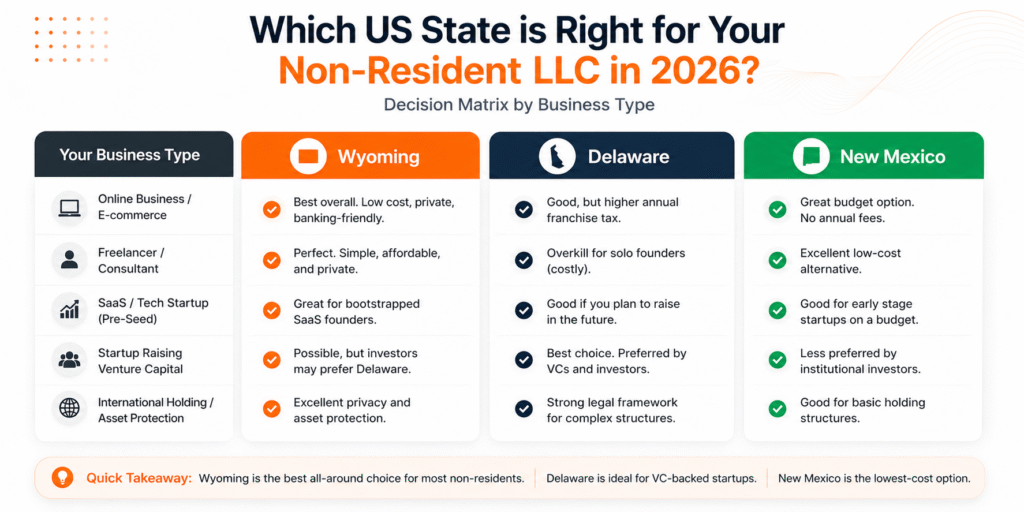
Which state is right for your business type? (decision matrix)
Stop second-guessing. Use this framework. Match your business type to the recommended state and move on.
| Business type | Recommended state | Reason |
|---|---|---|
| Freelancer / consultant | Wyoming | Lowest cost, simplest compliance, full payment processor support |
| Digital agency | Wyoming | Privacy, low annual fees, compatible with all platforms |
| SaaS product (bootstrapped) | Wyoming | Strong asset protection, no state income tax, low overhead |
| E-commerce (Shopify / Amazon) | Wyoming | Lowest ongoing cost, works with Amazon Seller Central, Stripe |
| Content creator / influencer | Wyoming or New Mexico | Either works — NM if minimising lifetime fees is priority |
| Holding company / asset protection | Wyoming | Strongest charging order protection for single-member LLCs |
| Startup seeking VC funding | Delaware | Investor requirement — institutions expect Delaware C-Corp or LLC |
| Pre-IPO / institutional investor ready | Delaware | Court of Chancery, established precedent, 90% of US IPOs |
| Solo online business, cost-first | New Mexico | Zero annual fees — lowest lifetime cost of any US state |
What this means for you: 90% of non-resident founders reading this should choose Wyoming. If you are raising VC, choose Delaware. If your only goal is the lowest possible lifetime cost, choose New Mexico. Everything else is noise.
Ready to form your Wyoming or Delaware LLC?
Rocket Wave handles the full formation — state filing, registered agent, EIN, and operating agreement — so you are operational in 2–3 weeks.
We have helped 400+ non-resident founders from Bangladesh, UAE, India, Pakistan, Nigeria, and 25+ other countries choose the right state and get their LLC fully set up.
3 common mistakes founders make when choosing a state
1. Choosing Delaware because it sounds more credible Delaware’s reputation is built on corporate law for large companies and VC-backed startups. For a non-resident running a digital business, it costs you ~$240 more per year and delivers nothing extra. Your clients, bank, and payment processors do not care which state your LLC is in.
2. Treating New Mexico as a permanent solution without considering legal infrastructure New Mexico is excellent for cost minimisation, but it has less developed LLC case law than Wyoming. If you ever face a business dispute or need to demonstrate the legitimacy of your structure to an institutional partner, Wyoming’s 50-year track record is the stronger foundation.
3. Changing state after formation because of second-guessing Switching states (domestication) involves additional legal fees, paperwork, and compliance steps. Make the right choice upfront based on your actual business type — do not switch unless your situation changes materially (e.g. you actually start raising VC).
For more on what comes after choosing your state — registered agent, EIN, compliance — read our US LLC compliance guide for non-residents. Also see our explanation of what a registered agent does and how to choose one before you file.
Full checklist before you file
Once you have chosen your state, work through this before filing:
- Confirm your business type matches the recommended state from the decision matrix above
- Check your business name availability on the state Secretary of State website
- Identify a registered agent service in your chosen state (bundled formation is cleanest)
- File Articles of Organization (Wyoming) or Certificate of Formation (Delaware)
- Apply for your EIN from the IRS — by phone (+1-267-941-1099) or fax (Form SS-4)
- Draft your Operating Agreement before applying for a bank account
- Apply to Mercury or Relay with: Certificate of Formation + EIN letter + Operating Agreement + passport
- Set your annual compliance reminders: state annual report, Form 5472 (April 15), BOI filing
Which state is best for a non-resident LLC in 2026?
Wyoming is the best state for most non-resident founders in 2026. It has no state income tax, strong privacy protections, low annual fees (~$60/year), and works seamlessly with Mercury, Stripe, and PayPal. Delaware is better if you plan to raise venture capital. New Mexico is the best choice if minimising total lifetime cost is your only priority.
Which state is best for a non-resident LLC in 2026?
Wyoming is the best state for most non-resident founders in 2026. It has no state income tax, strong privacy protections, low annual fees (~$60/year), and works seamlessly with Mercury, Stripe, and PayPal. Delaware is better if you plan to raise venture capital. New Mexico is the best choice if minimising total lifetime cost is your only priority.
Does the state I choose affect my Mercury or Stripe approval?
No. Mercury, Relay, Stripe, and PayPal do not differentiate between Wyoming, Delaware, or New Mexico LLCs. All three states receive identical treatment from US banks and payment processors. State choice affects costs and privacy — not banking or payment eligibility.
What is the cheapest state for a non-resident LLC?
New Mexico is the cheapest with a ~$50 one-time filing fee and no annual report or recurring state fee. Wyoming costs ~$100 to form and ~$60/year. Delaware costs ~$90 to form but ~$300/year in franchise tax — making it the most expensive option over time.
Can I form a US LLC in any state as a non-resident?
Yes. There are no citizenship or residency requirements to form an LLC in any US state. Non-residents can form and fully own an LLC in Wyoming, Delaware, New Mexico, or any other state — entirely remotely, without visiting the US.
Is Wyoming better than Delaware for non-residents?
For most non-resident founders — yes. Wyoming is cheaper, simpler, more private, and has stronger asset protection laws for single-member LLCs. Delaware is only the better choice if you are building a startup that will seek institutional investment or venture capital funding.
Do I need to visit the US to form an LLC in Wyoming or Delaware?
No. Both Wyoming and Delaware LLCs can be formed entirely remotely. You do not need to visit the US, have a US address, or be a US citizen. The entire process — filing, EIN, bank account — is handled online or by mail from anywhere in the world.
State selected. Now let us build the rest.
Rocket Wave handles your US LLC from state filing to first-year compliance — so you can start operating, not filing paperwork.
We have helped 400+ non-resident founders from 30+ countries — EIN processing, registered agent, operating agreement, bank account guidance, and ongoing compliance support.
No hidden fees. No surprises. No trips to the US.
Legal Disclaimer: This guide is for informational purposes only and does not constitute legal or tax advice. State fees, tax rules, and compliance requirements change frequently — always verify current rules with the relevant Secretary of State and a qualified tax professional before filing. Recommendations in this guide depend on your individual situation; consult a professional for advice specific to your circumstances.