Every year, more than 700,000 non-US residents form a US LLC — and most of them had no idea it was even possible until someone told them. You do not need to be a US citizen. You do not need to travel to the US. You do not need a Social Security Number.
What you do need is an accurate map of the process — because the internet is full of “$0 LLC” ads that leave out the registered agent fee, the EIN complexity, and the annual compliance obligations that follow you forever.
This is the guide that tells you everything upfront. Which state to choose, how to get your EIN without an SSN as a non-resident, how to open a US bank account remotely, what taxes actually apply to you, and what filings you cannot afford to miss. Written from the experience of helping 400+ global founders build their US business infrastructure — from Bangladesh, the UAE, Pakistan, India, Nigeria, and beyond.
Quick answer
Can a non-US resident form a US LLC? Yes — any foreign national can legally own 100% of a US LLC without being a citizen, resident, or visa holder. The full process can be completed entirely remotely in 1–3 weeks. No SSN required.
In this guide
Why non-resident founders choose a US LLC
This is the question worth answering before the how.
A US LLC gives you access to things your home country entity often cannot provide: a real US business bank account, Stripe and PayPal without restrictions, USD invoicing that international clients trust, and a business structure that global partners recognize immediately.
For freelancers, agency owners, SaaS founders, and e-commerce sellers operating globally, a US LLC is not just a legal formality. It is the infrastructure that makes global business work smoothly.
The most common reasons non-resident founders open a US LLC include:
- Accepting payments via Stripe, PayPal, and US payment processors without friction or account holds
- Opening a US business bank account (Mercury, Relay) entirely remotely
- Invoicing US and international clients in USD with a credible, recognized entity
- Accessing Amazon, Shopify, and US platforms that require a US business entity
- Separating personal liability from business obligations
What this means for you: If you are earning or planning to earn international income — from clients, e-commerce, SaaS, or consulting — a US LLC removes the biggest friction points between you and getting paid reliably.
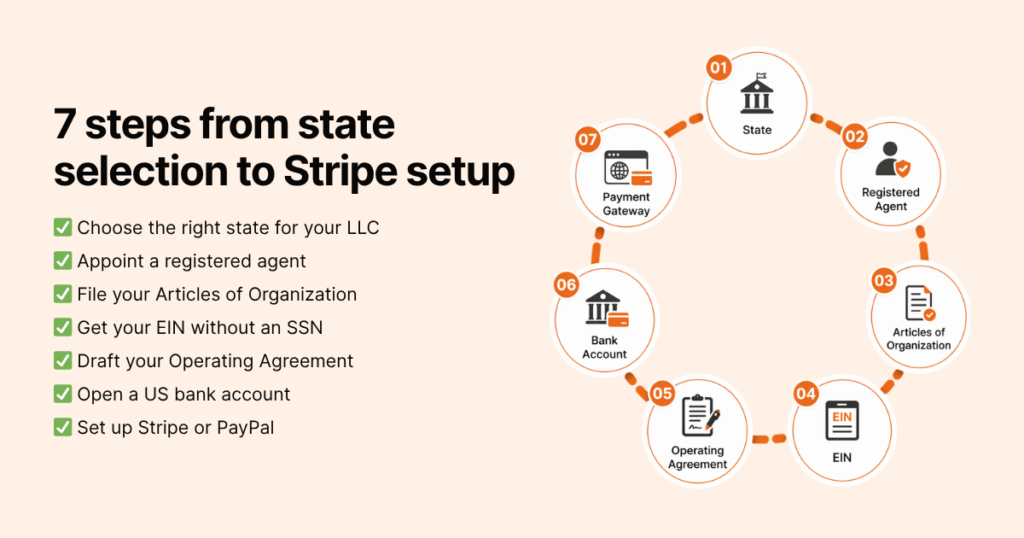
Step 1: Choose the right state for your non-resident LLC
This is where most first-time non-resident founders spend too much time second-guessing. For the vast majority of global founders, the decision comes down to three states — and the right answer depends on your business model.
Wyoming — best for most non-resident digital founders
Wyoming is the most practical choice for non-residents running online businesses, digital agencies, SaaS products, freelance services, or e-commerce stores. It has no state income tax, low annual fees (around $60/year), strong privacy protections, and minimal administrative burden. Wyoming was the first US state to create the LLC structure and is fully compatible with Mercury, Stripe, and PayPal.
Delaware — best for founders planning to raise capital
Delaware is better suited if you plan to raise venture capital, bring on US investors, or eventually convert to a C-Corp. Delaware has a more established legal framework and is the strong preference of institutional investors. The annual franchise tax is around $300/year. For most bootstrapped global founders, Delaware is not the right starting point.
New Mexico — the lowest-cost option
New Mexico has the lowest filing fee ($50) and no annual report requirement — making it the cheapest option over time. The tradeoff is lower name recognition compared to Wyoming or Delaware. Not sure which state fits you? Read our full Wyoming vs Delaware breakdown before you decide.
What this means for you: If you run a digital business with no US office or employees, start with Wyoming. It is the lowest-cost, lowest-maintenance option and is fully compatible with every major payment platform and online bank.
Step 2: Name your non-resident LLC and appoint a registered agent
Naming your LLC
Your LLC name must be unique within the state and must include “LLC” or “Limited Liability Company” at the end. Check availability on the Secretary of State’s website before filing. Keep the name relevant to your business — it will appear on your bank account, invoices, and contracts.
Registered agent: what it is and why you need one
Every US LLC is legally required to have a registered agent — a person or company with a physical address in your formation state who receives legal and government documents on behalf of your LLC.
As a non-resident, you cannot act as your own registered agent — you must hire a service, which typically costs $49–$150 per year. If you want to understand what a registered agent actually does before choosing one, we have a full guide covering the role, the requirements, and what to look for.
When evaluating formation services, look for one that bundles the registered agent fee into the package. Many “$0 LLC” offers charge separately for this — but it is not optional.
What this means for you: Budget for a registered agent as a recurring annual cost. Make sure any formation service includes it clearly in the total price — not as a hidden add-on.
Step 3: File your Articles of Organization
The Articles of Organization officially creates your LLC. You file it with the Secretary of State along with the state filing fee.
- Wyoming: ~$102 (one-time)
- Delaware: ~$108 (one-time)
- New Mexico: ~$50 (one-time)
These fees can be paid directly to the stateSOS with a processing fee ranging $2-$3. You can file directly through the state’s official website or use a formation service. Processing times range from same-day (with expedited filing) to 5–15 business days. If you want to compare costs across all 50 states before choosing, see our full state-by-state fee breakdown.
Step 4: Get your EIN without an SSN — the most important step
Your EIN (Employer Identification Number) is your LLC’s federal tax ID. You need it to open a US bank account, activate Stripe or PayPal, and file taxes. Without an EIN, your LLC legally exists but cannot transact money.
This is where non-resident founders most commonly stall. US residents apply online in minutes using their SSN. As a non-resident, you cannot use the online portal. Your three options:
By fax (Recommended): Fax your completed Form SS-4 to the IRS. Processing takes 10–15 business days.
By mail (Optional): Slowest option — 4 to 6 weeks. Use only if phone and fax are both inaccessible.
By phone (fastest): Call the IRS Business and Specialty Tax Line at +1-267-941-1099 (international callers). Have your completed Form SS-4 ready. Though fastest but not the recommended method for non-residents, as this processing can not be completed for most country residents.
The EIN application is where many “$0 formation” services fail non-residents — they file the LLC but leave you to handle the IRS yourself. If you are unsure about the difference between an EIN, SSN, and ITIN, we explain all three clearly. And if you are wondering whether you need an ITIN as a non-resident — the short answer is probably not, but it depends on your tax situation. For example; if you have an ITIN already then filing for your EIN by phone call can be the best option for you.
What this means for you: The EIN is the single most important document after your Certificate of Formation. Plan for the phone or fax method and allow 1–2 weeks in your timeline. Do not delay it.
Getting stuck on the EIN process?
Rocket Wave handles EIN applications for non-residents — the IRS call, Form SS-4 preparation, and follow-up.
We have helped 400+ founders from Bangladesh, UAE, India, Pakistan, Nigeria, and 25+ other countries get their EIN and open their US LLC — without a single trip to the US.
See what Rocket Wave includesStep 5: Draft your Operating Agreement
The Operating Agreement is your LLC’s internal governance document — it records ownership structure, profit distribution, management roles, and decision-making rules.
Most states do not require you to file it publicly, but virtually almost every bank will ask for it when you apply to open a business account. It also reinforces the legal separation between you and your LLC, which is the foundation of your liability protection.
For a single-member LLC (most non-resident founders start here), the operating agreement is straightforward. Most formation services include a template. Multiple members or a complex ownership structure may benefit from professional review.
Step 6: Open a US bank account as a non-resident LLC owner
Traditional US banks (Chase, Wells Fargo) generally require in-person visits — not practical for founders in Asia, Dubai, or Lagos. Online-first banks have changed this significantly.
AirWallex and Relay are the two platforms most widely used by non-resident LLC owners. Both support fully remote account opening with no monthly fees. You will need:
- Your LLC’s Certificate of Formation (issued by the state)
- Your EIN confirmation letter from the IRS
- Your Operating Agreement
- A valid passport
Important: Apply for your bank account only after your EIN has been confirmed. Applying without one triggers automatic rejection.
Wise Business is a useful complement — it gives you a US account number for receiving USD payments — but it is not a full US business bank account and should not replace Mercury or Relay.
For a full walkthrough of the application process, the documents required, and what to do if your application is rejected, read our complete guide to opening a US bank account as a non-resident.
What this means for you: Start with Mercury or Relay. Have all documents ready before applying. If rejected, the most common cause is missing or mismatched business information — not your country of origin.
Step 7: Set up Stripe or PayPal and stay compliant
Once your LLC and bank account are active, setting up Stripe is straightforward. Apply as the LLC entity (not as a foreign individual), using your EIN and US bank account details. Stripe supports non-US founders with US LLCs in most countries.
The process is simpler than most people expect, but there are a few approval pitfalls to avoid. We cover the full application flow, what Stripe checks, and how to avoid common rejection reasons in our step-by-step Stripe approval guide for non-US residents.
Taxes for non-residents: what your US LLC actually owes
Whether you owe US federal income tax depends on whether your LLC has “Effectively Connected Income” (ECI). For most non-residents running online businesses with no US physical presence, no US employees, and no US-based operations, your LLC income is typically not ECI and is not subject to US federal income tax.
However — and this is critical — you still have filing obligations regardless of whether you owe tax.
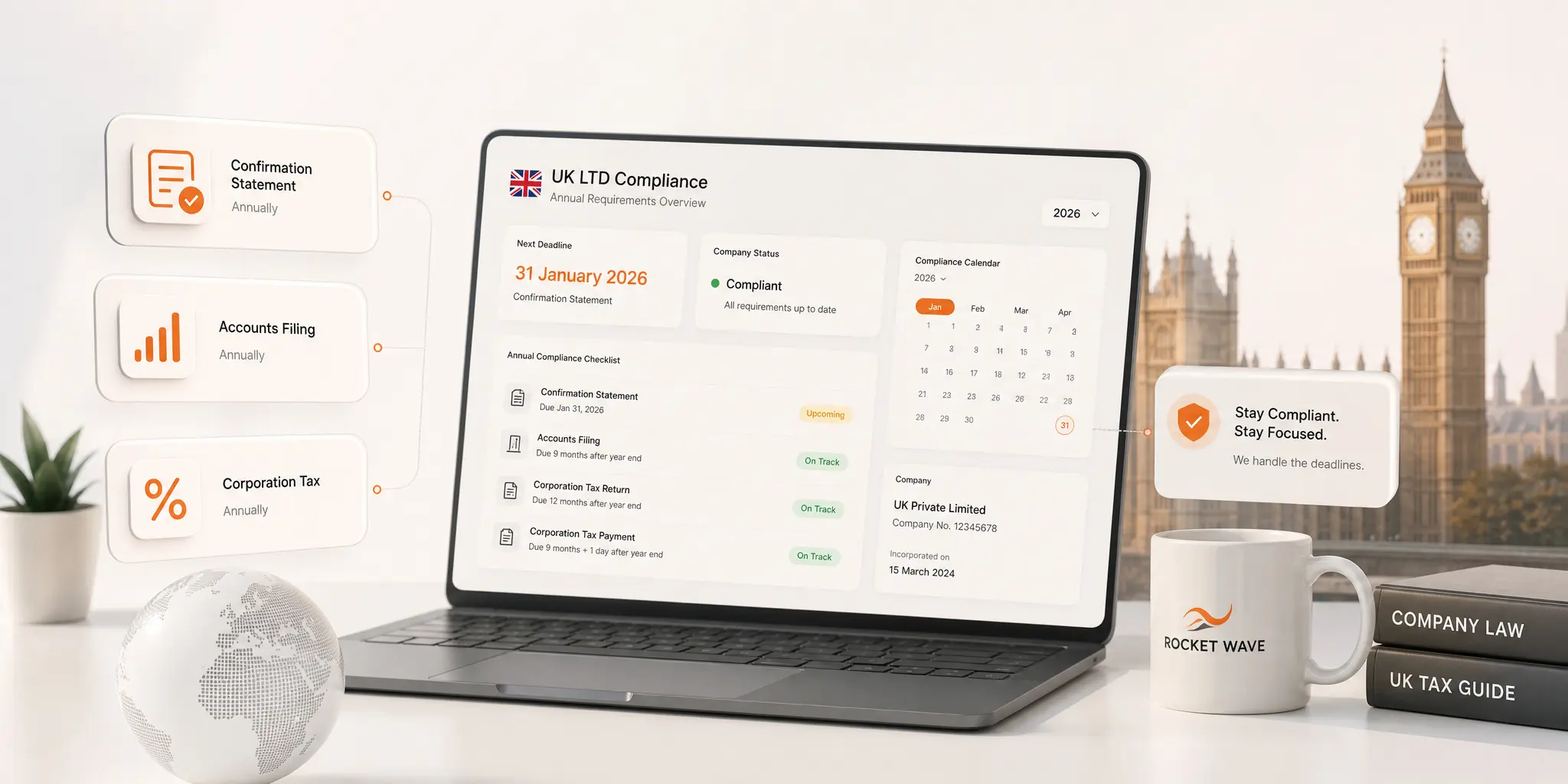
Form 5472 with a Pro Forma 1120: Required annually for foreign-owned single-member US LLCs. Deadline: April 15. Failure to file carries a minimum $25,000 penalty per year — even if you owe no tax. You can read the full Form 5472 guidance on the IRS website for the technical details.
BOI Filing: Required under the Corporate Transparency Act, filed with FinCEN. Requirements have been updated in 2025 — always verify current BOI requirements at FinCEN.gov before filing, as rules can change.
Annual state report: Wyoming ~$60/year. Delaware ~$300/year franchise tax. New Mexico: $0.
For the full picture on what your LLC owes and when, read our US LLC compliance guide for non-US residents. You can also check annual filing fees for every state, or go deeper on the tax side with our LLC tax guide written specifically for global founders.
What this means for you: You may owe nothing in US taxes, but you still have annual filing obligations. Missing Form 5472 is an expensive mistake. Build the compliance calendar into your routine from the day your LLC is formed.
5 common mistakes non-resident founders make when forming a US LLC
1. Choosing a state based on brand, not fit Delaware is not automatically the best choice. For most non-resident digital founders, Wyoming’s lower fees and simpler compliance make it the smarter option.
2. Forming the LLC before planning for the EIN Getting an EIN takes longer for non-residents. Factor in 1–2 weeks and start the application immediately after your LLC is approved.
3. Using a $0 formation service without checking total cost State filing fees, registered agent fees, and EIN processing are almost never included in “$0” offers. Calculate the genuine first-year total before committing.
4. Applying for a bank account before the EIN arrives Mercury, Relay, and other platforms require your EIN. Applying too early triggers automatic rejection. Wait for EIN confirmation, then apply.
5. Missing the Form 5472 filing deadline This is the most financially dangerous mistake. The $25,000 minimum penalty applies even if your LLC earned nothing. Set a reminder for April 15 every year.
Real cost breakdown: what it actually costs to form a US LLC as a non-resident
Costs vary by state, service provider, and your specific needs. Here are honest ranges — not advertised minimums.
| Item | Typical Range | Notes |
|---|---|---|
| State filing fee | $50 – $200 (one-time) | NM = $50, WY = $100, DE = $90 |
| Registered agent | $49 – $150/year | Annual recurring. Non-negotiable. |
| Formation service fee | $0 – $300 (one-time) | “$0” usually excludes state fees. |
| EIN assistance | $50 – $100 | If using a service. Can DIY via IRS phone. |
| Operating agreement | $0 – $150 | Template = free. Custom/reviewed = $150. |
| US bank account | $0/month | Mercury and Relay are both free. |
| Annual state report / tax | $0 – $300/year | NM = $0, WY = ~$60, DE = ~$300 |
| Form 5472 filing | $150 – $400/year | If using a professional. Required annually. |
Total first-year realistic cost: approximately $300 – $900, depending on your state choice and whether you use a service.
If you want to compare every state before deciding, take a look at our full cost guide across all 50 states — it covers filing fees, annual report requirements, and ongoing maintenance costs side by side.
Wyoming vs Delaware vs New Mexico: quick comparison for non-residents
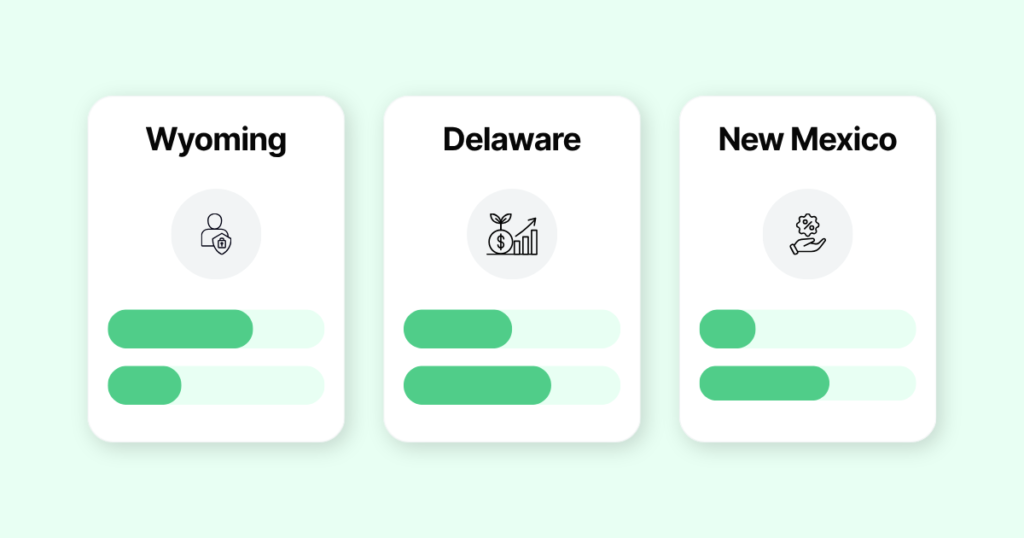
| Factor | Wyoming | Delaware | New Mexico |
|---|---|---|---|
| State income tax | None | None | None |
| One-time filing fee | ~$100 | ~$90 | ~$50 |
| Annual recurring cost | ~$60/year | ~$300/year | $0/year |
| Annual report required | Yes | Yes | No |
| Member privacy | High | Moderate | High |
| Investor preference | Low | High | Low |
| Best for | Freelancers, agencies, SaaS, e-commerce | VC-backed startups | Lowest-cost option |
Still undecided between Wyoming and Delaware? We go much deeper on the legal, tax, and practical differences in our detailed side-by-side guide — including which one is right for your specific business type.
Non-resident US LLC formation checklist
Work through this in order. Each step depends on the one before it.
- Decide between Wyoming, Delaware, or New Mexico based on your business model
- Check business name availability on the state Secretary of State website
- Identify a registered agent service (bundled with formation is cleanest)
- File Articles of Organization with the state (online or via formation service)
- Apply for EIN via IRS phone call (+1-267-941-1099) or fax (Form SS-4)
- Draft or receive your Operating Agreement
- Gather banking documents: Certificate of Formation + EIN letter + Operating Agreement + passport
- Apply to Mercury or Relay for a US business bank account
- Connect your US bank account to Stripe or PayPal using your LLC EIN
- Set annual compliance reminders: Form 5472 (April 15), state annual report, BOI filing
Frequently asked questions
Can a non-US resident legally own a US LLC?
Yes. Any foreign national can legally form and own 100% of a US LLC without being a US citizen, resident, or visa holder. There are no citizenship or residency requirements for LLC ownership in any US state. The process is fully remote.
Do I need an SSN to form a US LLC as a non-resident?
No. You do not need a Social Security Number to form a US LLC. You will need an EIN (Employer Identification Number) from the IRS, which non-residents obtain by phone or fax using Form SS-4 — not through the online portal, which requires an SSN.
How long does it take to get an EIN without an SSN?
By phone: same-day, if the call connects. By fax: 4–7 business days. By mail: 4–6 weeks. Most non-residents use the IRS international phone line at +1-267-941-1099 with Form SS-4 ready before calling.
Do non-US residents pay US taxes on their LLC income?
It depends on your situation. Most non-residents running online businesses with no US physical presence do not owe US federal income tax on their LLC income. However, you still have annual filing obligations — particularly Form 5472 — regardless of whether you owe tax. The minimum penalty for missing this filing is $25,000 per year.
Which is the cheapest US state for a non-resident LLC?
New Mexico has the lowest one-time filing fee (~$50) and no annual report requirement. Wyoming is the most popular overall with a $100 filing fee and ~$60/year in annual fees. Delaware costs more (~$300/year franchise tax) and is best for startups planning to raise capital.
Can I open a US bank account as a non-resident LLC owner?
Yes. Mercury and Relay both support fully remote account opening for non-resident LLC owners. You need your EIN, Certificate of Formation, Operating Agreement, and a valid passport. Traditional banks like Chase typically require an in-person visit at a US branch.
What is BOI filing and does it apply to my non-resident LLC?
Beneficial Ownership Information (BOI) reporting is required under the Corporate Transparency Act, filed with FinCEN. Most newly formed LLCs must comply. Requirements were updated in 2025 — always verify the current rules directly at FinCEN.gov before filing, as deadlines and exemptions can change.
Can I use Stripe with a US LLC if I live outside the US?
Yes. Stripe supports non-US founders who have formed a US LLC. You apply as the LLC entity using your EIN and US business bank account details. This is one of the main reasons non-residents form a US LLC. For the full step-by-step process, read our Stripe approval guide for non-US residents.
Ready to form your US LLC?
Rocket Wave handles everything — from state selection to your first-year compliance.
We have helped 450+ non-resident founders build their US business infrastructure — EIN processing, registered agent, operating agreement, bank account guidance, and ongoing compliance support.
No hidden fees. No surprises. No trips to the US.
Legal Disclaimer: This guide is for informational purposes only and does not constitute legal or tax advice. Tax obligations vary based on your individual situation, business structure, country of residence, and applicable tax treaties. Always consult a qualified tax professional or attorney for advice specific to your circumstances. BOI filing requirements are subject to ongoing regulatory updates — verify current rules at FinCEN.gov before filing.