Your UK LTD is registered. Companies House has your details. And now you’re staring at a question nobody explained clearly before you incorporated. As a non-UK resident director and shareholder, what do you actually owe HMRC?
The honest answer is that your UK LTD owes UK tax regardless of where you live, but you personally may owe very little, or nothing at all, depending on how you take money out of the company. This distinction between company tax and personal tax is the single most important thing to understand, and it’s the part most non-resident founders get confused about first.
This guide breaks down all three layers of UK LTD tax as a non-resident. Corporation tax on the company’s profits, dividend tax on what you personally withdraw, and VAT once your turnover crosses the threshold. It also covers what actually needs to be filed, when, and where double tax treaties come into play. Written from the experience of helping 150+ founders form and run UK LTDs from Bangladesh, India, UAE, and other markets around the world.
Quick answer
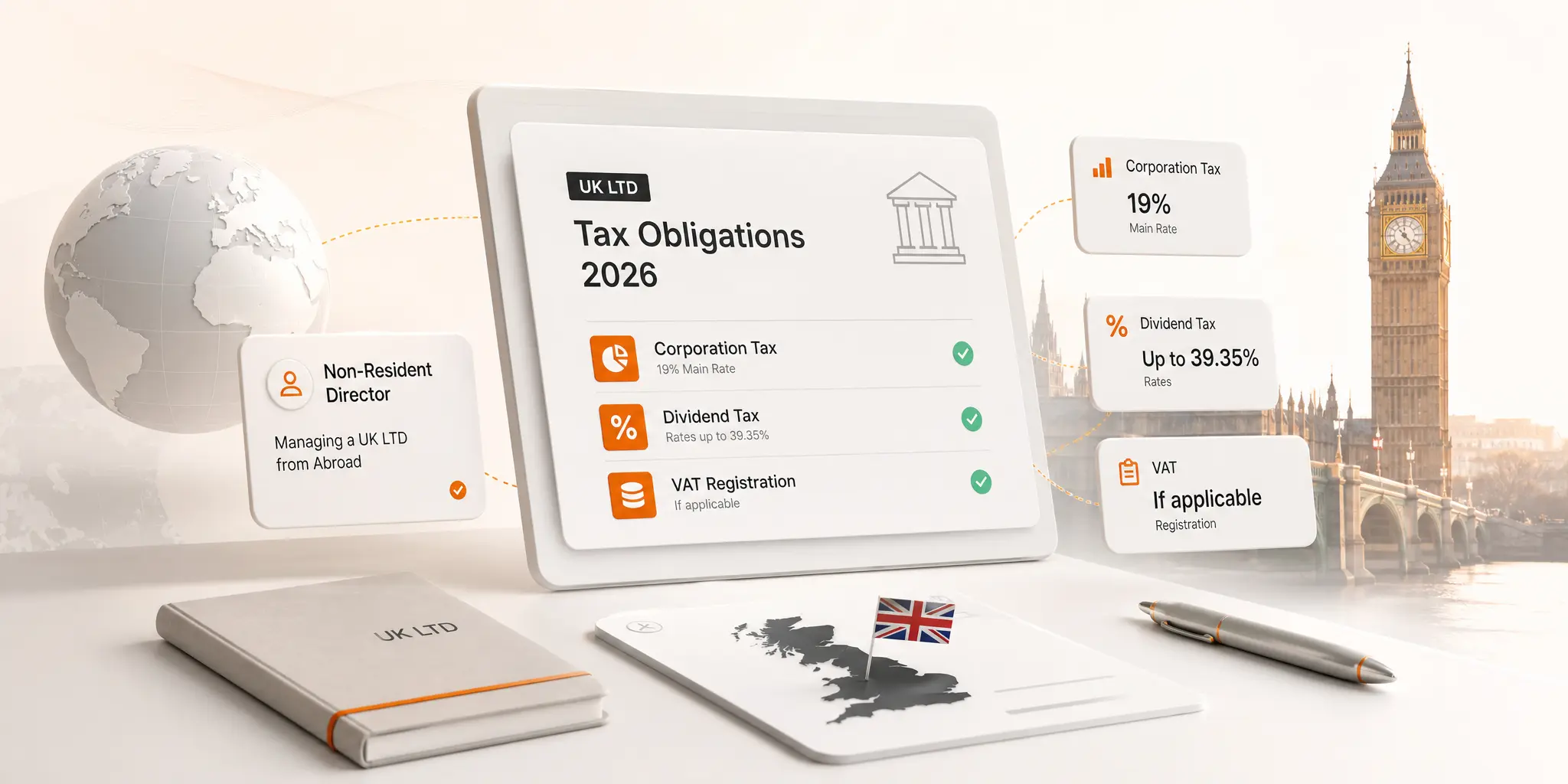
Do non-UK residents pay UK tax on their LTD company’s profits? Your UK LTD pays UK Corporation Tax on its profits, 19 to 25 percent, regardless of where its director or shareholder lives. As a non-resident, you personally may owe little to no additional UK tax on dividends withdrawn from the company, though your home country will likely tax that income under its own rules. VAT applies separately once turnover exceeds roughly £90,000 per year.
Important notice: This guide is for informational purposes only. Your specific tax position depends on your country of residence, applicable double tax treaties, and how you structure your income. Rocket Wave is a business operating system and not a law firm, and does not provide tax advice. Always consult a qualified UK accountant or a tax advisor in your home country before making decisions.
In this guide
The three layers of UK LTD tax for non-residents
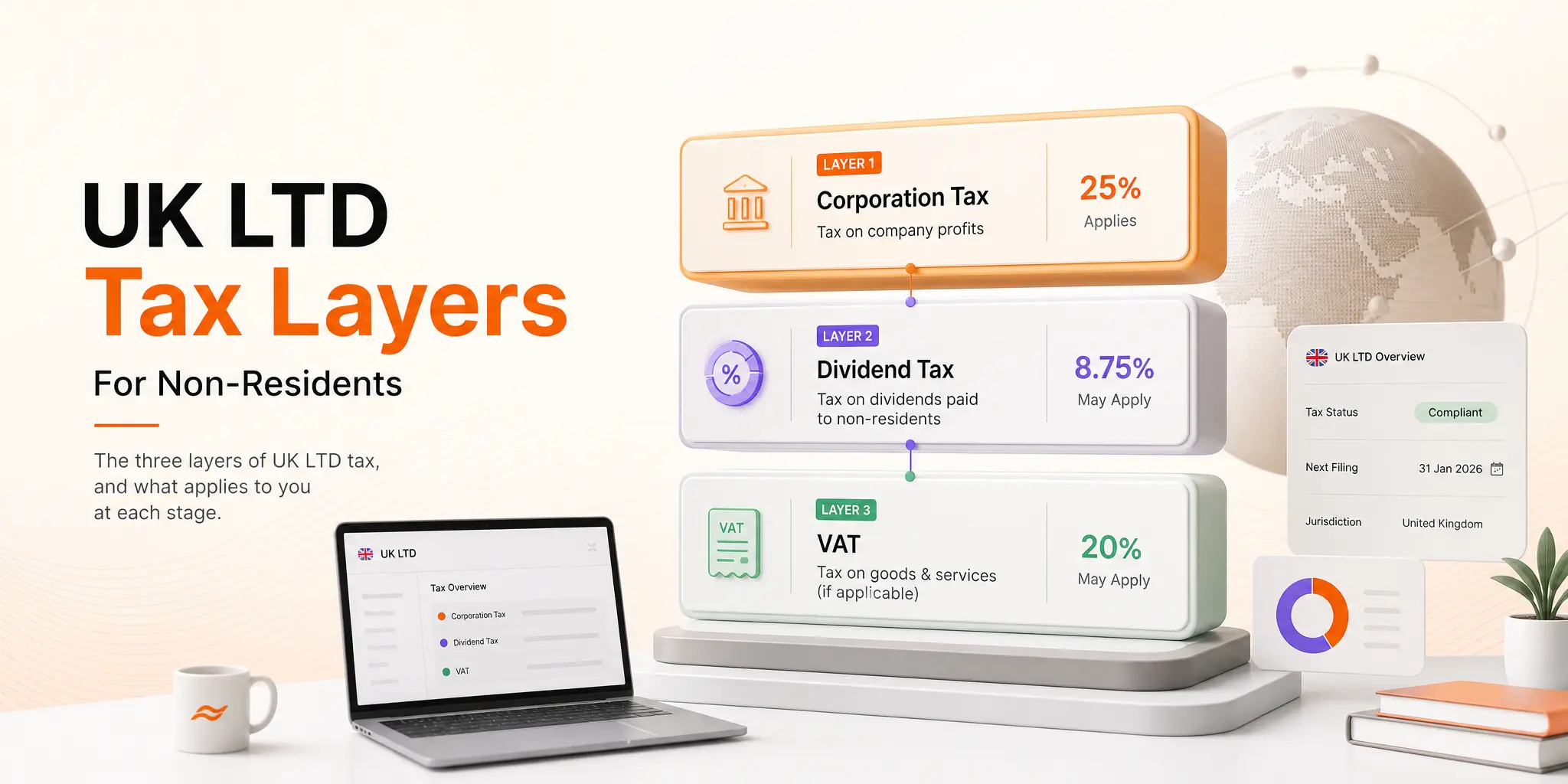
UK tax for a non-resident-owned LTD works in three separate layers. Confusing these layers is where most of the anxiety around UK tax comes from, so it’s worth getting this framework clear before anything else.
| Layer | Who pays it | Rate |
| 1. Corporation Tax | The company itself, regardless of where the director lives | 19 to 25 percent of company profit |
| 2. Dividend or salary tax | You personally, only on what you withdraw | Depends on your residency and home country rules |
| 3. VAT | The company, only once turnover crosses the threshold | 20 percent standard rate |
What this means for you: Your company always owes Corporation Tax. You personally may owe very little UK tax, because as a non-resident, dividend withdrawals are often not subject to UK tax withholding. Your home country’s tax rules on that income are what usually matter most for you personally.
Layer 1: Corporation Tax, what the company pays
Your UK LTD pays Corporation Tax on its profits every year, calculated after allowable business expenses. This applies regardless of where you, the director, live, and regardless of where your customers are based. A UK-incorporated company is a UK tax resident by default.
2026 Corporation Tax rates
| Profit level | Rate | Notes |
| Up to £50,000 | 19 percent | The small profits rate |
| £50,001 to £250,000 | 19 to 25 percent | Marginal relief applies, tapering the rate up |
| Over £250,000 | 25 percent | The main rate |
What counts as an allowable expense
Corporation Tax is calculated on profit, not revenue, so legitimate business expenses reduce your taxable amount. Common allowable expenses for a non-resident-run UK LTD include:
- Software subscriptions and tools used for the business
- Registered office and accountancy fees
- Marketing and advertising costs
- Contractor and freelancer payments for work done for the business
- A reasonable proportion of home office costs if you work from home
When and how Corporation Tax is paid
Corporation Tax is due 9 months and 1 day after your accounting period ends. Most UK LTDs run a 12-month accounting period, so if your year ends 31 March, tax is due by 1 January the following year. Payment is made directly to HMRC online, using your UTR as the reference.
What this means for you: Corporation Tax is unavoidable for a UK LTD, but it’s also predictable. Set aside roughly 20 percent of profit throughout the year so the payment never comes as a surprise.
Layer 2: Dividend tax, what you personally pay
This is the layer that actually affects your personal finances, and it’s where non-resident status genuinely works in your favour.
Salary vs dividends for non-resident directors
Most non-resident director-shareholders choose to take no salary at all, or a very small one, and withdraw profit as dividends instead. Here’s why this matters.
- A director’s salary through PAYE is subject to UK income tax if you spend significant time working in the UK. Most non-residents avoid this entirely by not taking a salary
- Dividends paid to non-UK resident shareholders are typically not subject to UK withholding tax. The UK generally does not tax dividends paid to non-residents at source
- Your home country will very likely tax that dividend income under its own personal income tax rules. This is not a way to avoid tax altogether, it’s a way to avoid paying UK tax twice on the same income
⚠ Non-resident does not mean tax-free. You are very likely to owe personal tax on dividends in your country of residence. Rocket Wave does not provide tax advice on your home country’s rules. Confirm your specific position with a local tax advisor before assuming any income is untaxed.
How dividends actually work in practice
Step 1: The company pays Corporation Tax on its profit first. Only post-tax profit is available to distribute as dividends.
Step 2: The company declares a dividend. This is a formal decision, recorded in board minutes, showing the amount and date of the dividend payment.
Step 3: You receive the dividend into your personal account. This can be your home country bank account directly, or transferred from your UK business account.
Step 4: You report and pay tax in your home country, if required. This depends entirely on your home country’s tax rules on foreign dividend income.
What this means for you: The combination of Corporation Tax at the company level and no UK withholding on dividends to non-residents is one of the more efficient structures available. It’s a major reason UK LTDs are attractive to global founders, alongside the speed and reputation benefits.
Want your UK LTD tax structure set up correctly from day one?
Rocket Wave connects non-resident founders with UK accountants who specialise in exactly this situation, so your Corporation Tax, dividends, and filings are handled properly.
150+ global founders. Full setup handled remotely, backed by a 7-day money-back guarantee.
Layer 3: VAT, only once you cross the threshold
VAT is the layer most non-resident founders don’t need to think about early on, but it’s important to understand before you get there.
When VAT registration is required
You must register for VAT once your UK taxable turnover exceeds roughly £90,000 in any rolling 12-month period, the 2026 threshold. This is based on turnover, not profit, so gross revenue is what counts toward the threshold.
Should you register voluntarily before the threshold?
Voluntary VAT registration can make sense if most of your business expenses are UK-VAT-charged, since you can reclaim that input VAT. For most non-resident founders billing international clients with few UK-based expenses, voluntary registration adds complexity without much benefit. Wait until you’re required to register.
VAT on services to clients outside the UK
If your clients are businesses located outside the UK, many digital services fall under the reverse charge mechanism, meaning you may not need to charge UK VAT at all, even once registered. This area has specific rules depending on your client type and location. Always confirm the correct treatment with a UK accountant, and see the official guidance at HMRC’s VAT registration service.
What this means for you: Most non-resident founders in their first one to two years of operation never need to think about VAT at all. Don’t let it create anxiety before it’s relevant. Track your turnover monthly and register only when you approach the threshold.
Double tax treaties, avoiding paying twice
The UK has double tax treaties with many countries, designed to prevent the same income being taxed twice, once by the UK and once by your home country.
How double tax treaties generally work
If a treaty exists between the UK and your country of residence, it typically sets out which country has the primary right to tax specific types of income, and provides a mechanism, usually a tax credit, so you’re not taxed twice on the same amount.
Where this matters most for UK LTD owners
- If you take a director’s salary and spend time working in the UK, a treaty affects which country taxes that employment income
- If your home country taxes worldwide income, including UK dividends, a treaty may provide a credit for any UK tax already paid on that income
- Treaty positions vary significantly by country, so a blanket statement doesn’t apply to everyone
⚠ Treaty benefits are not automatic. In most cases you need to actively claim treaty relief, either through HMRC or through your home country’s tax authority. This is not something that happens by default just because a treaty exists.
What this means for you: Do not assume a treaty eliminates your home country tax obligation. It usually reduces or credits double taxation, it does not exempt the income altogether. Confirm your country’s specific treaty position with a tax advisor who understands both UK and your local tax rules.
What non-resident directors must file, and when
Understanding what to file, and when, prevents the most common and most expensive compliance mistakes.
| Filing | Who files it | Deadline |
| CT600, Corporation Tax Return | The company, via your accountant | 12 months after the accounting period ends |
| Corporation Tax payment | The company | 9 months and 1 day after the accounting period ends |
| Annual Accounts | The company, filed with Companies House | 9 months after the accounting period ends |
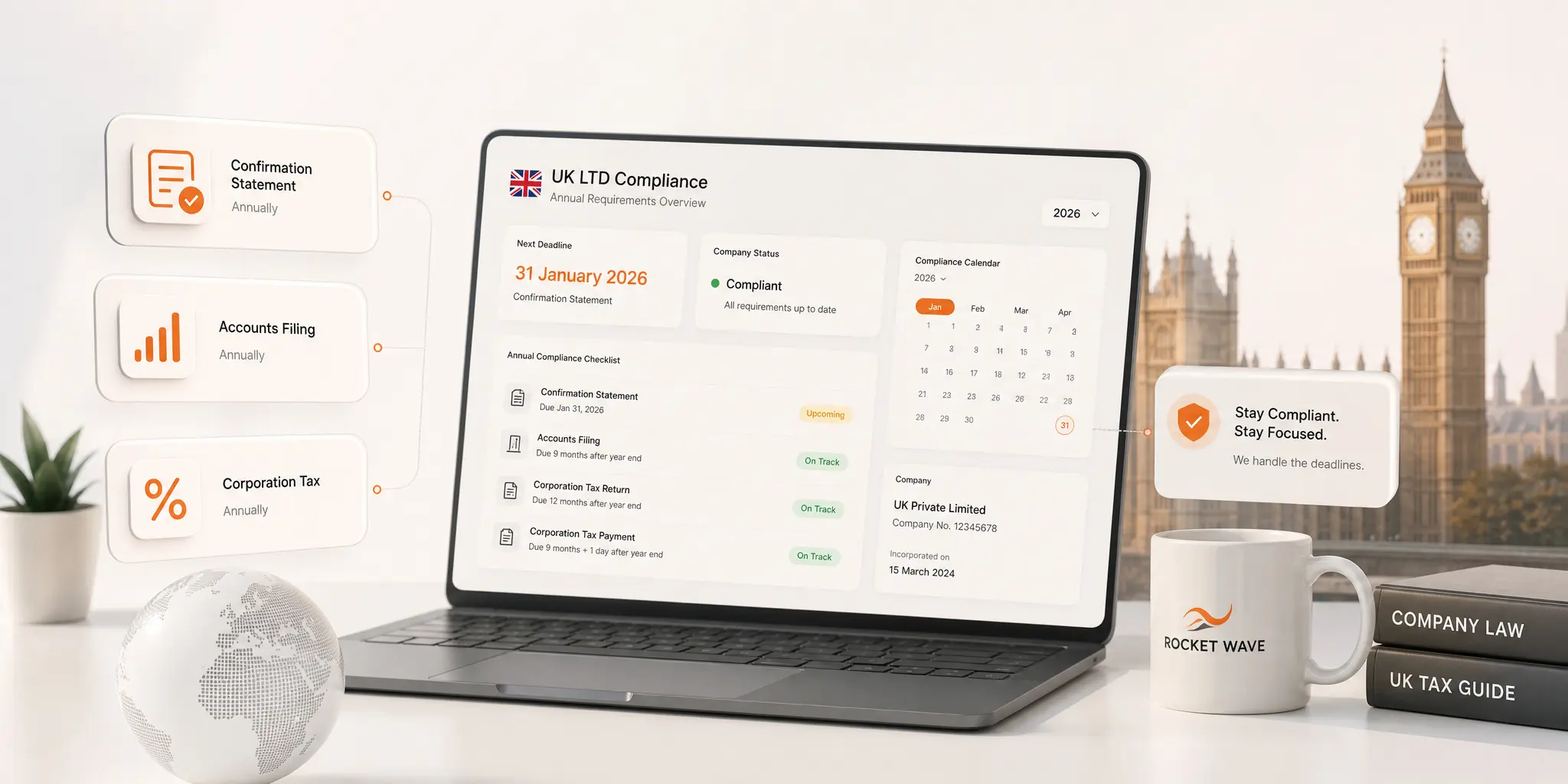
| Confirmation Statement | The company, filed with Companies House | Annually, from incorporation date |
| VAT Returns, if registered | The company | Quarterly, one month and seven days after quarter end |
| Self Assessment, if applicable | You personally, only if you have UK-sourced personal income | 31 January following the tax year |
Most non-resident director-shareholders who take no UK salary and only receive dividends do not need to file a UK Self Assessment personally. This depends entirely on your specific situation, so confirm with your accountant whether Self Assessment applies to you.
What this means for you: Engage a UK accountant who specifically works with non-resident-owned companies. They will confirm exactly which filings apply to your situation and keep you compliant without you needing to interpret HMRC guidance yourself.
5 tax mistakes non-resident UK LTD owners make
1. Assuming non-resident status means no UK tax at all. Your company still pays Corporation Tax regardless of where you live. Only your personal dividend position benefits from non-resident status, and even then, your home country likely taxes that income.
2. Not setting aside money for Corporation Tax throughout the year. Corporation Tax is due 9 months after your accounting period ends, which can feel far away until it isn’t. Set aside roughly 20 percent of profit as you go.
3. Ignoring home country tax obligations on dividends. Just because the UK doesn’t withhold tax on dividends to non-residents doesn’t mean your home country won’t tax that income. This is the most common and most costly assumption we see.
4. Registering for VAT before it’s required. Voluntary VAT registration adds quarterly filing obligations without much benefit for most non-resident founders with international clients. Wait until you’re required to register.
5. Not engaging a UK accountant who understands non-resident structures. Generic UK accountants sometimes miss non-resident-specific nuances, particularly around dividend withholding and treaty positions. Choose one with specific experience serving non-resident director-shareholders.
UK LTD tax checklist for non-resident directors
Use this annually, starting from the day your UK LTD is incorporated.
- Confirm your accounting year end and set reminders for all key deadlines
- Set aside roughly 20 percent of profit throughout the year for Corporation Tax
- Engage a UK accountant who specialises in non-resident-owned companies
- Decide on salary vs dividend structure with your accountant before withdrawing any money
- Track UK taxable turnover monthly to monitor the VAT threshold
- Confirm your home country’s tax treatment of UK dividend income with a local advisor
- Check whether a double tax treaty applies between the UK and your country of residence
- File CT600, Annual Accounts, and Confirmation Statement on time every year
- Keep clean records of all dividend declarations, board minutes, and payments
Frequently asked questions
Do I have to pay UK income tax as a non-resident director?
Generally not, if you take no salary and do not spend significant time physically working in the UK. Most non-resident director-shareholders take dividends instead of salary specifically to avoid this. Your company still pays Corporation Tax regardless of your personal tax position.
Is UK dividend income tax-free for non-residents?
The UK generally does not withhold tax on dividends paid to non-resident shareholders, but this does not mean the income is tax-free. Your home country will very likely tax that dividend income under its own rules. Confirm your specific position with a tax advisor in your country of residence.
What is the UK Corporation Tax rate in 2026?
19 percent on profits up to £50,000, rising with marginal relief between £50,001 and £250,000, up to a main rate of 25 percent on profits over £250,000. This applies to the company regardless of where the director or shareholder lives.
Do I need to register for VAT immediately after incorporation?
No. VAT registration is only required once your UK taxable turnover exceeds roughly £90,000 in a rolling 12-month period, the 2026 threshold. Most non-resident founders in their early years do not need to register.
Will I be taxed twice, once by the UK and once by my home country?
This is exactly what double tax treaties are designed to prevent, where a treaty exists between the UK and your country. However, treaty relief usually needs to be actively claimed rather than applying automatically. Confirm your specific treaty position with a tax advisor familiar with both UK and your local tax rules.
Do I need to file a UK Self Assessment as a non-resident director?
Most non-resident director-shareholders who take dividends rather than salary and have no other UK-sourced personal income do not need to file a Self Assessment. This depends on your specific circumstances, so confirm directly with your UK accountant whether it applies to you.
Can Rocket Wave help with my UK LTD tax filings?
Rocket Wave is a business operating system and not a law firm or accountancy, so we do not file taxes directly. We connect non-resident founders with UK accountants who specialise in non-resident-owned companies, and every UK LTD formation package includes lifetime compliance alerts so you never miss a deadline.
Form your UK LTD with the right tax structure from day one.
Rocket Wave handles your UK LTD formation and connects you with accountants who understand non-resident director tax, so Corporation Tax, dividends, and filings are set up correctly from the start.
150+ global founders. Starting from $299, no hidden fees, backed by a 7-day money-back guarantee.
Legal Disclaimer: Rocket Wave is a business operating system and not a law firm, which means we do not provide official legal or tax advice. This guide is for general informational and educational purposes only. UK tax rates, VAT thresholds, and treaty positions change frequently and vary by individual circumstance. Always verify current details at gov.uk and hmrc.gov.uk. Always consult a qualified UK accountant and a tax advisor in your country of residence for advice specific to your circumstances.