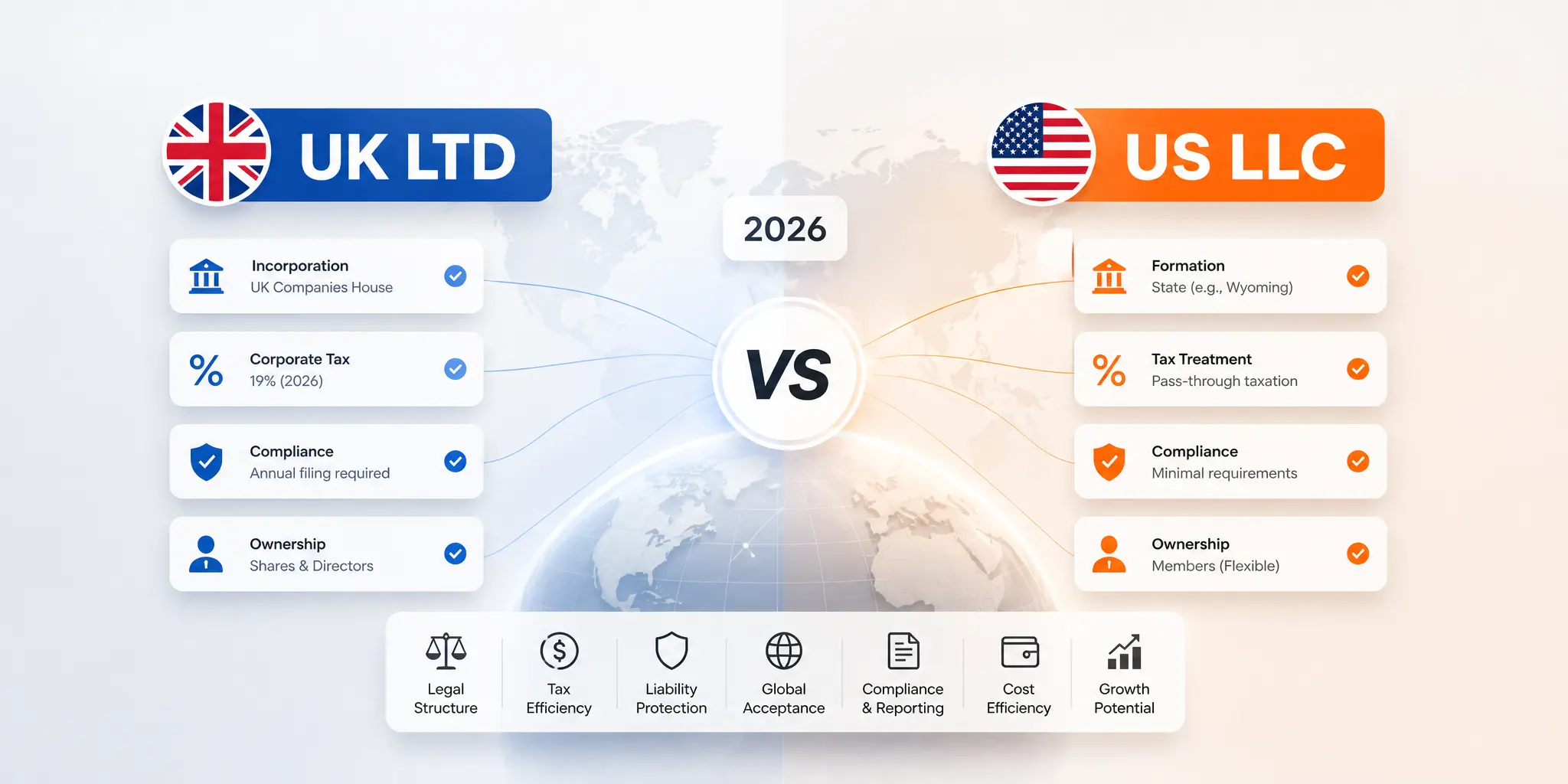
You’re a global founder ready to launch. Your customers could be in the US, Europe, or both. And you have to make a decision that will shape your business’s tax bill, banking access, credibility, and admin burden for years to come. Form a UK LTD or a US LLC?
Most articles answering this question do one of two things. Either they declare one the winner, which can’t really be true since they solve different problems, or they bury you in a wall of features without helping you actually decide. This guide takes a different approach. It walks through the seven factors that actually matter, customer location, currency, tax, banking, reputation, cost, and complexity, and shows you how each affects the decision for your specific situation.
Written from the experience of helping 550+ founders choose the right structure, many of whom form both, some of whom regret picking the wrong one first. The best structure depends less on which one is objectively better and more on where your customers are, what currency you bill in, and how you want your business to be perceived. Let’s break it down properly.
Quick answer
UK LTD vs US LLC, which is better? Neither is universally better. Choose UK LTD if your customers are primarily in Europe, the UK, or the Middle East, you bill in GBP or EUR, or you want the fastest and lowest-cost globally credible entity. Choose US LLC if your customers are primarily in the US, you bill in USD, or you want pass-through taxation with no entity-level tax for non-resident owners. Many founders eventually form both.
In this guide
UK LTD vs US LLC, the full comparison at a glance
Before we walk through each factor in depth, here’s the side-by-side view. Use this as your quick reference. The sections below unpack each row in detail.
| Factor | UK LTD | US LLC |
| Best customer location | Europe, UK, Middle East, Africa | United States, Canada, Latin America |
| Best billing currency | GBP, EUR | USD |
| Tax on business profits | 19 to 25 percent Corporation Tax paid by the company | No entity tax for non-resident owners, pass-through |
| Tax on personal income | UK dividends often taxed in home country only | Personal income tax based on home country rules |
| Formation cost | From $299 via Rocket Wave | From $197 + State Fee via Rocket Wave |
| Formation time | 24 hours | 3 to 5 business days |
| Annual state or government fee | Confirmation statement filing fee | $0 (New Mexico) to $300 (Delaware) |
| Accounting cost | $300 to $800 per year (UK accountant) | $150 to $400 per year (Form 5472 preparation) |
| Banking options | Wise, Revolut, Tide, Payoneer | Mercury, Relay, Wise, Payoneer |
| Stripe support | Direct. The UK is supported | Direct. The US is supported |
| Reputation with EU clients | Very strong | Moderate |
| Reputation with US clients | Moderate | Very strong, a native entity |
| VAT or sales tax | VAT required if turnover exceeds roughly £90K per year | Sales tax only if you have US nexus |
| Director or owner details | Public on Companies House | Varies by state. Wyoming keeps it private |
What this means for you: This table is the whole comparison in one glance, but the reason each row matters depends on your specific situation. The seven sections below walk through what each factor actually means for you as a founder.
Factor 1: Customer location and reputation
This is the single most important factor. Where your customers are shapes which entity they’ll take more seriously, and which one makes contracting, invoicing, and payments smoother.
If your customers are in Europe, UK, or Middle East
A UK LTD is often the stronger choice. UK companies are a familiar and trusted counterparty across the EU, even post-Brexit. British business identity carries commercial weight in the Middle East and Africa in ways a US LLC simply doesn’t. If you’re invoicing German agencies, Dubai-based startups, or French SaaS companies, a UK LTD will typically feel more native to them than a Delaware or Wyoming LLC.
If your customers are in the United States
A US LLC has the reputation edge. American clients, particularly enterprise buyers, procurement teams, and SaaS platforms, often prefer contracting with US entities. It reduces perceived jurisdictional risk on their side, simplifies their vendor onboarding forms, and avoids the friction of an international vendor flag in their finance systems.
If your customers are global or mixed
Look at your top 20 percent of revenue and pick based on where that concentrates. If 60 percent of revenue comes from EU clients and 40 percent from the US, form the UK LTD first since it optimises for the larger share. You can always add a US LLC later when the US customer base grows enough to justify it.
What this means for you: Founders sometimes agonise over reputation, but in practice, for most digital services, SaaS, and freelance work under $50K contracts, clients don’t care about your jurisdiction as long as your paperwork is clean and payments work. Reputation matters most at higher deal sizes and enterprise procurement.
Factor 2: Currency and payment processing
Currency friction is one of the most underrated factors in this decision. Every currency conversion costs 1 to 4 percent in exchange fees. Do that a few times across your monthly revenue and it becomes real money.
| Billing currency | UK LTD | US LLC |
| GBP | Native. No conversion | Requires GBP to USD conversion |
| EUR | Handled well via Wise or Revolut | Requires EUR to USD conversion |
| USD | Requires USD to GBP conversion or a USD sub-account | Native. No conversion |
| Mixed multi-currency | Wise Business gives you all three in one dashboard | Wise Business, added to Mercury, does the same |
The currency you bill most often should match your primary business account currency. A UK LTD with a GBP main account handles UK and EU clients elegantly. A US LLC with a USD main account handles US clients elegantly. Both structures allow multi-currency accounts via Wise Business, but native currency reduces friction.
Stripe support
Both the UK and US are fully supported by Stripe. You can accept card payments from customers globally with either structure. The difference is administrative. A US LLC uses your EIN, and a UK LTD uses your Companies House number. For the full Stripe setup process for non-residents, read our Stripe setup guide for non-US residents with a US LLC. The UK equivalent follows the same logic with UK-specific documents.
What this means for you: If you’re currently receiving USD payments from US clients through PayPal or wire transfers with heavy conversion fees, a US LLC with Mercury and Stripe can save you 2 to 4 percent on every transaction. That savings alone often justifies the formation cost within the first quarter.
Factor 3: Tax structure, pass-through vs entity-level
This is where the two structures fundamentally differ. Understanding it upfront prevents unpleasant surprises in your first year.
How US LLC taxes work for non-residents
A US LLC is a pass-through entity, meaning the LLC itself pays no federal income tax. Profits pass through to the owner and are taxed at the owner’s level. For a non-US resident with no US physical presence, no US employees, and no US-based operations, that pass-through income is typically not subject to US federal income tax at all. However, you must still file Form 5472 annually. The $25,000 penalty for missing it is real. Read our full US LLC taxes for non-residents guide for the complete picture.
How UK LTD taxes work
A UK LTD is an entity-level taxpayer. The company itself pays UK Corporation Tax on profits, 19 percent up to £50K profit, sliding up to 25 percent at £250K and above. This is paid by the company before any profits are distributed to you. When you take profits out as dividends, those dividends may then be taxed again at your personal level under your home country’s rules.
The practical comparison
| Scenario | US LLC | UK LTD |
| Company earns $100K profit | Company pays $0 US tax | Company pays roughly $19K to $25K Corporation Tax |
| You extract profit | No withholding. You take it as owner | Take as salary, usually $0, or dividends |
| Personal home country tax | Home country taxes you on $100K | Home country taxes you on dividends taken |
| Total effective tax | Only home country tax | Corporation Tax plus home country dividend tax |
⚠ The right answer depends on your home country’s tax rules. Some countries tax foreign business income aggressively. Others give favourable treatment to dividends or offshore corporate income. Always consult a tax advisor familiar with your specific residency situation before deciding.
What this means for you: For most non-resident founders in low-tax-treaty countries, a US LLC delivers a lower effective tax bill than a UK LTD, because the pass-through structure avoids the entity-level Corporation Tax. For founders in countries with strong UK ties or specific dividend treatment, the UK LTD can be competitive or even better.
Not sure which structure fits your situation?
Rocket Wave forms both UK LTDs and US LLCs for non-resident founders, with expert guidance on which structure fits your customer base, currency, and tax position.
550+ global founders. Full setup handled remotely, backed by a 7-day money-back guarantee.
Factor 4: Banking access from abroad
Both structures have excellent remote banking options in 2026, but they connect to different fintech ecosystems.
| Bank | US LLC | UK LTD |
| Mercury | Yes. Built specifically for US LLCs | No |
| Relay | Yes. Sub-accounts, US LLC friendly | No |
| Wise Business | Yes, as a multi-currency add-on | Yes, very strong for UK LTDs |
| Revolut Business | No. US companies aren’t supported | Yes, supported |
| Tide | No | Yes, supported |
| Payoneer | Yes | Yes |
| Traditional banks | Requires US presence, impractical | Requires a UK visit, impractical for most non-residents |
For US LLCs, Mercury is the default
Mercury has become the standard US business bank for non-resident LLC owners. Fully remote application, no monthly fee, and direct Stripe integration. Relay is a strong alternative if you want sub-account budgeting. See our US bank account guide for non-resident LLC owners for the full application process.
For UK LTDs, Wise, Revolut, and Tide dominate
Wise Business is popular for its multi-currency support and low FX fees. Revolut Business offers a stronger everyday banking experience. Tide is the UK-native business bank of choice. All three support non-resident directors fully remotely with just your Certificate of Incorporation and passport.
What this means for you: Banking is essentially a wash between the two structures. Both have excellent remote options in 2026. The differentiator is your currency preference. If you want native USD payouts, US LLC plus Mercury wins. If you want native GBP or EUR flexibility, UK LTD plus Wise or Tide wins.
Factor 5: Formation speed and cost
If speed and low upfront cost matter, this is a clear win for one side.
| Cost item | UK LTD | US LLC |
| Government or agent fee | From $299 via Rocket Wave, includes registered office | From $197 + State Fee via Rocket Wave |
| Registered office or agent | Included in UK LTD packages | Registered agent typically $50 to $150 per year after year one |
| Formation time | 24 hours | 3 to 5 business days |
| Tax number | UTR issued automatically within 14 days | Requires a separate EIN application via Form SS-4 |
| Total setup cost, first year | From $299 all-in via Rocket Wave | From $197 + State Fee via Rocket Wave |
A UK LTD often has a lower starting cost and can be operational faster. The US LLC path adds the EIN application step, which we cover in detail in our EIN without SSN guide for non-residents. This typically adds a few business days to the timeline compared with the UK’s automatic UTR issuance.
What this means for you: If your priority is launching in the next few days with the lowest possible entry cost, a UK LTD tends to win. If you’re comfortable with a slightly longer setup for US market alignment, a US LLC wins. Neither is meaningfully expensive. Both fit comfortably into any bootstrap budget.
Factor 6: Annual compliance burden
This is where the two structures diverge most significantly. A UK LTD has heavier annual admin. A US LLC has fewer moving parts but one large penalty if you miss its key filing.
US LLC annual compliance
- File Form 5472 and Pro Forma 1120 with the IRS by April 15. A $25,000 minimum penalty applies if missed
- File your state annual report, ranging from $0 in New Mexico to roughly $300 in Delaware
- Renew registered agent, typically $50 to $150 per year
- Update the FinCEN BOI report if ownership or personal information changes
- Keep records of transactions between you and the LLC
For the full breakdown, see our US LLC compliance checklist for non-residents.
UK LTD annual compliance
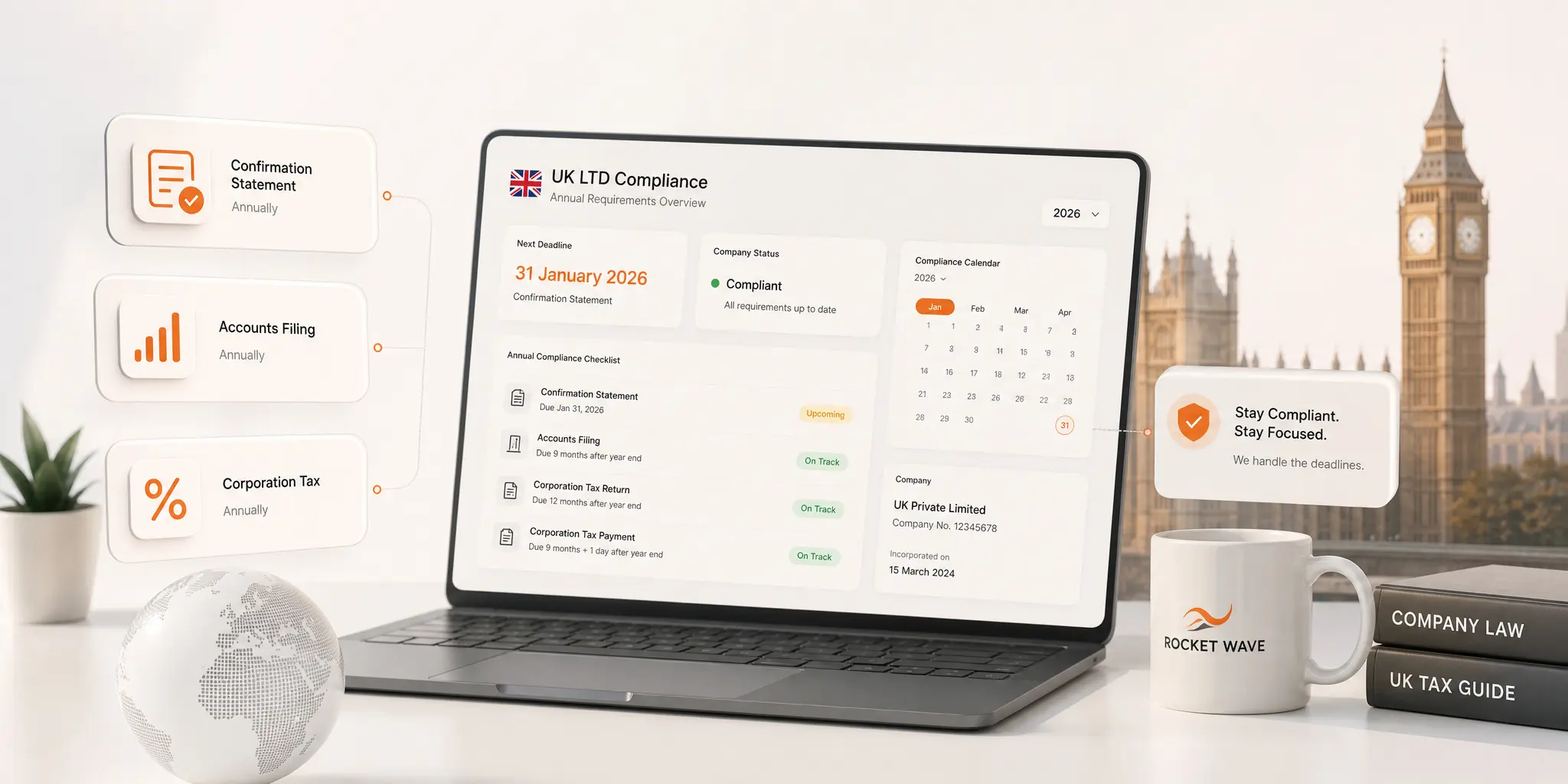
- File Confirmation Statement annually with Companies House
- File Annual Accounts within 9 months of the accounting period end
- File Corporation Tax Return (CT600) within 12 months of the accounting period end
- Pay Corporation Tax within 9 months and 1 day of the accounting period end
- Register for VAT if turnover exceeds roughly £90K, the 2026 threshold, and file quarterly VAT returns
- Maintain PSC register and update within 14 days of changes
The UK’s compliance is more frequent and requires ongoing accounting work. Most UK LTDs need an accountant, typically $300 to $800 per year. The US LLC is simpler in normal operation but has one very expensive potential failure point.
What this means for you: If you want the simplest possible annual admin, a US LLC in Wyoming or New Mexico with a single April 15 filing is easier than a UK LTD’s multiple deadlines. If you’re comfortable engaging an accountant to handle everything, a UK LTD’s compliance is straightforward. Neither is unmanageable. Both are routine business admin.
Factor 7: Privacy and public disclosure
Both jurisdictions have made ownership more transparent in recent years, but there are meaningful differences in what becomes public.
| Information | UK LTD | US LLC |
| Director or manager name | Public on Companies House | Varies. Wyoming keeps it private, Delaware publishes it |
| Director address | Public, though a service address is available | Varies by state |
| Owner (member or PSC) name | Public if ownership exceeds 25 percent | Filed with FinCEN, not public directly |
| Ownership percentage | Public via PSC register | Filed with FinCEN, not public |
| Company financials | Small companies file abridged accounts, which are public | Not filed with any US authority |
| Annual accounts filed | Yes, public | No, internal only |
If privacy matters to you, and increasingly it does for many founders, a Wyoming or New Mexico US LLC keeps ownership significantly more private than any UK LTD. All UK LTD ownership above 25 percent is publicly searchable on Companies House, and all UK LTD financials, even abridged ones, are publicly filed.
⚠ Private does not mean anonymous. Both the US and UK now require Beneficial Ownership Information reporting to their respective governments. What varies is whether that information is publicly searchable or held only by the government.
What this means for you: If privacy is a top-three priority for you, a US LLC in Wyoming or New Mexico is the clear choice. Companies House transparency is deeper than most non-residents realise before they file, worth knowing before you commit.
The decision framework, pick the right one for your situation
Enough theory. Here’s the practical framework we use with 550+ founders to arrive at the right decision quickly.
Choose a US LLC if:
- 60 percent or more of your revenue comes from US clients
- You bill primarily in USD
- You want pass-through taxation with no entity-level tax
- You want the simplest possible annual admin, for example Wyoming or New Mexico
- Privacy of ownership is important to you
- You need Stripe with a US bank account for lower processing fees
- You plan to sell to US enterprise clients or raise US venture capital eventually
Choose a UK LTD if:
- 60 percent or more of your revenue comes from EU, UK, Middle East, or African clients
- You bill primarily in GBP or EUR
- You want the fastest possible launch, 24 hours versus 3 to 5 days
- You want the lowest first-year setup cost
- You value the reputation of a British company for European clients
- You want an accountant to handle all compliance rather than filing yourself
- You plan to work with UK government contracts or UK-based investors
Form both if:
- You have significant revenue from both US and EU markets, roughly a 40 to 60 percent split
- You’re at a revenue level where the combined annual cost is easily justified
- You want to optimise for currency alignment on each side
- You want to reduce jurisdiction concentration risk
- You want maximum credibility with both American and European clients
What this means for you: The mistake most founders make is agonising over this decision for weeks. In practice, most businesses succeed with either entity. Getting started and beginning to generate revenue matters more than the perfect structure. Pick the one that fits your primary customer base today. You can add the other later.
Should you form both?
For many established global founders, the answer is eventually yes. Running both a UK LTD and a US LLC in parallel, as separate entities serving different markets, is a legitimate and increasingly common structure.
When forming both makes sense
- Your revenue is genuinely split between US and EU or UK markets
- You want native currency accounts on both sides, Mercury for USD and Wise or Tide for GBP or EUR
- You want to contract with US and EU clients in their own jurisdiction to reduce their perceived vendor risk
- You have the operational discipline to keep separate bookkeeping, separate compliance calendars, and separate bank accounts
When forming both is overkill
- You’re just starting out and haven’t validated your primary customer market yet
- Your revenue is under $50K per year and the combined annual cost eats into margins meaningfully
- You don’t yet have systems to handle multiple entities cleanly
- You’re the sole operator and juggling two entities will slow you down more than help
What this means for you: Start with one. Add the second only when you have concrete revenue from the other side and the operational maturity to run both cleanly. Founders who form both too early often end up neglecting one, creating compliance issues rather than commercial advantage.
Frequently asked questions
Is a UK LTD the same as a US LLC?
No. A UK LTD is an entity-level taxpayer that pays UK Corporation Tax on profits. A US LLC is a pass-through entity where profits flow through to the owner and are taxed at the owner’s level. Both provide limited liability protection, but their tax treatment, compliance obligations, and public disclosure rules are fundamentally different.
Can I run both a UK LTD and a US LLC at the same time?
Yes. Many global founders do exactly this, running them as separate legal entities serving different markets: UK LTD for European clients billing in GBP or EUR, and US LLC for American clients billing in USD. The combined annual compliance cost is manageable and worth it when both revenue streams justify it.
Which is cheaper to maintain, UK LTD or US LLC?
A US LLC in New Mexico or Wyoming is typically the cheapest to maintain long-term, with a low or zero annual state fee plus $150 to $400 CPA fee for Form 5472. A UK LTD costs roughly $300 to $800 per year all-in once accounting is included. For a full ongoing cost comparison, see our US LLC compliance checklist.
Do UK LTDs pay less tax than US LLCs?
For non-resident owners with no US business presence, a US LLC typically results in lower total tax because it pays no entity-level tax. You only pay personal tax in your home country. A UK LTD pays 19 to 25 percent Corporation Tax at the entity level regardless of where you live. The right answer depends entirely on your home country’s tax rules and any applicable tax treaties.
Can I move from a UK LTD to a US LLC, or the other way around, later?
You cannot convert one to the other since they are entities in different jurisdictions. But you can form the new entity, transfer contracts and clients over, transfer assets between them, and eventually wind down the original. Most founders don’t do this. Instead, they either add the second entity to run alongside the first, or they close the original if they migrated away from that market.
Which structure is better for accepting Stripe payments?
Both are equally supported by Stripe. The application process differs. A US LLC uses your EIN with US bank details, and a UK LTD uses your Companies House number with UK bank details. Neither is meaningfully easier to get approved. For the full Stripe application process, read our Stripe setup guide for non-US residents.
Which structure looks more credible to enterprise clients?
It depends on where the enterprise client is based. US enterprise clients typically prefer contracting with a US entity, which reduces their vendor onboarding friction. EU and UK enterprise clients often prefer a UK LTD, a familiar structure in a reachable jurisdiction with GDPR alignment. If enterprise is your target segment, match the structure to your primary buyer’s country.
Ready to form the right structure for your business?
Rocket Wave forms both UK LTDs and US LLCs for non-resident founders, with expert guidance on which structure fits your customer base, currency, and tax position.
550+ global founders. Full setup handled remotely, backed by a 7-day money-back guarantee.
Legal Disclaimer: Rocket Wave is a business operating system and not a law firm, which means we do not provide official legal advice. This guide is for general informational and educational purposes only. Tax rates, compliance deadlines, banking availability, and government policies change frequently in both the UK and US. Always verify current details at gov.uk, companieshouse.gov.uk, irs.gov, and fincen.gov before making decisions. Your specific tax position depends on your country of residence, any applicable tax treaties, and your business activities. Always consult a qualified accountant or attorney familiar with your circumstances.