
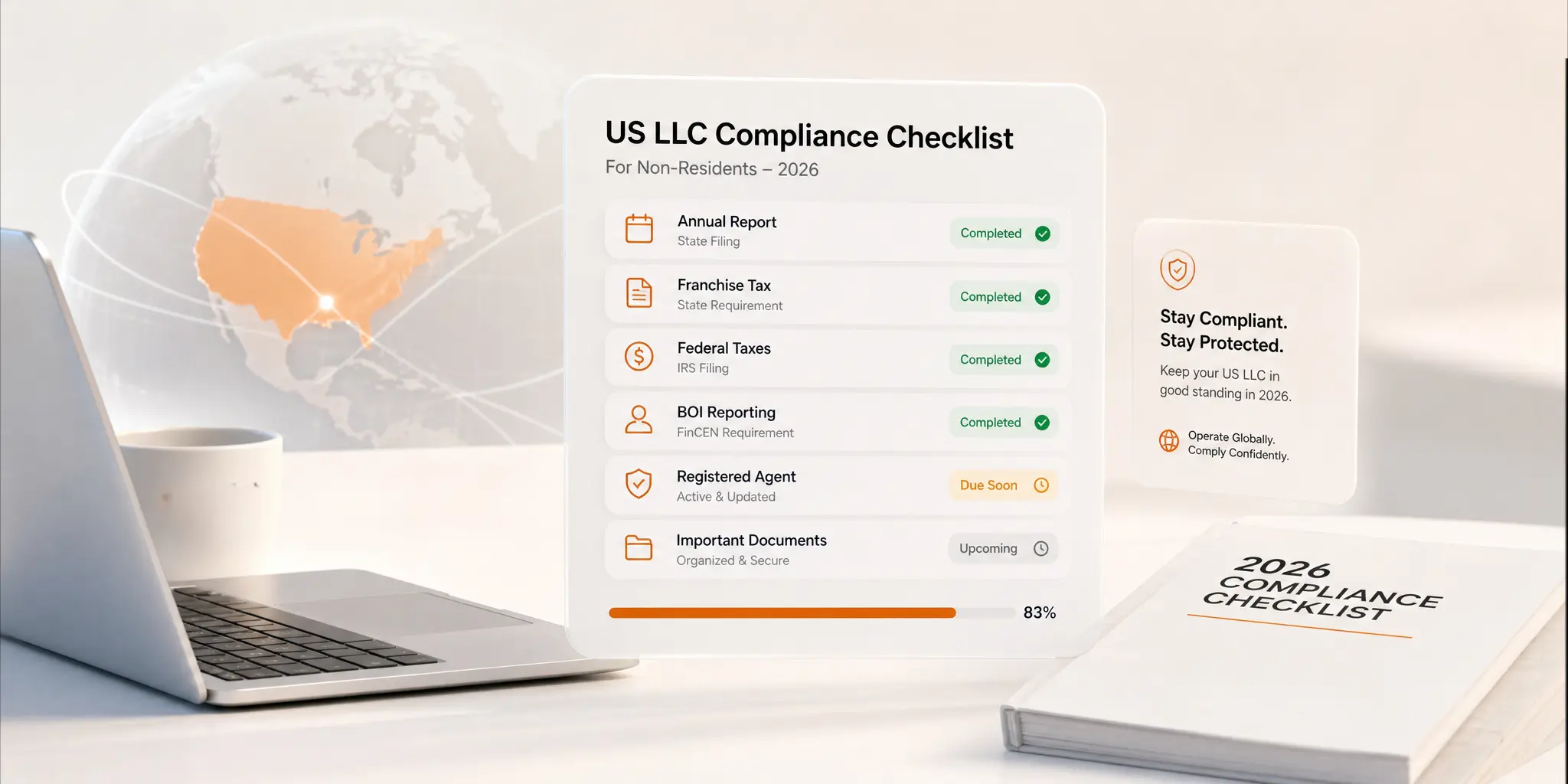
Forming your US LLC was the starting line — not the finish line. Once your LLC is active, a set of annual obligations begins. Most of them are simple. None of them are optional. And missing even one can quietly push your LLC into not-in-good-standing status, freeze your bank account, or trigger penalties that cost far more than the obligation itself.
The challenge for non-resident founders is that these obligations are scattered — split across the IRS, FinCEN, your formation state, and your registered agent. No single government agency sends you a consolidated reminder. The responsibility for tracking every deadline falls entirely on you.
This guide consolidates every annual compliance obligation for non-resident US LLC owners into one checklist — what it is, when it is due, where to file it, and what happens if you miss it. Use it every year from the date your LLC was formed.
Quick answer
What does a non-resident LLC owner need to do every year? File Form 5472 + Pro Forma 1120 with the IRS by April 15. File or update your BOI report with FinCEN. Pay your state annual report fee and file your state report by your state’s deadline. Renew your registered agent. Keep your operating agreement current. Store LLC financial records. That is the complete annual compliance picture for most non-resident single-member LLC owners.
In this guide
The 6 annual compliance pillars for non-resident LLC owners
Every non-resident US LLC owner has six categories of ongoing obligation. Miss any one of them and the consequences range from monetary penalties to losing your LLC’s active legal status. Here is the overview — each is covered in full in the sections below.
| Pillar | Obligation | Deadline | Penalty for Missing |
| 1 | Form 5472 + Pro Forma 1120 — IRS filing | April 15 every year | Minimum $25,000 per LLC per year |
| 2 | BOI Report — FinCEN filing | Within 90 days of formation, then update within 30 days of any change | Civil fines and criminal penalties |
| 3 | State Annual Report + Fee | Varies by state — typically anniversary month or fixed date | Not-in-good-standing status, administrative dissolution |
| 4 | Registered Agent renewal | Annual — before service lapses | Missed legal notices, automatic dissolution in some states |
| 5 | Operating Agreement update | As needed — when ownership, address, or business activity changes | Loss of liability protection, bank account issues |
| 6 | Financial records | Year-round — minimum 5 years retention | Inability to respond to IRS audit, inaccurate Form 5472 |
What this means for you: Think of these six pillars as your LLC’s annual health check. Set calendar reminders for every deadline the day your LLC is formed — not after the first year is already underway.
Pillar 1: IRS filings — Form 5472 and Pro Forma 1120
This is the most important and most commonly missed annual obligation for foreign-owned single-member LLCs. Every LLC that is 100% owned by a non-US person must file Form 5472 attached to a Pro Forma Form 1120 by April 15 every year — regardless of whether the LLC earned any income.
⚠ Penalty: $25,000 minimum per LLC per year. This is not a percentage of income. It is a flat penalty that applies even if your LLC had zero revenue. The IRS enforces this aggressively for foreign-owned entities.
Pillar 1 — Annual Checklist
- Record all transactions between you and your LLC throughout the year (capital contributions, distributions, payments)
- Hire a US CPA or enrolled agent with non-resident LLC experience before February
- File Form 5472 + Pro Forma 1120 by April 15 — by mail to IRS, Ogden, UT 84201-0011
- If you need more time — file Form 7004 by April 15 to extend the deadline to October 15
- Retain copies of all filed forms and supporting records for minimum 5 years
For a complete step-by-step guide to Form 5472 — including how to prepare the Pro Forma 1120, what counts as a reportable transaction, and how to handle the IRS mailing — read our US LLC taxes for non-residents guide.
Pillar 2: BOI report — FinCEN Corporate Transparency Act
The Corporate Transparency Act requires most US LLCs to file a Beneficial Ownership Information report with FinCEN — the US Financial Crimes Enforcement Network. This is a separate filing from your IRS obligations and goes to a different agency entirely.
What BOI reporting requires
Your BOI report discloses the identity of every beneficial owner of your LLC — anyone who owns 25% or more, or who exercises substantial control. For a single-member LLC, this means you.
You must provide: full legal name, date of birth, residential address, and an identifying document number — your passport number is accepted and no SSN or ITIN is required.
BOI filing deadlines
| When your LLC was formed | BOI filing deadline | Where to file |
| 2024 or later | Within 90 days of formation | FinCEN.gov |
| 2023 or earlier | Check current FinCEN guidance — rules have been subject to legal updates | FinCEN.gov |
| Any ownership or personal info change | Within 30 days of the change | FinCEN.gov — update existing report |
⚠ BOI rules have been subject to legal challenges and regulatory updates in 2025–2026. Always verify the current filing status and deadlines directly at FinCEN.gov before filing — do not rely on this guide alone for current requirements.
Pillar 2 — Annual Checklist
- File initial BOI report within 90 days of LLC formation at FinCEN.gov
- Update BOI within 30 days if your address, passport number, or ownership percentage changes
- Check FinCEN.gov annually for any rule changes or updated guidance
- Retain your BOI filing confirmation for your records
Want someone to track every compliance deadline for you?
Rocket Wave provides lifetime compliance alerts — so you never miss an annual report, Form 5472 deadline, or registered agent renewal.
550+ founders. No missed deadlines.
Pillar 3: State annual report and fee
Every state requires LLCs to file an annual report and pay a fee to remain in good standing. This is an administrative obligation — it is not a tax return — and it exists separately from your IRS obligations. The deadline, fee, and filing process vary by state.
| State | Annual Fee | Due Date | How to File |
| Wyoming | ~$60 (minimum) | 1st day of anniversary month | Wyoming Secretary of State — online |
| Delaware | ~$300 (franchise tax) | June 1 | Delaware Division of Corporations — online |
| New Mexico | $0 | No annual report required | N/A — no filing needed |
| Florida | $138.75 | May 1 | Florida Division of Corporations — online |
| Texas | Varies | May 15 | Texas Comptroller — online |
New Mexico is the only popular non-resident LLC state with no annual report requirement and no annual fee — which is why it is increasingly popular among founders who want the lowest possible ongoing costs.
What happens if you miss the state annual report
- Your LLC is placed in not-in-good-standing status
- Your registered agent may stop accepting legal service on your behalf
- Your bank may flag the status change — some banks review accounts when LLC status changes
- If the delinquency continues, the state administratively dissolves your LLC
- Reinstating a dissolved LLC requires paying all back fees plus a reinstatement fee — and in some states, filing all missed reports individually
Pillar 3 — Annual Checklist
- Know your state’s annual report due date — set a calendar reminder the day your LLC is formed
- File your annual report on the state’s official website (not third-party sites that charge unnecessary fees)
- Pay the annual fee by the due date — late fees apply in most states
- Retain the filing confirmation as proof of good standing
- Request a Certificate of Good Standing after filing if needed for banking or investor purposes
For a full state-by-state fee breakdown, read our complete guide to LLC annual fees by state.
Pillar 4: Registered agent — renewal and responsibilities
Every US LLC must maintain a registered agent — a person or service with a physical address in the formation state who is available during business hours to receive legal documents on behalf of your LLC. As a non-resident, you cannot serve as your own registered agent, which means you must use a registered agent service.
What a registered agent does
- Receives legal notices — lawsuits, subpoenas, government correspondence — on behalf of your LLC
- Receives your state’s annual report reminder notices
- Provides a physical state address for your LLC’s public registration record
- Forwards documents to you — by email or mail — so you are never caught off guard
Most registered agent services charge $50–$150 per year. Rocket Wave includes registered agent service in its LLC formation packages for the first year — after which you renew directly with the service.
What happens if your registered agent lapses
- Legal documents served to your address go undelivered — you can lose a lawsuit by default without ever knowing it was filed
- The state may place your LLC in not-in-good-standing status
- In some states, failure to maintain a registered agent results in administrative dissolution
⚠ Registered agent lapse is the most silent compliance failure. Nothing alerts you when it happens — the service simply stops accepting documents. Check your registered agent renewal date and set a reminder 60 days in advance.
Pillar 4 — Annual Checklist
- Know your registered agent renewal date — it is usually annual from your LLC formation date
- Set a 60-day advance reminder for renewal
- Pay the registered agent renewal fee before the service lapses
- If switching registered agents — file the change of registered agent form with your state before the old service lapses
- Confirm your registered agent’s contact email is current so you receive forwarded notices promptly
Pillar 5: Operating agreement — when and how to update it
Your operating agreement is your LLC’s internal governance document. Most founders create it at formation and never touch it again — which is a mistake. Banks, payment processors, and investors occasionally request an up-to-date operating agreement, and an outdated one can cause friction at exactly the wrong moment.
When to update your operating agreement
- You add a co-founder or new member to the LLC
- You change your address — home address or business address
- You change the LLC’s principal business activity
- You change ownership percentages between existing members
- You add or remove a manager in a manager-managed LLC structure
- A bank, Stripe, or investor requests a current version during onboarding
Stripe and the operating agreement
Stripe sometimes requests an operating agreement during account verification — particularly for LLCs with higher transaction volumes or when a dispute triggers a review. An operating agreement with an incorrect address or outdated member information can cause your Stripe account to be held pending reverification. Keep it current. For more on Stripe’s requirements for non-US founders, read our Stripe setup guide for non-US resident LLC owners.
Pillar 5 — Annual Checklist
- Review your operating agreement once per year — confirm all details are still accurate
- Update if any member, address, activity, or ownership detail has changed
- Date and sign the updated version — keep the old version on file as well
- Store your current operating agreement as a PDF alongside your Certificate of Formation and EIN confirmation
Pillar 6: Financial records and bookkeeping
Maintaining clean financial records is not just good practice — it is a legal requirement for Form 5472 accuracy and an essential defence in the event of an IRS audit. Non-resident founders often underestimate how important this is because their LLC may have minimal activity.
What records to keep — and for how long
| Record Type | Retention Period | Why It Matters |
| Bank statements — monthly | Minimum 5 years | Primary source for Form 5472 reportable transactions |
| Capital contribution records | Minimum 5 years | Required for Form 5472 — every contribution is a reportable transaction |
| Distribution records | Minimum 5 years | Required for Form 5472 — every distribution is a reportable transaction |
| Filed tax forms (Form 5472, 1120) | Minimum 5 years | Proof of compliance — requested in any IRS audit |
| Invoices and contracts | Minimum 5 years | Supports income and expense claims, demonstrates business legitimacy |
| BOI filing confirmations | Indefinitely | Proof of FinCEN compliance |
| State annual report confirmations | Indefinitely | Proof of good standing history |
| Operating agreement versions | Indefinitely | Corporate governance record |
Recommended bookkeeping setup for non-resident founders
- Option 1 — Spreadsheet (minimum viable): Maintain a simple Google Sheet with monthly income, expenses, capital contributions, and distributions. Download bank statements monthly. Sufficient for low-activity LLCs.
- Option 2 — Accounting software (recommended): Wave Accounting (free) or QuickBooks Online connects directly to your Mercury or Relay bank account and categorises transactions automatically. Generates the reports your CPA needs to file Form 5472 quickly and accurately.
- Option 3 — Bookkeeper (for active LLCs): If your LLC has regular revenue, hire a remote bookkeeper who works in USD — $100–$300 per month for basic monthly bookkeeping is standard. It makes CPA fees lower, tax filings cleaner, and audits far less stressful.
What this means for you: The #1 reason Form 5472 filings get delayed or contain errors is incomplete records of transactions between the founder and the LLC. Download your bank statements every month — do not rely on logging in once a year to reconstruct the full year.
Pillar 6 — Annual Checklist
- Download monthly bank statements from Mercury or Relay — do not wait until tax season
- Record all capital contributions and distributions in your bookkeeping system
- Reconcile your bank accounts monthly — flag any unexplained transactions
- Organise all invoices and contracts in a folder (Google Drive or Dropbox) labelled by tax year
- At year end — prepare a full transaction summary for your CPA before January 31
- Retain all records for minimum 5 years in a cloud storage system accessible from anywhere
What happens if your LLC falls out of good standing
Good standing means your LLC has met all of its obligations to the state where it is registered — annual reports filed, fees paid, registered agent in place. Falling out of good standing triggers a chain of consequences that compounds quickly.
| Stage | What Happens | How to Fix It |
| Not in good standing | State flags your LLC — registered agent may stop service, Certificate of Good Standing requests are rejected | File overdue annual report and pay outstanding fees — plus late fee |
| Administrative dissolution | State terminates your LLC’s legal existence | File reinstatement petition + pay all back fees + reinstatement fee (varies by state, $100–$500+) |
| Bank account review | Mercury, Relay, or Stripe may flag the status change — account holds are possible | Restore good standing first, then provide updated Certificate of Good Standing to the bank |
| EIN still active | Your EIN remains valid even if your LLC is dissolved | Reinstate the LLC before attempting to resume business activity |
| Missed legal notice | A lawsuit or government notice served to your registered agent went undelivered | Contact an attorney immediately — missed legal deadlines have serious consequences |
⚠ Reinstating a dissolved LLC is not always possible. Some states have time limits on reinstatement. If your LLC was administratively dissolved for several years, you may need to form a new LLC and transfer assets — losing your original formation date, EIN, and banking history.
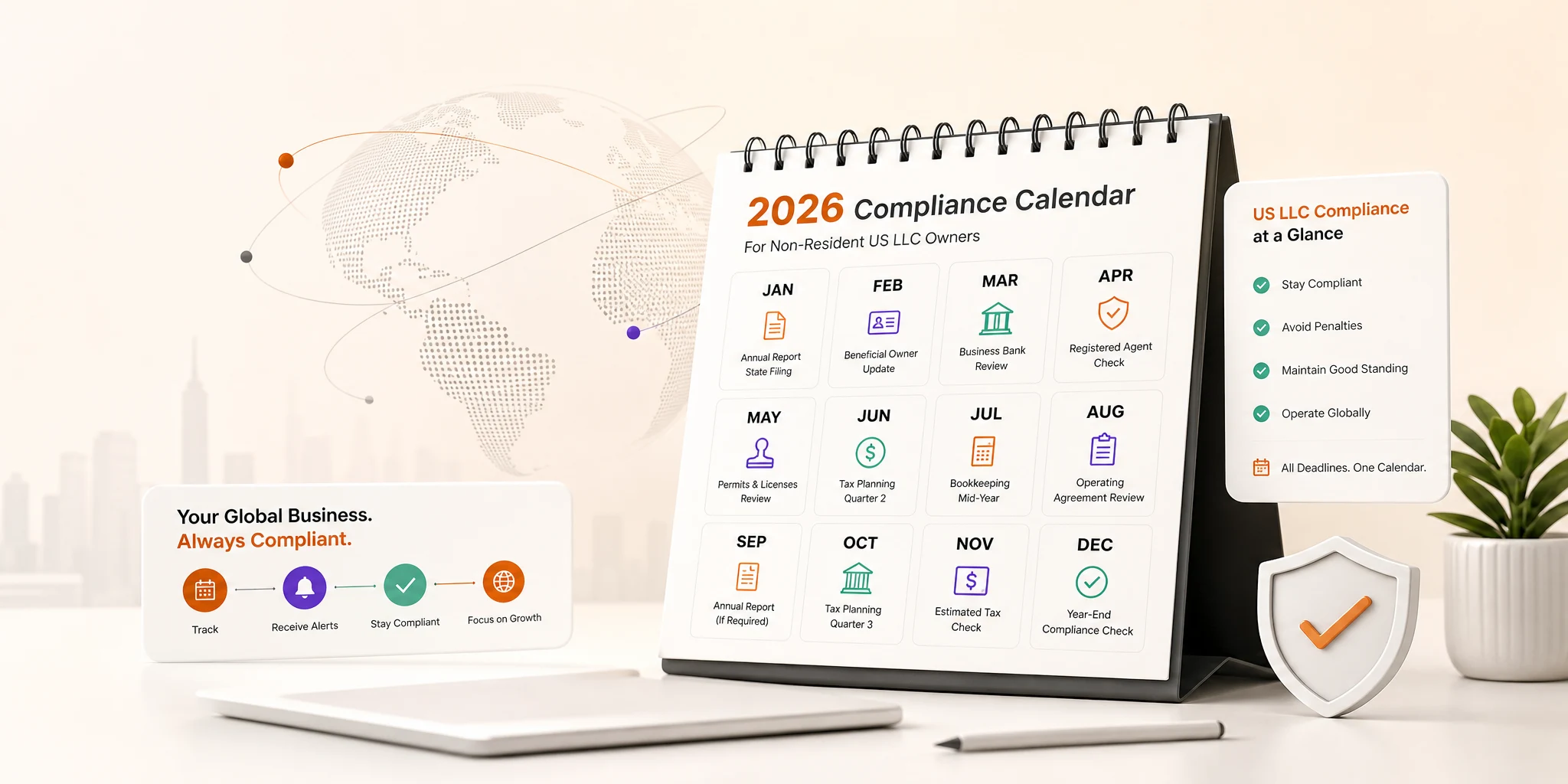
Complete annual compliance calendar for non-resident LLC owners
Set these reminders from the day your LLC is formed. Review this calendar at the start of every calendar year.
| When | Action | Applies To | Where |
| Day LLC is formed | File BOI report within 90 days — start the clock today | All new LLCs (2024+) | FinCEN.gov |
| Day LLC is formed | Set April 15 reminder for Form 5472 + Pro Forma 1120 | All foreign-owned single-member LLCs | IRS — mail to Ogden, UT |
| Day LLC is formed | Note your state annual report due date and set reminder | All LLCs (except New Mexico) | Your formation state’s website |
| January | Compile full-year transaction records — prepare CPA handoff document | All foreign-owned LLCs | Your bookkeeping system |
| February | Engage CPA / enrolled agent for Form 5472 preparation | All foreign-owned LLCs | Your accountant |
| April 15 | File Form 5472 + Pro Forma 1120 — OR file Form 7004 extension | All foreign-owned single-member LLCs | IRS — mail |
| May 1 | Florida LLC annual report due | Florida LLCs | Florida Division of Corporations |
| June 1 | Delaware LLC annual report + franchise tax due | Delaware LLCs | Delaware Division of Corporations |
| Anniversary month (1st) | Wyoming LLC annual report + ~$60 fee due | Wyoming LLCs | Wyoming Secretary of State |
| 60 days before renewal | Registered agent renewal — check and pay before lapse | All LLCs | Your registered agent service |
| October 15 | Extended Form 5472 deadline (if Form 7004 was filed) | LLCs that filed for extension | IRS — mail |
| Year-round | Update BOI within 30 days of any change | All LLCs with BOI on file | FinCEN.gov |
| Year-round | Download monthly bank statements | All active LLCs | Mercury / Relay / your bank |
| Annual review | Review and update operating agreement if anything has changed | All LLCs | Internal — signed and dated |
Frequently asked questions
How can international founders manage US LLC compliance remotely?
All six compliance pillars can be managed entirely remotely. IRS Form 5472 is mailed — no in-person visit required. BOI is filed online at FinCEN.gov. State annual reports are filed online for all major formation states. Registered agent services operate remotely and forward documents by email. The only thing you need is a reminder system, a CPA with non-resident experience, and a registered agent service — all of which can be arranged from outside the US.
What is the cheapest US state for ongoing LLC compliance?
New Mexico has zero annual state fee and no annual report requirement — making it the lowest ongoing cost of any popular formation state. Wyoming is the next best option at approximately $60 per year with a straightforward annual report. For the full comparison, read our Wyoming vs Delaware vs New Mexico state comparison.
Do I need to file Form 5472 if my LLC had no revenue?
Yes — if there was at least one reportable transaction. A capital contribution — the money you put in to open the bank account — is a reportable transaction. Most LLCs have at least one reportable transaction per year. The only situation where Form 5472 may not be required is if there were genuinely zero transactions between you and the LLC in the entire tax year — which is rare for any active entity.
What is a Certificate of Good Standing and when do I need one?
A Certificate of Good Standing is an official state document confirming your LLC has met all its state obligations. Banks, investors, and some government agencies may request it. You can request one from your formation state’s website — typically for a small fee ($10–$50). It is only issued if your LLC is current on all annual reports and fees.
Can my LLC lose its EIN if it is dissolved?
No — your EIN is permanent and is never cancelled or reissued, even if your LLC is dissolved. However, if your LLC is dissolved, you cannot use it to conduct business or open new bank accounts. Reinstate your LLC first, then your EIN resumes its active function. See our EIN guide for non-residents for more on EIN management.
Does Rocket Wave help with ongoing compliance after LLC formation?
Yes. Rocket Wave provides lifetime compliance alerts — reminders for annual state reports, registered agent renewals, and Form 5472 deadlines — as part of every LLC formation package. We also connect founders with CPA partners who specialise in non-resident LLC filings for Form 5472 and annual compliance at competitive rates.
Keep your US LLC compliant from anywhere in the world.
Rocket Wave provides lifetime compliance alerts, registered agent service, and connections to non-resident CPA specialists — so every deadline is tracked and nothing falls through the cracks.
550+ non-resident founders. No dissolved LLCs. No missed filings.
Legal Disclaimer: This guide is for informational purposes only and does not constitute legal or tax advice. Compliance requirements, fees, and deadlines vary by state and are subject to change. BOI reporting rules under the Corporate Transparency Act have been subject to ongoing legal challenges — always verify current requirements at FinCEN.gov. Always consult a qualified US attorney, CPA, or enrolled agent for advice specific to your circumstances.