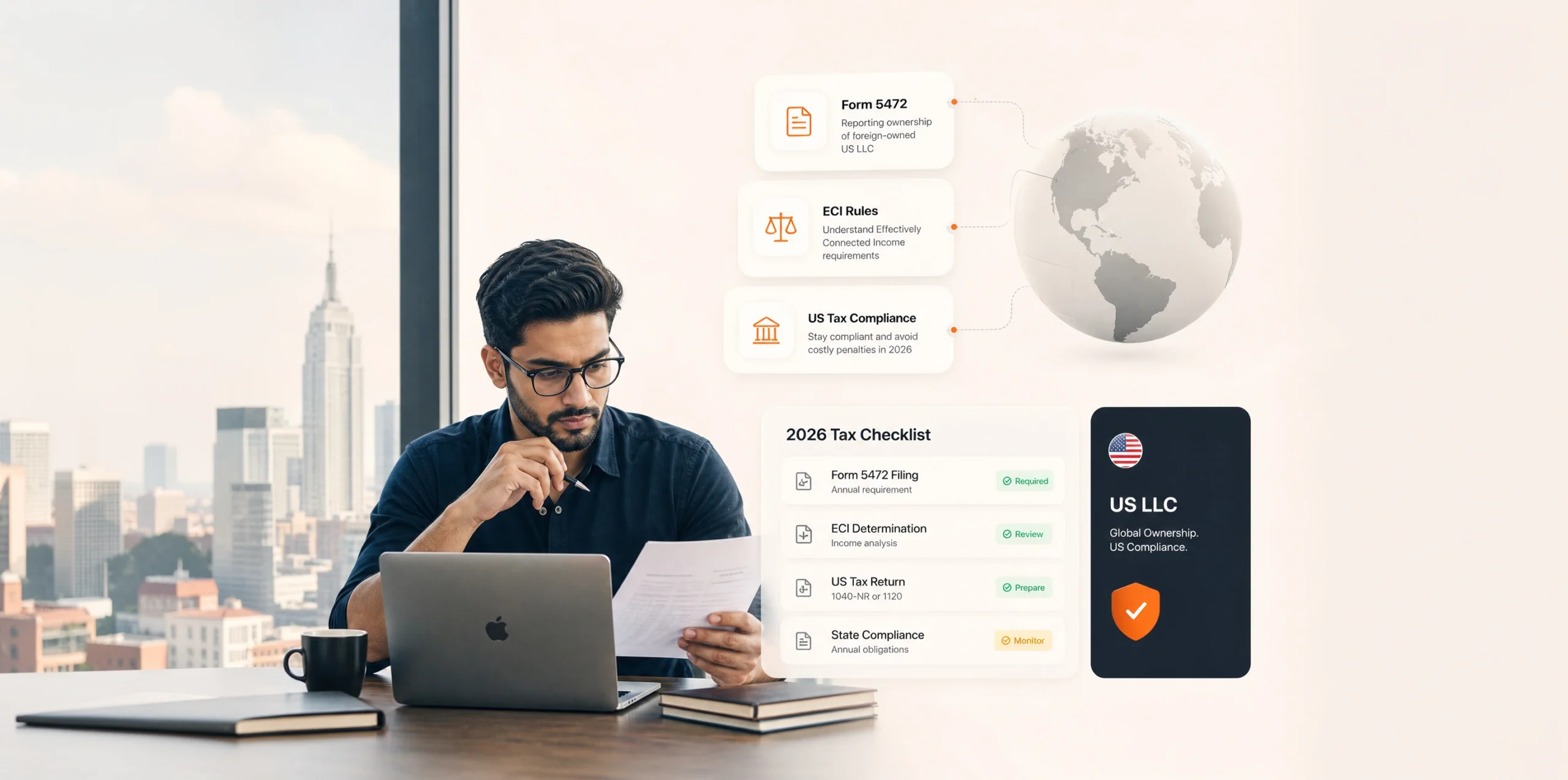
The most common question we get from non-resident LLC owners, right after the bank account is open: do I actually owe US tax?
The short answer is: probably yes but maybe not — but you do have to mandatorily file as per tax obligations, and missing them can carry a $25,000 in penalties, per year. Even if your LLC has earned nothing.
This is the part of US LLC ownership that surprises non-resident founders the most. You can owe zero US federal income tax and still be required to file paperwork with the IRS every April. Understanding the difference between owing tax and being required to file is the single most important thing in this guide.
This post covers the full picture — what Effectively Connected Income (ECI) is and why it determines your tax position, the Form 5472 filing obligation that applies to almost every foreign-owned single-member LLC, BOI reporting under the Corporate Transparency Act, state-level annual fees, and the five filing mistakes that cost non-resident founders thousands of dollars every year.
Written from the experience of helping 500+ global founders stay compliant from Bangladesh, UAE, India, Pakistan, Nigeria, and beyond.
Important notice: This guide is for informational purposes only. US tax law is complex and your situation depends on your country of residence, business type, income sources, and applicable tax treaties. Always consult a qualified US tax professional — a CPA or enrolled agent with non-resident LLC experience — for advice specific to your circumstances.
Quick answer
Do non-US residents owe US tax on LLC income? Most non-residents running online businesses with no US physical presence, no US employees, and no US customers do not owe US federal income tax on LLC income. However, every foreign-owned single-member LLC must file Form 5472 with a Pro Forma 1120 by April 15 every year — regardless of whether any tax is owed. Missing this filing carries a minimum $25,000 penalty.
In this guide
How the US taxes non-resident LLC owners: the two categories
The IRS divides income that could potentially be taxable for a non-resident into two categories. Which category your LLC’s income falls into determines whether you owe US federal income tax.
| Category | What it is | When it applies to you |
|---|---|---|
| Effectively Connected Income (ECI) | Income that is directly connected to a US trade or business | You have a US office, US employees, US-based operations, or you regularly provide services physically inside the US |
| FDAP Income | Fixed, Determinable, Annual, or Periodical income from US sources — dividends, interest, royalties, rents | You receive passive income sourced from inside the US — US bank interest, US rental income, US-sourced royalties |
| Neither — no US tax owed | Income with no US connection | You run a fully remote online business with no US physical presence, no US employees, and no US-based clients or operations |
For most non-resident founders running digital businesses — SaaS products, agencies, e-commerce stores, consulting services, freelancing — income falls into the third category. Your LLC income is not ECI and not FDAP, which means no US federal income tax is owed on it.
What this means for you: The critical word is ‘sourced’. Where your customers are does not determine where income is sourced. What determines it is where the business activity that generates the income takes place. For a non-resident running a digital agency from Dhaka with no US office or employees, the income is not US-sourced — even if US clients pay you.
Effectively Connected Income (ECI): what it is and when it applies
ECI is income that is treated as effectively connected to conducting a trade or business within the United States. If your LLC has ECI, that income is taxed at regular US graduated tax rates — the same rates that apply to US residents.
The IRS uses two tests to determine whether income is ECI:
The Asset-Use Test: Is the income derived from assets used in, or held for use in, the conduct of a US trade or business? For example: a US-based server that generates rental income, a US property, or US-based intellectual property generating royalties.
The Business Activities Test: Were the activities of the US trade or business a material factor in the realisation of the income? For example: income generated from sales made by US-based sales staff, or services performed by employees physically located in the US.
When most non-resident digital founders do NOT have ECI
- You have no US office, co-working space, or physical business address
- You have no US-based employees, contractors, or agents making sales on your behalf
- You do not regularly travel to the US to conduct business
- Your services are performed entirely outside the US
- Your LLC’s income comes from digital products, online services, or e-commerce fulfilled from outside the US
When non-resident founders MAY have ECI
- You have a US-based employee or agent regularly acting on your behalf
- You rent a US office or maintain a regular place of business in the US
- You regularly travel to the US for extended periods to conduct business
- You provide professional services physically inside the US
What this means for you: If you are unsure whether your LLC has ECI, consult a US CPA with non-resident experience before filing season. Getting this wrong in either direction is costly — either paying tax you don’t owe, or missing a filing you’re required to make.
FDAP income: the other US tax category non-residents should know
FDAP stands for Fixed, Determinable, Annual, or Periodical income. This category covers passive income that originates from US sources — and it is taxed differently from ECI.
FDAP income is taxed at a flat 30% withholding rate on the gross amount — unless a tax treaty between your home country and the US reduces this rate. The payer of FDAP income (a US company paying you dividends, for example) is generally responsible for withholding and remitting this tax to the IRS.
Common types of FDAP income that could affect a non-resident LLC owner:
- Interest income from a US bank account (though most banks withhold automatically)
- Dividends from US-based investments held by the LLC
- Royalties from US-based intellectual property
- US-source rental income
What this means for you: For most non-resident digital founders, FDAP is not a concern because their LLC is not holding US investments, US real estate, or US-sourced intellectual property. If your LLC does have US-source passive income, work with a CPA to ensure withholding obligations are met.
Form 5472: the annual filing every foreign-owned LLC must make
This is the filing that catches non-resident founders off guard. Even if your LLC has zero US tax liability — even if it earned nothing at all — if it is a foreign-owned single-member LLC, you are required to file Form 5472 with a Pro Forma Form 1120 every year by April 15.
⚠ Penalty for missing Form 5472: Minimum $25,000 per year, per LLC. This is not a percentage of income. It is a flat penalty that applies regardless of whether your LLC earned anything. There is no grace period and the IRS enforces this aggressively.
What is Form 5472?
Form 5472 is the Information Return of a 25% Foreign-Owned US Corporation or a Foreign Corporation Engaged in a US Trade or Business. For non-resident owners of single-member LLCs, it reports all reportable transactions between the LLC and its foreign owner. You can read the official Form 5472 guidance on the IRS website.
Who must file Form 5472?
- Any US LLC that is 100% owned by a foreign national (non-US person)
- The LLC is treated as a disregarded entity for US tax purposes (the standard classification for a single-member LLC)
- There was at least one reportable transaction between the LLC and its foreign owner during the year
A reportable transaction includes any transfer of money or property between you and your LLC — including capital contributions (money you put into the LLC), distributions (money you take out), and payments for services. In practice, almost every active LLC has at least one reportable transaction per year.
How to file Form 5472
Step 1 — Prepare a Pro Forma Form 1120. Form 5472 cannot be filed on its own. It must be attached to a Pro Forma (skeleton) Form 1120, even though a disregarded entity LLC does not normally file Form 1120. The Pro Forma 1120 simply provides the entity information header for the submission.
Step 2 — Complete Form 5472. Report all reportable transactions: capital contributions, distributions, loans, and payments between you and your LLC during the tax year.
Step 3 — File by April 15. The combined Form 5472 + Pro Forma 1120 is filed by mail — it cannot be e-filed. Address: Department of the Treasury, Internal Revenue Service, Ogden, UT 84201-0011. If you need an extension, file Form 7004 by April 15 to get a 6-month extension to October 15.
Step 4 — Keep records. Retain copies of all filed forms and all supporting records of transactions for at least 5 years.
What this means for you: Most non-resident founders use a US CPA or enrolled agent to prepare and file Form 5472. Fees typically range from $150–$400 per year — far less than the $25,000 penalty for missing it. Build this into your annual budget from year one.
Don’t want to navigate US tax filings alone?
Rocket Wave connects you with US compliance specialists who handle Form 5472, Pro Forma 1120, and annual state reports for non-resident LLC owners — so nothing gets missed.
500+ founders. 30+ countries. No missed filings.
BOI filing: the Corporate Transparency Act obligation
Separate from your IRS tax obligations, non-resident LLC owners must also comply with the Corporate Transparency Act — a US law that requires most LLCs to report their beneficial ownership information to FinCEN (the Financial Crimes Enforcement Network).
What is BOI reporting?
Beneficial Ownership Information (BOI) reporting requires your LLC to disclose who owns and controls it — name, date of birth, address, and an identifying document number (such as a passport number) for each beneficial owner.
This is not filed with the IRS — it is filed separately with FinCEN. Always verify the current BOI requirements directly at FinCEN.gov before filing, as the rules and deadlines have been subject to legal challenges and regulatory updates in 2025–2026.
Key BOI filing rules for non-resident LLC owners
- Most US LLCs must file a BOI report — there is no exemption for non-resident ownership
- Your passport can be used as the identifying document — no SSN or ITIN required
- You must update your BOI report within 30 days if any ownership information changes
- Penalties for non-compliance can include civil fines and criminal charges
⚠ BOI requirements are subject to ongoing legal and regulatory changes. Do not rely on this guide alone for current deadlines and filing status — check FinCEN.gov directly before filing.
What this means for you: BOI filing is separate from your IRS filings — it is easy to overlook because it goes to a different agency. And as there is no compliance for BOIR, your calendar may not have it marked along Form 5472’s deadline.
State-level annual fees and reports
Beyond IRS filings, your LLC has an annual obligation to the state where it was formed. These are administrative fees — not income taxes — and they are required to keep your LLC in good standing.
| State | Annual Fee | Annual Report Required | Notes |
|---|---|---|---|
| Wyoming | ~$60/year | Yes — due by the 1st day of the anniversary month | Lowest ongoing cost — ideal for most non-resident founders |
| Delaware | ~$300/year (franchise tax) | Yes — due by June 1 (LLCs) | Higher cost — worth it only if you are raising VC capital |
| New Mexico | $0/year | No annual report required | Lowest overall cost — no ongoing state fee or report |
| Florida | $138.75/year | Yes — due May 1 | Relevant if you chose Florida for banking or proximity reasons |
| Wyoming (foreign qualified) | $100+ filing + $60/year | Yes | Only if you registered your Wyoming LLC in a second state |
Missing your annual state report or fee payment puts your LLC into “not in good standing” status, which can result in administrative dissolution — meaning your LLC is no longer legally active. If dissolved, you lose your EIN’s active status and your registered agent stops accepting service on your behalf.
For a full breakdown of fees across all 50 states, read our complete state-by-state LLC annual fees guide.
What this means for you: Set a calendar reminder for your state annual report due date the day your LLC is formed. Missing it is the most avoidable compliance failure — and reinstating a dissolved LLC costs significantly more than the original annual fee.
Tax treaties: do they help non-resident LLC owners?
The US has tax treaties with many countries that can reduce or eliminate withholding tax on certain types of income. However, for most non-resident founders running digital businesses with no ECI, tax treaties are not particularly relevant — because there is no US income tax to reduce in the first place.
Where tax treaties do matter for non-resident LLC owners:
- If your LLC receives FDAP income (dividends, interest, royalties from US sources) — a treaty may reduce the 30% withholding rate
- If your LLC has ECI — a treaty may affect how that income is taxed
- If you personally receive income from a US source as an individual — treaty benefits can apply to your personal tax situation
Bangladesh, India, Pakistan, UAE, Nigeria, and most Southeast Asian countries each have different treaty positions with the US. The UAE notably has no income tax treaty with the US. Bangladesh has a limited treaty. Always verify your specific country’s treaty status with a qualified tax advisor.
What this means for you: Do not assume a tax treaty eliminates all US filing obligations. Even with a treaty position, Form 5472 and BOI filing requirements remain. A treaty affects how income is taxed — not whether you need to file.
5 filing mistakes that cost non-residents thousands
Mistake 1 — Missing Form 5472 entirely. The most common and most expensive mistake. Many non-resident founders form their LLC, open their bank account, and never hear about Form 5472 — until the IRS sends them a $25,000 penalty notice. The filing is not optional and it is not well-publicised. Set a reminder for April 15 every year from the year your LLC is formed.
Mistake 2 — Assuming ‘no income = no filing required’. Wrong. Form 5472 must be filed even if your LLC had zero revenue and zero transactions. A capital contribution — the money you put in to open the bank account — is a reportable transaction. Almost no active LLC has zero reportable transactions.
Mistake 3 — Filing Form 5472 without the Pro Forma 1120. Form 5472 cannot be submitted on its own. It must be attached to a Pro Forma Form 1120 as a cover document. Filing 5472 alone without the 1120 results in the filing being rejected and treated as unfiled — triggering the penalty.
Mistake 4 — Missing the state annual report deadline. Every state has a different due date. Wyoming’s is the anniversary month. Delaware’s is June 1. Florida’s is May 1. Missing these puts your LLC into not-in-good-standing status, which can cascade into banking issues, Stripe account reviews, and eventual administrative dissolution.
Mistake 5 — Not updating BOI when ownership or personal information changes. You have 30 days to update your BOI report after any change — a new address, a new passport number, a change in ownership percentage. Non-compliance penalties apply from day 31.
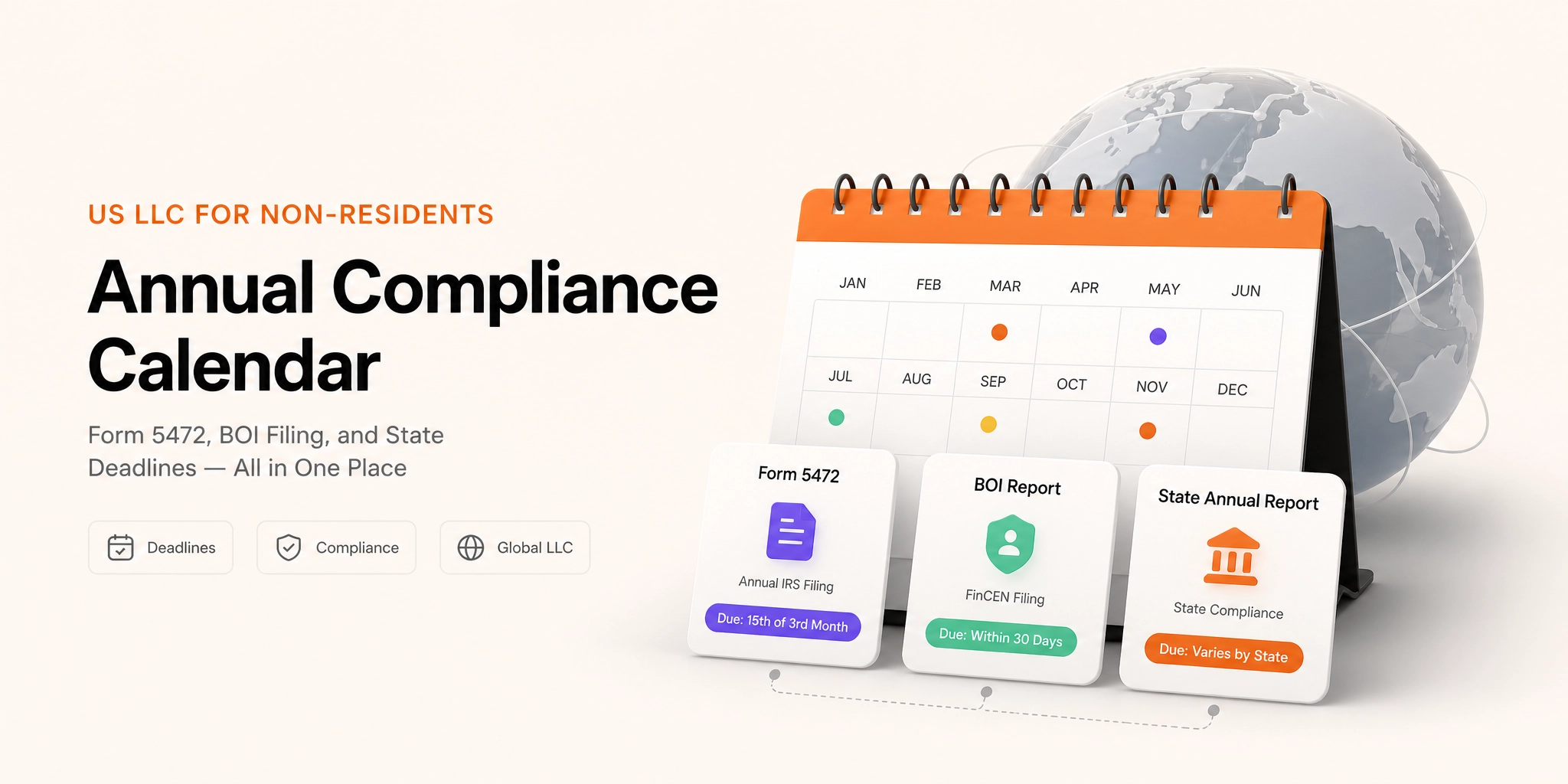
Annual compliance calendar for non-resident LLC owners
Use this calendar to set annual reminders from the day your LLC is formed. Every item here is mandatory — not optional.
| Deadline | Filing / Obligation | Who It Applies To | Where to File |
|---|---|---|---|
| January 1 | BOI report — new LLCs formed in 2024+ must file within 90 days of formation | All new US LLCs | FinCEN.gov |
| April 15 | Form 5472 + Pro Forma 1120 | All foreign-owned single-member LLCs | IRS — by mail (Ogden, UT) |
| April 15 | Form 7004 — if you need an extension on Form 5472 | Any LLC that cannot file by April 15 | IRS |
| May 1 | Florida LLC annual report (if formed in Florida) | Florida LLCs | Florida Division of Corporations |
| June 1 | Delaware LLC annual report + franchise tax | Delaware LLCs | Delaware Division of Corporations |
| Anniversary month (1st day) | Wyoming LLC annual report + ~$60 fee | Wyoming LLCs | Wyoming Secretary of State |
| Within 30 days of any change | BOI update — new address, new passport, ownership change | All US LLCs with BOI on file | FinCEN.gov |
| October 15 | Extended Form 5472 deadline (if Form 7004 was filed) | LLCs that filed for extension | IRS — by mail |
| Year-round | Keep records of all LLC transactions for Form 5472 reporting | All foreign-owned single-member LLCs | Your own records — minimum 5 years |
For more detail on every compliance obligation — including registered agent renewal, operating agreement updates, and EIN maintenance — read our complete US LLC compliance guide for non-residents.
Non-resident LLC tax and compliance checklist
Use this annually. Start from the day your LLC is formed.
- Determine ECI status — does your business have any US physical presence, employees, or US-based operations?
- Determine FDAP exposure — does your LLC receive passive income from US sources?
- Set April 15 reminder for Form 5472 + Pro Forma 1120 filing
- Hire a US CPA or enrolled agent with non-resident LLC experience
- Record all transactions between you and your LLC throughout the year (capital contributions, distributions, payments)
- File BOI report within 90 days of LLC formation at FinCEN.gov
- Update BOI within 30 days of any ownership or personal information change
- Pay annual state report fee and file annual report by state deadline
- Renew registered agent service before it lapses
- Download and file LLC bank statements annually for tax record purposes
- If income position changes — consult CPA before next filing season
Frequently asked questions
Do I owe US income tax if my LLC earns money from non-US clients?
What happens if I miss the Form 5472 deadline?
Do I need a US Social Security Number to file Form 5472?
Is Wyoming better than Delaware for non-resident tax purposes?
What is the difference between Form 5472 and Form 1120?
Can I file Form 5472 myself or do I need a CPA?
Does my LLC need to pay quarterly estimated taxes?
Ready to form your US LLC and stay compliant from day one?
Rocket Wave handles your complete US business setup — LLC formation, EIN application, Operating Agreement, bank account guidance, and connections to compliance specialists for Form 5472 and annual filings.
500+ non-resident founders across 30+ countries. No hidden fees. No missed deadlines. No trips to the US.
Legal Disclaimer: This guide is for informational purposes only and does not constitute legal or tax advice. US tax law is complex and your obligations depend on your specific situation, country of residence, income sources, business structure, and applicable tax treaties. Form 5472 requirements, BOI filing rules, and penalty structures are subject to change — always verify current details at irs.gov and fincen.gov. Always consult a qualified US CPA, enrolled agent, or tax attorney for advice specific to your circumstances.