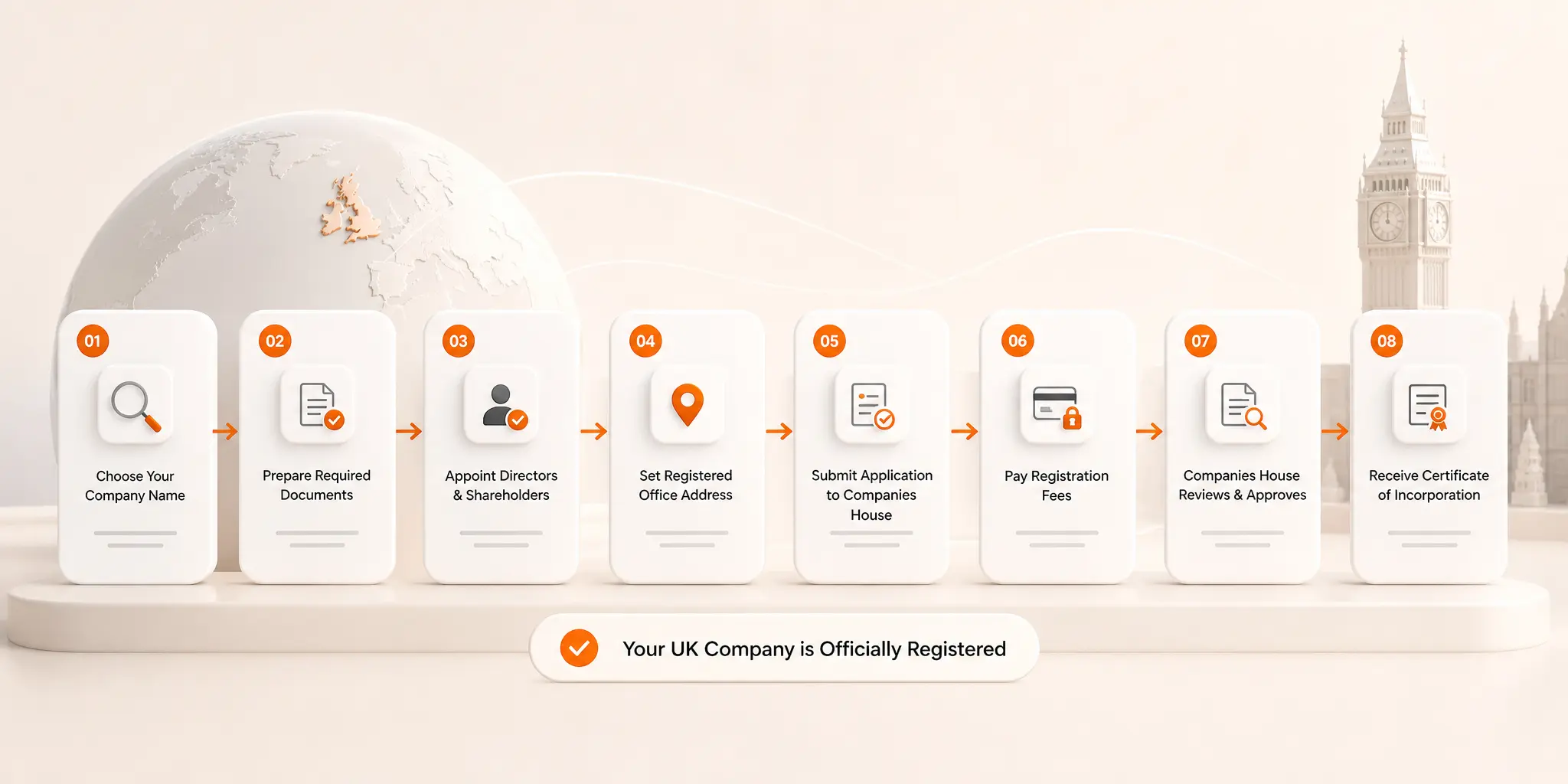
Registering a UK limited company as a non-resident takes 24 hours and starts from $299 in formation cost. The process is fully remote. No UK address, no UK bank account, no UK visit required before you start. And the resulting entity is one of the most commercially credible structures available to a global founder.
But the process has specific steps that trip up non-residents, particularly around identity verification under the UK’s Economic Crime Act, the registered office requirement, and what happens in the 14 days after incorporation when your UTR arrives. This guide covers every step, in the exact order you need to complete it.
Written from the experience of helping 150+ founders form UK LTDs from all around the world, without a single trip to London.
Quick answer
How long does UK LTD registration take for a non-resident? The Companies House registration itself takes 24 hours once submitted. Before submitting, you need to arrange a UK registered office address, which can be done the same day, and prepare your director and shareholder information, roughly 30 minutes. After registration, allow 14 days for your UTR to arrive by post. Total time from decision to operational is typically 2 to 3 weeks.
In this guide
Can a non-UK resident register a UK LTD?
Yes, fully. There is no requirement for any director, shareholder, or person with significant control (PSC) to be a UK citizen or UK resident. You can be based in Bangladesh, India, UAE, Nigeria, or anywhere else in the world and register a UK LTD without a UK visa, UK bank account, or UK visit.
The UK Companies Act 2006 allows foreign nationals to incorporate and operate UK private limited companies. The only UK-based requirement is a registered office address, but this can be fulfilled by a registered office service, not by you personally.
| Requirement | Non-resident position |
| UK citizenship or residency | Not required. Any nationality is fine |
| UK visa | Not required for registration, only if you physically visit the UK for business |
| UK bank account | Not required before registration. Open after incorporation |
| Physical UK presence | Not required. The entire process is remote |
| UK registered office address | Required. Fulfilled by a registered office service or formation agent |
| Identity verification | Required. Completed remotely via a formation agent under the Economic Crime Act |
| Minimum share capital | £1, or even lower. No minimum threshold |
| Minimum age | 16 years old for directors |
What this means for you: The UK is one of the most non-resident-accessible jurisdictions in the world for company formation. The entire barrier to entry is a registered office address, and that costs roughly $30 to $100 per year to arrange.
What you need before starting, the pre-registration checklist
Have all of this ready before you sit down to fill in the Companies House application. The application itself is fast. The preparation takes longer.
Pre-registration checklist
- Proposed company name, checked for availability on Companies House
- UK registered office address, arranged via formation agent or virtual office service
- Director details: full legal name, date of birth, nationality, home address, occupation
- Shareholder details: name, address, number of shares, share value
- SIC code, identified from the Companies House SIC list
- Valid passport, clear scan ready for identity verification
- Decision on share structure: how many shares, what value, who holds them
- Articles of association: model articles are fine for most companies
Step 1: Choose and check your company name
Your company name must be unique, must end in Limited or Ltd, and must not contain restricted or sensitive words without permission. This is the step most founders rush, and the one that causes the most delays.
Name availability check
Search your proposed name on the Companies House company name availability checker. An exact match, or a name deemed too similar to an existing company, will be rejected. Too similar includes swapping Ltd for Limited, adding The at the start, or using common punctuation variants.
Restricted and sensitive words
- Restricted words requiring approval: British, National, Royal, International, Group, Association, Institute
- Sensitive words requiring evidence: Bank, Insurance, Trust, University, Charity
- Words implying a government connection are prohibited without explicit authorisation
Trademark check
A name that is available on Companies House can still infringe a registered trademark. Run a quick search on the UK Intellectual Property Office trademark database before committing. For international founders building a brand, this check is not optional.
What this means for you: The name you register on Companies House becomes the legal name of your company. It appears on all HMRC correspondence, bank applications, contracts, and your Companies House public profile. Choose deliberately.
Step 2: Set up a UK registered office address
Every UK LTD must have a registered office, a physical UK address that can receive official correspondence from HMRC, Companies House, and courts. As a non-resident, you cannot use your home country address. Your options are:
| Option | Cost | Best for |
| Formation agent registered office | $30 to $100 per year | Most non-residents. Often included in formation packages |
| Virtual office service | $100 to $300 per year | Founders wanting a prestigious UK address and mail scanning |
| UK friend, family, or contact | Free | If you have a trusted UK-based contact. Note it becomes public |
| Solicitor or accountant address | $100 to $300 per year | Founders with an existing UK professional relationship |
The registered office address becomes publicly visible on Companies House. It does not need to be a place where you actually work. It only needs to be a UK address that can receive and forward official mail. For most non-residents, the formation agent’s address is the standard and most practical option.
⚠ Your registered office must be in the same country as your incorporation. A company incorporated in England and Wales must have its registered office in England or Wales. Scotland and Northern Ireland are separate. Most formation agents default to an England and Wales address. Confirm this is what you want before proceeding.
Step 3: Prepare your director and shareholder information
You’ll need to provide the following for each director and each shareholder (PSC). As the sole founder, you typically fill this in once, for yourself.
Director information required
- Full legal name, exactly as on passport
- Date of birth. Month and year are shown publicly. The full date is held by Companies House
- Nationality
- Country of residence
- Service address. You can use the company’s registered office address to keep your home address private
- Residential address. Required by Companies House but can be kept private if you use a service address
- Occupation
Shareholder / PSC information required
- Full legal name
- Address
- Nature of control, for example owning more than 25 percent of shares or holding voting rights
- Number of shares held and share class (Ordinary is standard)
- Date became a PSC
Share structure for non-resident sole founders
For a single founder company, the simplest and most common structure is:
- One class of shares: Ordinary shares
- 100 shares issued at £0.01 each, total paid-up capital £1.00
- All 100 shares held by you, giving you 100 percent ownership
What this means for you: You do not need to issue all authorised shares at formation. Most non-resident founders issue 100 shares at formation and leave room to issue more to future co-founders or investors without reforming the company.
Step 4: Choose your SIC code
A Standard Industrial Classification (SIC) code describes what your business does. Companies House uses it for statistical classification. It does not affect your taxes or legal status. You can list up to four SIC codes, and you can change them later via a confirmation statement. Find the full list at the Companies House SIC code reference.
| Business type | SIC code | Description |
| Software / app development | 62012 | Business and domestic software development |
| Digital marketing agency | 73110 | Advertising agencies |
| Management consulting | 70229 | Management consultancy activities not elsewhere classified |
| E-commerce / online retail | 47910 | Retail sale via mail order houses or via internet |
| IT consulting | 62020 | Information technology consultancy activities |
| Content creation / media | 59200 | Sound recording and music publishing activities |
| Financial services (general) | 64999 | Other financial service activities except insurance and pension funding |
| Recruitment / HR | 78109 | Other activities of employment placement agencies |
What this means for you: If your business spans multiple categories, choose the one that represents your primary revenue source as your first SIC code. Add secondary codes if genuinely relevant, not just to signal breadth.
Step 5: Complete identity verification under the Economic Crime Act
This is the step that changed most significantly in 2024 and 2025. Under the UK Economic Crime and Corporate Transparency Act, Companies House now requires identity verification for all directors and persons with significant control (PSCs) at or shortly after incorporation.
What identity verification involves
- Photo ID, your valid passport (preferred) or national identity card
- A facial recognition check, a live selfie matched to your ID document
- Completed either directly through Companies House’s system or via an Authorised Corporate Service Provider (ACSP) such as a formation agent
How non-residents complete identity verification
Non-residents cannot always complete the Companies House direct ID verification if their document is not supported by the system. The practical route is to use a formation agent. Rocket Wave and similar services are registered as ACSPs and complete identity verification on your behalf as part of the formation process.
⚠ Identity verification is now mandatory, not optional. Directors who have not completed identity verification may be restricted from filing documents with Companies House. Complete this at formation, not later.
What this means for you: Using a formation agent, an ACSP, is the cleanest solution for non-residents. They handle ID verification, submit the application, and ensure you are compliant with the Economic Crime Act from day one, no additional steps required on your side.
Step 6: Submit to Companies House
Once all information is ready and identity verification is arranged, submission takes roughly 15 to 30 minutes. You have two routes.
| Route | Process | Best for |
| Direct via Companies House Web Incorporation Service | Submit form IN01 directly at companieshouse.gov.uk for a small government fee | Founders confident in the process who want to save cost |
| Via a formation agent, recommended for non-residents | The agent prepares and submits everything, including registered office, ID verification, and post-incorporation documents, starting from $299 with Rocket Wave | Non-residents who want everything handled and documents verified |
What the application covers
- Company name
- Registered office address
- Director details
- Shareholder and PSC details
- Share structure
- SIC code or codes
- Memorandum of association, a short statement of intent to incorporate
- Articles of association. Model articles are selected by default and are appropriate for most companies
After submission
Companies House reviews and incorporates within 24 hours for online submissions during business days. You receive your Certificate of Incorporation by email, typically a PDF containing your company number and the date of incorporation. This is your proof that your company legally exists.
What this means for you: Apply Monday through Thursday during UK business hours for fastest processing. Friday and weekend submissions typically incorporate on the next UK business day.
Want your UK LTD registered in 24 hours, without the paperwork?
Rocket Wave handles the complete UK LTD registration for non-residents: registered office, identity verification, Companies House submission, Certificate of Incorporation, and UTR follow-up. All remote. All included.
150+ global founders. Starting from $299, no hidden fees, backed by a 7-day money-back guarantee.
Step 7: After incorporation, what arrives and when
Incorporation is not the end. It is the beginning of a 14-day waiting period during which several important things happen automatically.
| Item | When it arrives | What to do |
| Certificate of Incorporation | Within 24 hours of incorporation, by email | Save securely. You will need this for bank applications, Stripe, and investor due diligence |
| Memorandum and Articles of Association | Included with the Certificate | Save securely. Banks and some clients may request a copy |
| Share certificates | Issued by you or your formation agent after incorporation | Issue and sign. Keep on file |
| UTR (Unique Taxpayer Reference) | 7 to 14 days, posted by HMRC to the registered office | Forward to your accountant. Required for corporation tax filing |
| HMRC new company letter | 7 to 14 days, posted to the registered office | Confirms your company is registered for corporation tax. Keep on file |
| Companies House reminder (optional) | Annually, ahead of your confirmation statement due date | Set a calendar reminder immediately |
⚠ If your registered office does not forward mail reliably, you may miss your UTR letter. Contact your registered office service before incorporation to confirm their mail forwarding process. Your UTR cannot be emailed. It only comes by post. If it has not arrived within 21 days, contact HMRC at 0300 200 3410.
Step 8: Your first 30 days after incorporation
Once your Certificate of Incorporation arrives, you have a clear sequence to follow in your first 30 days. Skipping or reordering these creates friction later.
First 30 days, in order
- Save Certificate of Incorporation, Memorandum and Articles as PDFs in a secure cloud folder
- Issue share certificates. Sign and date, keep with corporate records
- Wait for the UTR letter. Track it with your registered office and forward it to your accountant immediately
- Open a UK business bank account. Apply to Wise Business, WorldFirst Business, or Tide using your Certificate and passport
- Engage a UK accountant who specialises in non-resident-owned UK companies
- Set your accounting year end. Your first accounting period starts on the incorporation date. A standard year end is 31 March or 31 December
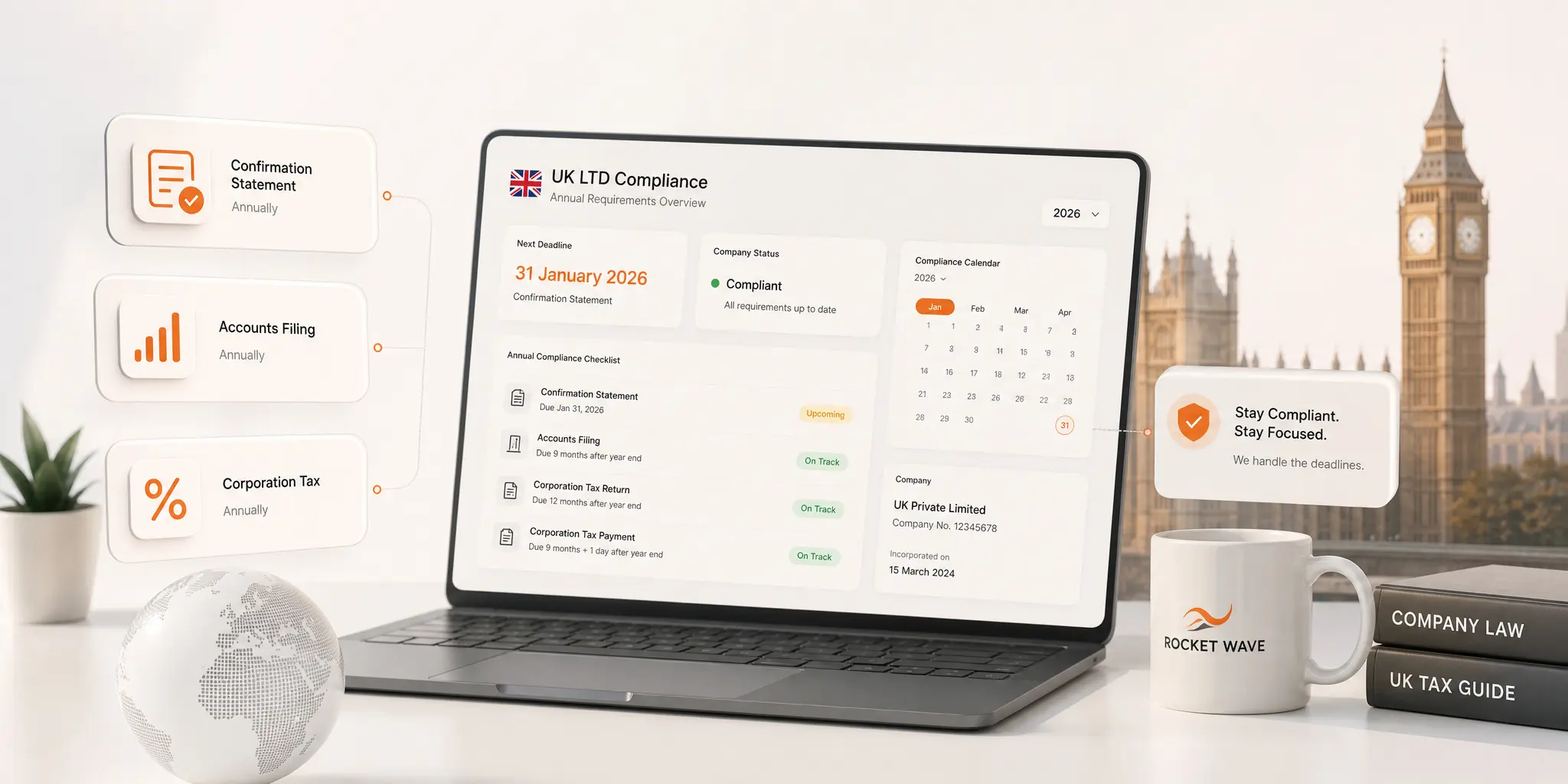
- Set your compliance calendar: confirmation statement (annual), accounts (9 months after year end), CT600 (12 months after year end)
- Register for Stripe using your Companies House number and UK bank account details
- Register for VAT only if approaching roughly £90K annual turnover (the 2026 threshold)
Frequently asked questions
Can I be the sole director and sole shareholder of a UK LTD as a non-resident?
Yes. A UK LTD requires at least one director aged 16 or over and at least one shareholder. Both roles can be filled by the same person, and that person can be a non-UK resident of any nationality. There is no requirement for any UK-based director or shareholder.
Do I need to visit the UK to register a company?
No. The entire registration process is remote. You do not need to visit a UK government office, a UK bank, or any UK address at any point during registration. Identity verification is completed remotely via a formation agent. Bank account opening is done online via Wise, WorldFirst, or Tide.
What is the difference between a registered office and a business address?
A registered office is the legal address of your company. It appears on the Companies House public register and receives official government and legal mail. A business address, or service address, is where you operate day to day and may also be used for director correspondence to keep personal addresses private. They can be the same address or different addresses.
Can I change my company name after registration?
Yes, by passing a special resolution of shareholders and filing a form with Companies House (NM01), which carries a small online fee. Your company number never changes, only the name. The name change takes effect when Companies House issues a new Certificate of Incorporation on Change of Name. Note that changing your company name may require updating bank accounts, Stripe, and client contracts.
What happens if I make a mistake in the registration?
Minor errors, such as an incorrect address or a spelling mistake in an officer’s name, can be corrected by filing a correction form with Companies House (AD01 for address, CH01 for director details). More significant errors, such as an incorrect share structure, may require a formal resolution. Using a formation agent minimises errors because they check all information before submission.
How do I register for VAT as a non-resident UK LTD owner?
VAT registration is done through HMRC, separate from Companies House. You can register voluntarily at any time, or you must register once your UK taxable turnover exceeds roughly £90,000 in any 12-month rolling period, the 2026 threshold. Registration is done online via HMRC’s VAT registration service using your UTR and company number. Start your VAT registration at HMRC.gov.uk.
Register your UK LTD in 24 hours, fully remote.
Rocket Wave handles the complete process: registered office, identity verification, Companies House submission, Certificate of Incorporation, UTR follow-up, and bank account guidance.
150+ global founders. Starting from $299, no hidden fees, backed by a 7-day money-back guarantee. No trip to London required.
Legal Disclaimer: Rocket Wave is a business operating system and not a law firm, which means we do not provide official legal advice. This guide is for general informational and educational purposes only. Companies House processes, fees, identity verification requirements, and HMRC procedures change frequently. Always verify current details at companieshouse.gov.uk and gov.uk before proceeding. VAT thresholds and tax rules are subject to change. Always consult a qualified UK accountant or solicitor for advice specific to your circumstances.