Forming a UK limited company as a non-UK resident is one of the most underrated moves a global founder can make in 2026. The application takes 24 hours. The formation itself starts from $299. There is no requirement to live in the UK, hold a UK visa, or have a British bank account before you start. And the resulting entity carries one of the strongest commercial reputations in the world, particularly for trading internationally, working with EU clients, and accessing British financial services.
And yet most founders default to a US LLC, even when a UK LTD would be the better fit. The reason is simple. The US LLC space has more guides, more YouTube videos, and more loud noise. The UK LTD path is quieter, but for founders selling to European clients, billing in GBP or EUR, or wanting an established commercial reputation in 24 hours, it is often the smarter choice.
This guide covers everything. What a UK LTD actually is, why non-residents form one, how the full registration process works at Companies House, what taxes and filings you’ll have, how to open a UK business bank account from abroad, and how a UK LTD compares to a US LLC. Written from the experience of helping 550+ founders form UK companies from markets around the world, without a single trip to London.
Quick answer
Can a non-UK resident form a UK LTD? Yes. Fully remote, in 24 hours, starting from $299 through Rocket Wave. You do not need a UK visa, a UK address (a registered office service works), or a UK bank account first. You can be the sole director and sole shareholder from anywhere in the world. The process is one of the most non-resident-friendly company formations available globally.
In this guide
What is a UK LTD and why non-residents form them
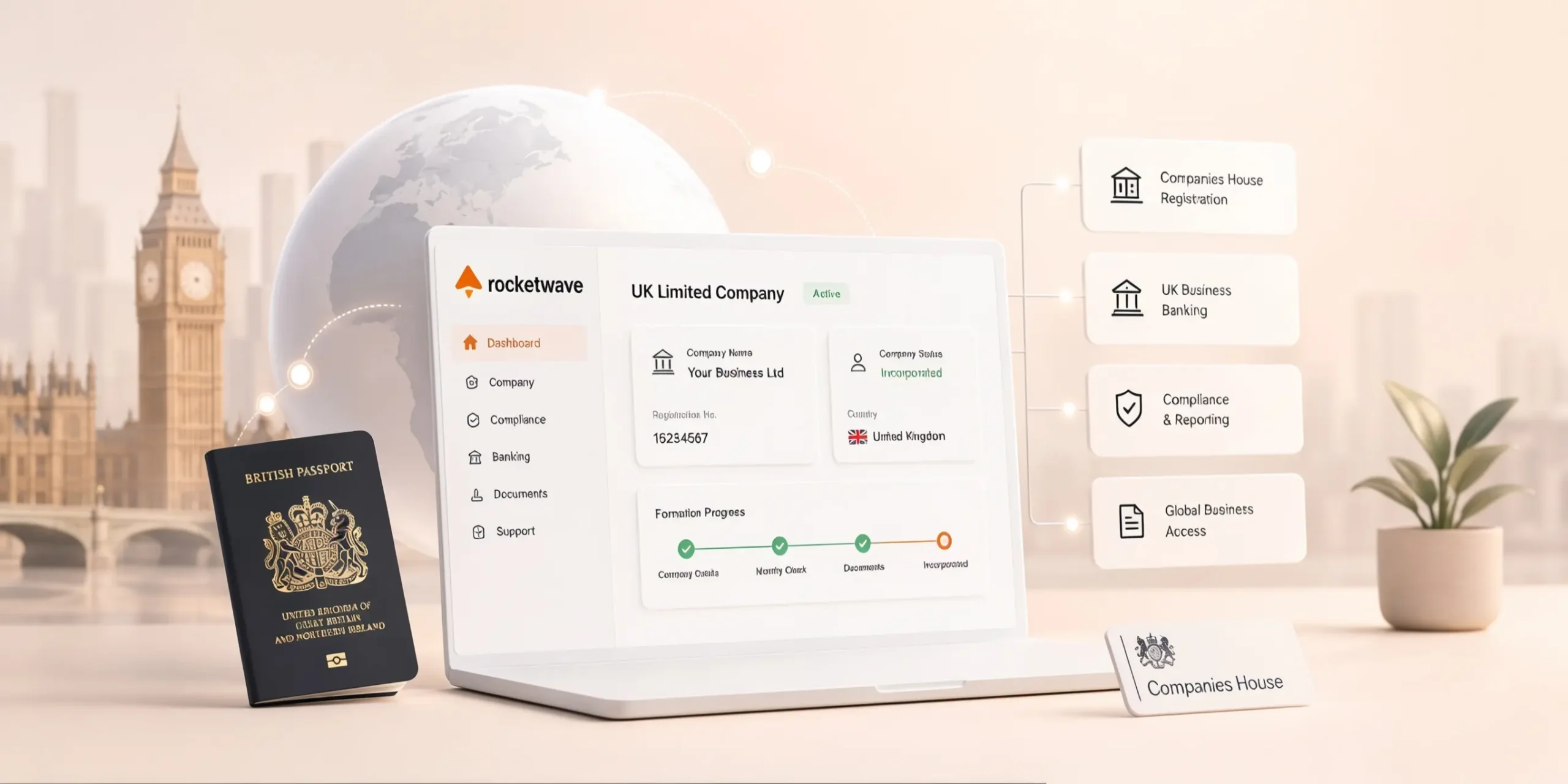
A UK LTD, formally a private company limited by shares, is a UK-incorporated legal entity registered with Companies House, the UK’s official company registrar. It is the standard structure used by the vast majority of UK businesses, from one-person consultancies to mid-market SaaS companies. For non-residents, it offers a unique combination of credibility, speed, and accessibility that few other jurisdictions match.
Why non-residents specifically choose UK LTDs
- Speed: UK LTDs can be incorporated in 24 hours. Many countries take weeks.
- Cost: Formation starts from $299 through Rocket Wave, often cheaper than equivalent US LLC formation once state fees are added.
- Reputation: UK companies are taken seriously by international clients, EU buyers, and global payment processors.
- No residency requirement: You can be the sole director and shareholder from any country.
- No physical presence required: Your registered office can be a virtual address service.
- Access to Wise, Revolut, Tide, and other UK fintechs: UK companies have far better banking options than most non-resident jurisdictions.
- English-language paperwork: Companies House, HMRC, and UK banks all operate in English, which simplifies the process significantly.
- EU client trust: Even post-Brexit, UK companies remain a familiar and trusted counterparty for European businesses.
What this means for you: If your customers are in Europe, the Middle East, or Africa, or if you want a globally recognised business identity at a lower starting cost than a US LLC with state fees included, the UK LTD often beats every other non-resident option. The speed and reputation are why founders from non-supported Stripe countries increasingly look at the UK first.
UK LTD vs US LLC: which structure is right for you?
This is the most common question we get from global founders. The honest answer is that neither is universally better. Each has strengths the other doesn’t. The right choice depends on where your customers are, what payment processors you need, and what currency you bill in.
| Factor | UK LTD | US LLC |
| Formation cost | From $299 (Rocket Wave) | From $197 + State Fee (Rocket Wave) |
| Ongoing annual cost | Confirmation statement fee plus accounting, typically $300 to $800 per year | State annual fee ($0 to $300 depending on state) plus Form 5472 preparation |
| Formation time | 24 hours via Companies House | 3 to 5 business days |
| Tax structure | Corporation tax, 19 to 25 percent, paid by the company | Pass-through. No entity-level tax for most non-residents |
| Reputation with EU clients | Very strong, pre and post-Brexit | Moderate. Sometimes seen as offshore |
| Reputation with US clients | Moderate. Works fine for B2B | Very strong. A native US entity |
| Banking options | Wise, Revolut, Tide, Monzo Business, all supporting UK LTDs | Mercury, Relay, built specifically for US LLCs |
| Stripe support | Yes, UK LTDs are supported directly | Yes, US LLCs are supported directly |
| VAT complexity | Required once turnover exceeds roughly £90K, adding complexity | No equivalent. Sales tax only applies if you have nexus |
| Public records | Director name, address, and ownership are all public | Member name may be public depending on the state |
| Best for | EU or UK clients, GBP or EUR billing, fast launch, lower entry cost | US clients, USD billing, pass-through taxation for non-residents |
When to choose UK LTD over US LLC
- Your customers are primarily in Europe, the UK, the Middle East, or Africa
- You bill in GBP or EUR more often than USD
- You want the fastest possible legal entity to start invoicing
- You want the lowest entry cost to a globally credible company
- You need access to UK fintechs such as Wise or Tide over US-only options
When to choose US LLC over UK LTD
- Your customers are primarily in the United States
- You bill in USD more often than GBP or EUR
- You want pass-through taxation with no entity tax for non-resident owners
- You want minimal annual compliance, for example in Wyoming or New Mexico
- Your business fits a US-supported industry, such as SaaS targeting American customers
For a complete US LLC comparison, read our US LLC for non-residents complete guide. Some founders form both, a UK LTD for European clients and a US LLC for American clients, operating them as separate entities serving different markets.
What this means for you: Many founders agonise over this choice for weeks. The truth is that most businesses succeed with either entity. The difference matters less than getting started and beginning to generate revenue. Pick the structure that fits your primary customer base and start operating.
Who can form a UK LTD: eligibility for non-residents
UK LTD formation is one of the most accessible in the world. The eligibility rules are simple, and there are very few barriers for non-residents.
What you do need
- At least one director aged 16 or over. You can be the sole director
- At least one shareholder. You can be the sole shareholder, and also the director
- A unique company name that is not already registered at Companies House
- A UK registered office address. This can be provided by a formation agent or virtual office service
- A valid passport for identity verification
- A description of the business activity, known as a SIC code
What you do NOT need
- UK citizenship, residency, or a visa. No immigration status is required
- To physically travel to the UK
- A UK bank account before forming the company
- A British co-founder or local partner
- Minimum share capital. You can incorporate with £1 in share capital
- A UK accountant during incorporation. You will need one for filings later, but not on day one
⚠ Some industries have restrictions. Banking, insurance, fund management, and other regulated sectors require FCA authorisation, separate from Companies House registration. Standard businesses such as consulting, e-commerce, and SaaS have no restrictions.
What this means for you: A UK LTD is the lowest-friction internationally credible entity you can form. If your business isn’t in a regulated industry, the eligibility bar is essentially: are you a human being with a passport? If yes, you can form one.
What you need before starting
UK LTD formation is fast, but only when you have everything ready before you begin the application. Gather these before you sit down to fill in the Companies House form.
1. Your proposed company name
Search the name on the Companies House name availability checker before you proceed. The name must be unique, must end in Limited or Ltd, and must not contain restricted words such as British, Royal, or Group without justification.
2. A UK registered office address
Your registered office must be a UK address where official mail such as HMRC notices, court documents, and Companies House correspondence can be received. As a non-resident, you have three options.
- A formation agent’s registered office service, typically $30 to $100 per year, the most common choice
- A virtual office service in the UK, typically $100 to $300 per year
- A friend, family member, or contact in the UK, free of charge but this becomes public and worth considering carefully for privacy and reliable mail delivery
3. Director information
- Full legal name, exactly as on passport
- Date of birth
- Nationality
- Residential address. This becomes public unless you use a service address instead
- Occupation
4. SIC code
A Standard Industrial Classification code describes your business activity, for example 62012 for business and domestic software development, 70229 for management consultancy activities, or 47910 for retail sale via mail order houses or the internet. You can list up to four SIC codes.
5. Share information
- Number of shares to issue. One share is fine for a sole shareholder
- Value per share. £1 is standard
- Currency. Pounds sterling is standard
- Shareholder name and address
Pre-application checklist
- Company name confirmed available on Companies House
- UK registered office address arranged, formation agent or virtual office
- Director details ready: full name, date of birth, nationality, address, occupation
- SIC code identified from the Companies House SIC list
- Share structure decided: number of shares, value, owner
- Valid passport ready for identity verification
Step-by-step: How to form a UK LTD as a non-resident
The complete process takes 24 hours from submission to incorporation. Here is exactly how it works.
Step 1: Choose your formation route. You have two options. Apply directly at Companies House for the government fee, which involves a slower form and fewer extras, or use a formation agent such as Rocket Wave starting from $299, which includes registered office, identity verification handling, and post-incorporation documents.
Step 2: Reserve your company name. Confirm name availability on Companies House. Check for trademark conflicts too. A name that’s available on Companies House can still infringe an existing UK or EU trademark, so run a quick search on the GOV.UK trademark database before committing.
Step 3: Provide director and shareholder details. Full legal names, dates of birth, addresses, and contact information. For non-residents, your home country address is acceptable.
Step 4: Set your registered office address. Enter your UK registered office address, typically your formation agent’s address. This must be a real UK address that can receive mail.
Step 5: Define your share structure. Number of shares, value per share, share classes (almost always Ordinary), and who holds them. For a single founder, 100 shares at £0.01 each, or one share at £1, are typical.
Step 6: Complete identity verification. Companies House requires identity verification for all directors and people with significant control, known as PSCs. For non-residents, this is typically done by a regulated formation agent using a passport scan and a selfie. This is a requirement under the Economic Crime Act.
Step 7: Sign the memorandum and articles of association. The memorandum is a short document confirming the subscribers’ intent to form the company. The articles are the internal governance rules. Companies House provides a standard set of model articles, which are sufficient for most companies. Custom articles are only needed for complex share structures or investor agreements.
Step 8: Submit and wait. Submit the application. Companies House reviews and typically incorporates within 24 hours, often within a few hours during business days. You’ll receive your Certificate of Incorporation by email.
What this means for you: If you apply on a Friday evening or over the weekend, expect incorporation by Monday or Tuesday. Apply Monday through Thursday for the fastest turnaround.
Want your UK LTD formed in 24 hours, done correctly?
Rocket Wave forms UK limited companies for non-residents in 24 hours, including registered office address, identity verification, Certificate of Incorporation, Memorandum and Articles, and UTR application support.
550+ global founders. Starting from $299, no hidden fees, backed by a 7-day money-back guarantee.
After incorporation: UTR, banking, and getting operational
Incorporation is the legal birth of your company, but you can’t operate yet. Three things need to happen next, in order.
1. Receive your UTR (Unique Taxpayer Reference)
HMRC automatically issues a UTR within 14 working days of incorporation. It is posted to your registered office address as a paper letter, and there is no faster way to receive it. Your UTR is a 10-digit number used for all corporation tax filings, VAT registration, and HMRC correspondence.
⚠ If you don’t receive your UTR within 21 days of incorporation, contact HMRC. Lost or delayed UTRs are common, particularly when registered office addresses don’t forward mail reliably. Your formation agent should track and forward this to you.
2. Open a UK business bank account
UK banking is where non-resident founders often hit friction. Traditional UK banks such as Barclays, NatWest, HSBC, and Lloyds generally require directors to visit a UK branch, which isn’t realistic for most non-residents. The fintech option is your real route in.
| Bank | Non-resident support | Monthly fee | Notes |
| Wise Business | Yes, well established | Free, with transaction fees | Best for multi-currency operations. Not a UK bank but provides GBP account details |
| Revolut Business | Yes | Free to £100 per month tiers | Strong for international payments and FX |
| Tide | Yes | Free to £50 per month | UK-native business bank that supports non-resident directors |
| Monzo Business | Yes, but a UK director is typically required | £0 to £5 per month | Often a barrier for non-residents without a UK-based director |
| Starling Bank | Limited | Free | Generally requires UK residency |
Most non-resident UK LTD owners start with Wise Business or Revolut. Both can be opened fully remotely with your Certificate of Incorporation, passport, and proof of address. Tide is a strong UK-native option if you want a more traditional business bank feel.
3. Register for relevant taxes
HMRC automatically registers your company for corporation tax when you receive your UTR. You’ll need to additionally register for the following, only if they apply to you.
- VAT, only required if turnover exceeds roughly £90,000 per year (the 2026 threshold). Many small companies voluntarily register earlier for input VAT recovery
- PAYE, only required if you pay yourself or any other employees a salary
- Self-Assessment, only required if you, as director, receive personal income from the UK such as dividends from the company
What this means for you: Don’t rush to register for VAT before you need to. Mandatory VAT registration kicks in at roughly £90K turnover. Below that, voluntary registration only helps if your major expenses are UK-VAT-charged. For most early-stage non-resident businesses, skip VAT until required.
UK LTD taxes: corporation tax, VAT, and personal director taxes
UK tax for a non-resident-owned LTD has three layers. Understanding each upfront prevents the most common compliance mistakes.
Layer 1: Corporation Tax, paid by the company
Your UK LTD pays corporation tax on its profits. The rate depends on profit level.
- Profits up to £50,000: 19 percent, the small profits rate
- Profits between £50,001 and £250,000: marginal relief, with an effective rate of 19 to 25 percent
- Profits over £250,000: 25 percent, the main rate
Corporation tax is due 9 months and 1 day after your accounting period ends. Most UK LTDs have a 12-month accounting period, so if your year ends 31 March, corporation tax is due by 1 January the following year.
Layer 2: VAT, only if turnover exceeds roughly £90,000
If your annual turnover exceeds roughly £90,000, the 2026 threshold, you must register for VAT within 30 days of crossing it. The standard VAT rate is 20 percent. VAT returns are filed quarterly. This is based on turnover, not profit, so gross revenue is what counts.
Layer 3: Personal tax on director or shareholder income
As a non-UK resident director and shareholder, your personal UK tax position depends on the type of income you take from the company.
- Director salary. Paid through PAYE. UK income tax applies if you spend significant time working in the UK. Most non-residents take no salary at all
- Dividends. Typically paid to non-resident shareholders without UK withholding tax. Your home country may tax dividends, so check your local tax treaty
- Director’s loan. Funds you withdraw above your salary or dividends, with complex tax implications best avoided where possible
⚠ UK director duties apply even if you are non-resident. Statutory duties include filing accounts, filing the confirmation statement, maintaining records, and acting in the company’s best interest. Failure can result in fines and director disqualification, even for non-resident directors.
For most non-resident owners, the optimal structure is to take no director salary, withdraw profits as dividends, and handle the personal tax position under your home country’s rules. Always confirm your country-specific position with a qualified UK accountant, starting with the HMRC business tax guidance.
Annual obligations: confirmation statement, accounts, and PSC register
Every UK LTD has three annual obligations to Companies House and HMRC. Missing any one can result in fines, strike-off, and director disqualification.
| Filing | What it is | Deadline |
| Confirmation Statement | Annual confirmation of your company’s details: directors, shareholders, registered office. A small online filing fee applies | Every 12 months from incorporation date, with 14 days to file after the due date |
| Annual Accounts | Financial statements showing your company’s income, expenses, and assets | 9 months after your accounting period ends. The first set is due 21 months after incorporation |
| Corporation Tax Return (CT600) | HMRC filing reporting your taxable profits | 12 months after your accounting period ends |
| PSC Register | Identifies People with Significant Control, meaning anyone with more than 25 percent shares or voting rights | Maintained internally and reported in the confirmation statement |
| VAT Returns, if registered | Quarterly VAT calculation and payment | One month and seven days after each VAT quarter ends |
| PAYE filings, if employer | Monthly RTI submissions | Each pay date |
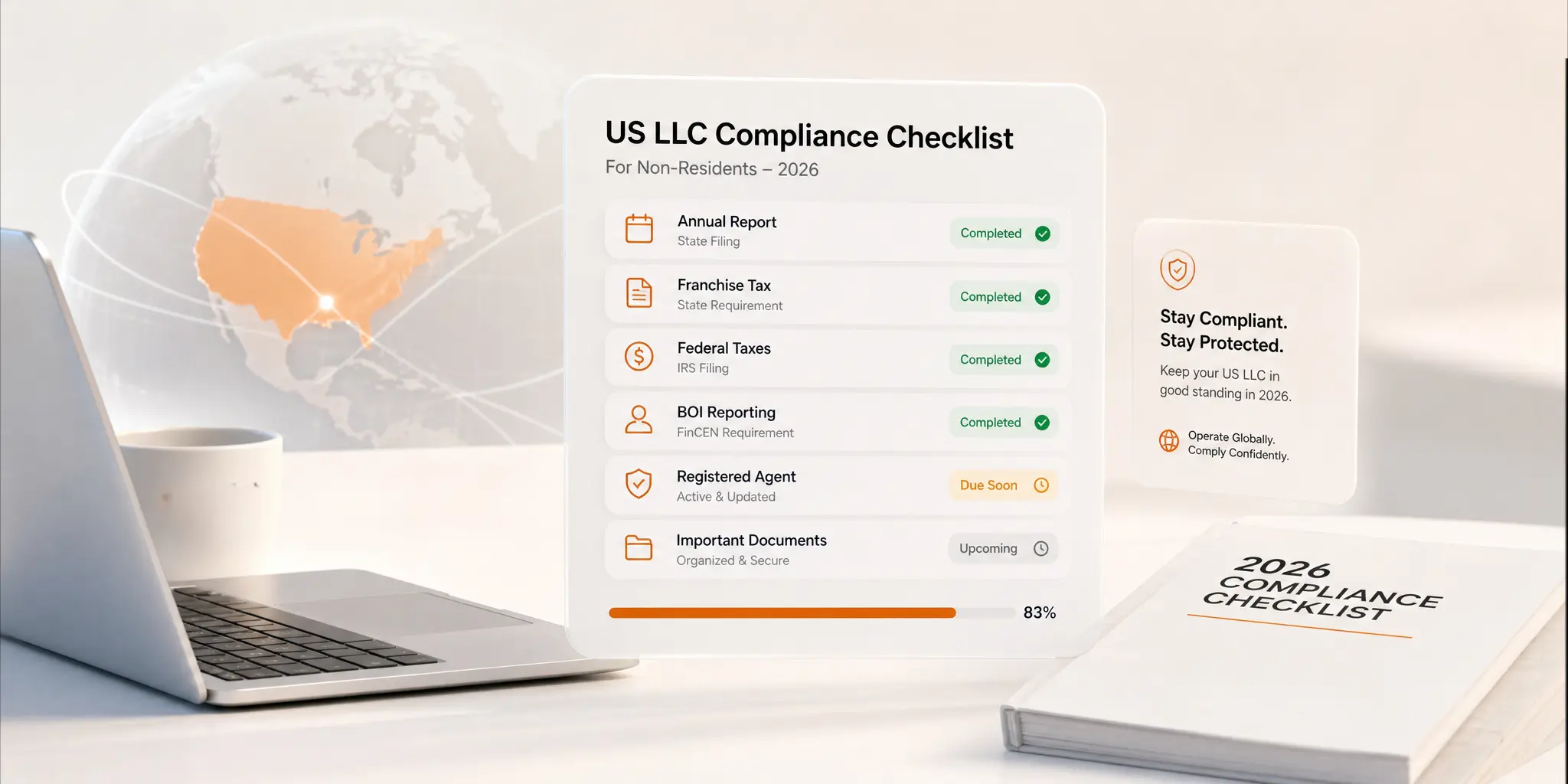
⚠ Missing your annual accounts is the most expensive UK compliance mistake. Late filing penalties start at £150 and rise to £1,500. Continued failure can result in your company being struck off the register and your bank account closed.
What this means for you: Engage a UK accountant within three months of incorporation. They handle confirmation statements, annual accounts, corporation tax, and VAT, typically for $300 to $800 per year for a small non-resident UK LTD. Trying to manage UK compliance yourself as a non-resident is a false economy.
UK LTD complete formation checklist for non-residents
Work through this in order. Every step depends on the one before it.
Phase 1: Pre-formation
- Confirm company name availability at Companies House
- Arrange UK registered office address, formation agent or virtual office
- Decide on share structure: number of shares, value, owner
- Identify your SIC code or codes for business activity
- Prepare passport scan for identity verification
- Decide whether to apply direct or via a formation agent such as Rocket Wave, from $299
Phase 2: Formation
- Submit incorporation application via Companies House or formation agent
- Complete director and PSC identity verification
- Receive Certificate of Incorporation, typically within 24 hours
- Receive memorandum and articles of association
- Save all documents securely: Certificate, MOA, share certificates
Phase 3: Post-formation, first 30 days
- Wait for UTR letter from HMRC, within 14 days, and track this
- Open UK business bank account: Wise, Revolut, or Tide
- Set up basic bookkeeping, using Xero, QuickBooks, or FreeAgent
- Engage a UK accountant and research and book consultations
- Set calendar reminders for confirmation statement and accounts deadlines
- Set up business email on your own domain
Phase 4: Operational, ongoing
- Track turnover monthly and register for VAT when approaching roughly £90K
- Maintain financial records throughout the year
- File confirmation statement annually
- File annual accounts within 9 months of the accounting period end
- File corporation tax return within 12 months of the accounting period end
- Update PSC register if ownership changes
Frequently asked questions
Can a non-UK resident be the sole director of a UK LTD?
Yes. A non-UK resident can be the sole director and sole shareholder of a UK LTD. There is no requirement for any director to be UK-resident, hold UK citizenship, or have a UK visa. You can also be the sole Person with Significant Control, or PSC, of the company.
How long does UK LTD formation actually take?
From application submission to Certificate of Incorporation, typically 24 hours, often within 3 to 6 business hours during weekdays. Applications submitted on Fridays, weekends, or UK bank holidays will process on the next business day. After incorporation, expect 7 to 14 additional days for your UTR to arrive in the post.
Do I need to file UK taxes if my UK LTD has no UK customers?
Yes. Your UK LTD is a UK tax resident regardless of where its customers are. You must file annual accounts with Companies House, a CT600 corporation tax return with HMRC, and a confirmation statement annually, even if your customers are entirely outside the UK. Corporation tax applies to your worldwide profits as a UK-incorporated entity.
Can I open a Stripe account with a UK LTD?
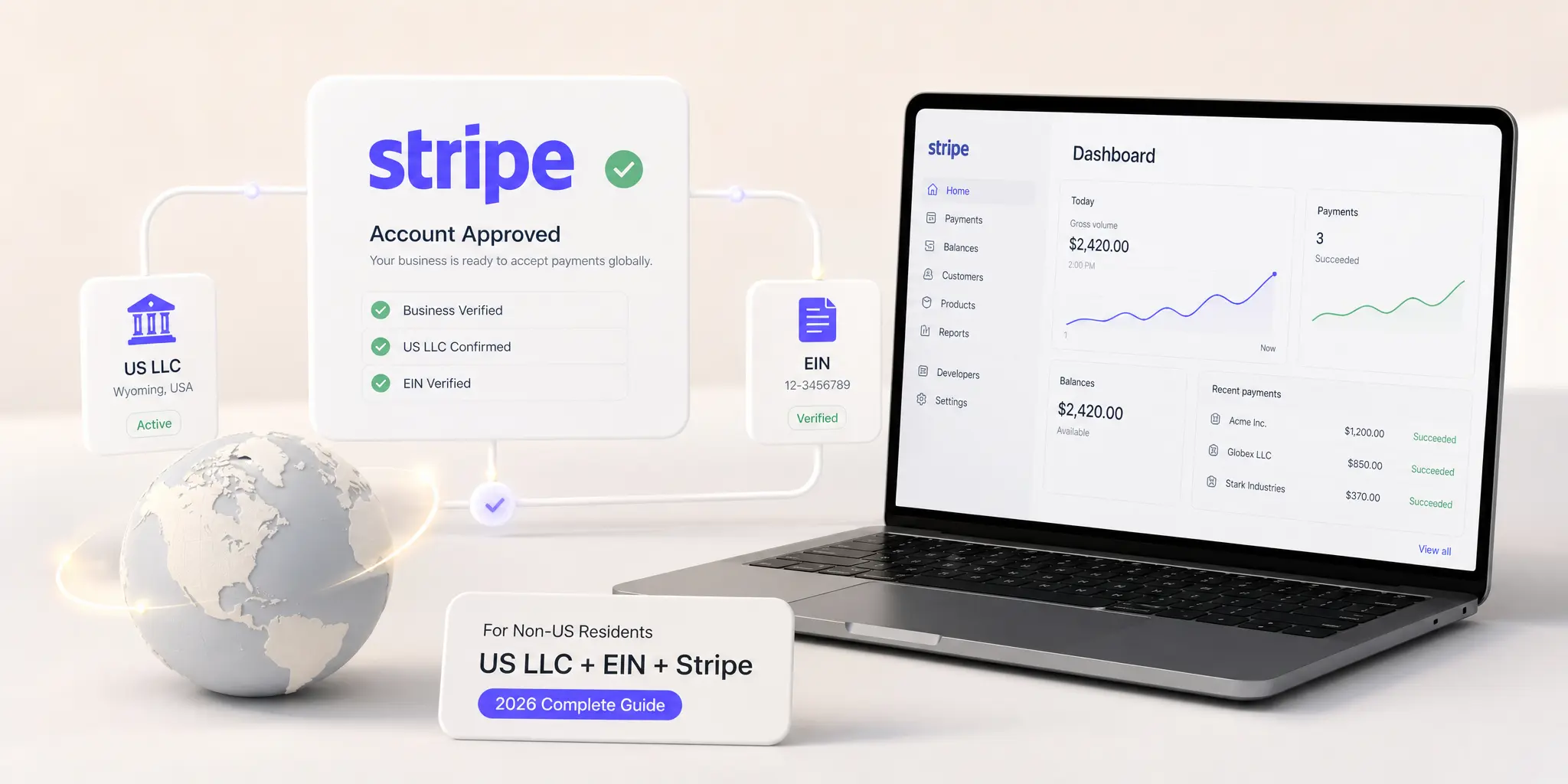
Yes. The UK is one of Stripe’s strongest supported countries. The application process is similar to the US LLC route but uses Companies House data instead of IRS data. For founders from non-Stripe-supported countries, a UK LTD is often the fastest path to Stripe approval. Our Stripe setup guide for non-US residents covers the equivalent process for US LLCs. The UK LTD process follows the same logic with UK-specific documents.
What if I want to change my registered office address later?
You can change your registered office address at any time by filing a form AD01 at Companies House, free for online filings. The change takes effect immediately. Most non-resident founders change their registered office only if they switch formation agents or move to a paid virtual office service for better mail forwarding.
Are director and shareholder details public?
Yes. Companies House makes director names, dates of birth showing month and year only, and addresses publicly searchable. Shareholder names and share counts are also public. If privacy is a concern, use a service address, provided by your formation agent, instead of your home address. This is legal and common.
Can I form both a UK LTD and a US LLC?
Yes. Many founders do exactly this, running them as separate entities serving different markets: UK LTD for European clients and GBP or EUR billing, and US LLC for American clients and USD billing. Compare structures in our US LLC for non-residents guide before deciding.
Does Rocket Wave help with ongoing UK LTD compliance?
Yes. Rocket Wave’s UK LTD formation packages include lifetime compliance alerts for confirmation statements, annual accounts deadlines, and tax filings. We connect non-resident founders with UK accountants who specialise in non-resident-owned companies, typically $300 to $800 per year for ongoing compliance.
Form your UK LTD in 24 hours, from anywhere in the world.
Rocket Wave handles the complete UK LTD setup: Companies House registration, registered office, identity verification, Certificate of Incorporation, UTR follow-up, and connections to non-resident UK accountants.
550+ global founders. Starting from $299, no hidden fees, backed by a 7-day money-back guarantee.
Legal Disclaimer: Rocket Wave is a business operating system and not a law firm, which means we do not provide official legal advice. This guide is for general informational and educational purposes only. UK company law, tax thresholds, and Companies House procedures change frequently. Always verify current details at gov.uk and companieshouse.gov.uk before making decisions. Always consult a qualified UK accountant or solicitor for advice specific to your circumstances.